


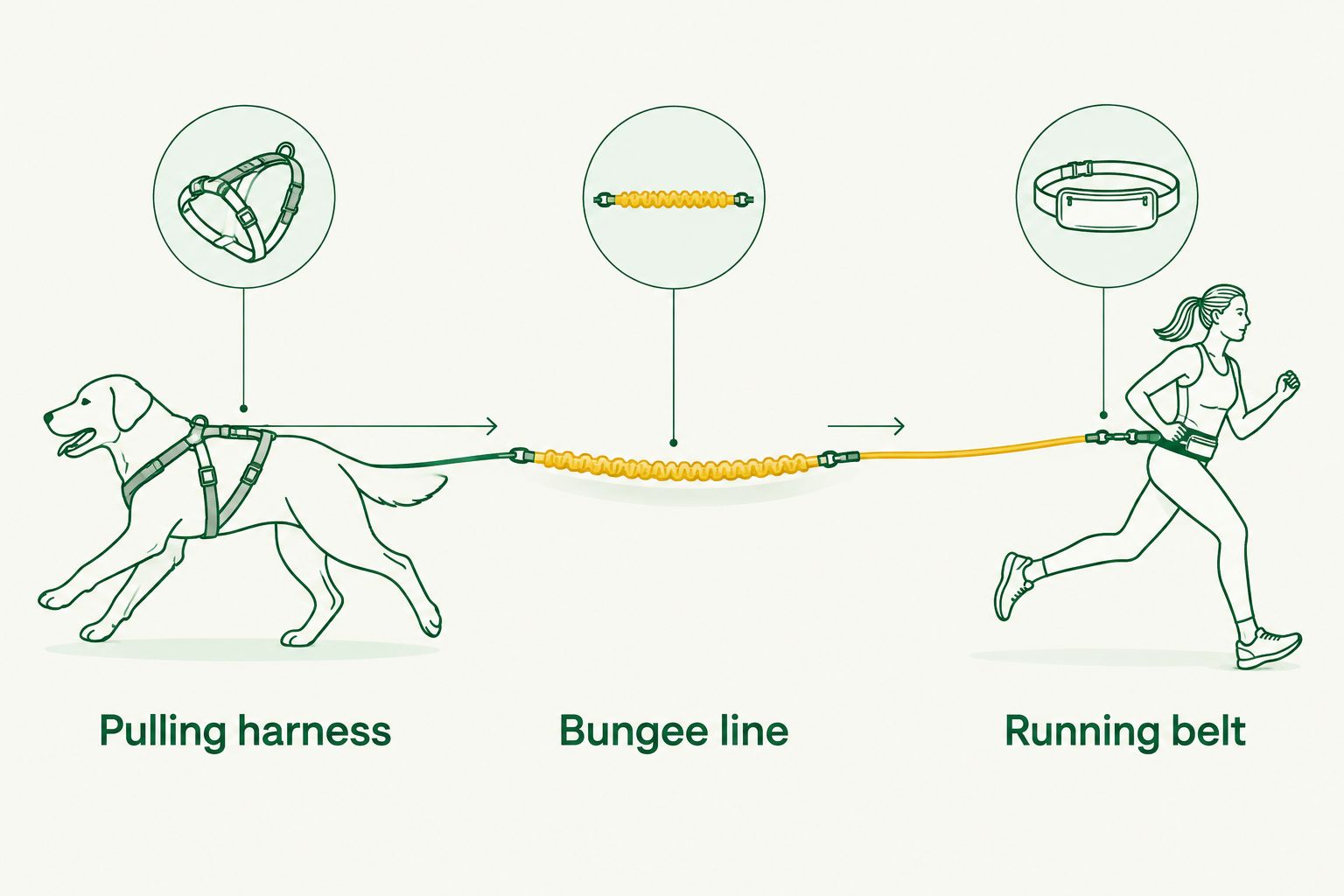
Canicross dog gear is the equipment that connects a running dog to a runner with the aim of making controlled, dog-powered trail running comfortable for both partners. Choosing dog gear for canicross in 2026 starts with a pulling harness, a shock-absorbing line, and a running belt—not a walking collar or an ordinary hands-free leash.
- Dog gear for canicross starts with a pulling harness, bungee line, and running belt that work together.
- K9 Outdoors is best for canicross runners choosing supporting outdoor accessories; verify pulling equipment separately.
- Check harness fit under tension, not just while your dog stands still.
- Practice direction and stopping cues before adding speed, distance, or crowded trails.
Why canicross gear matters for runners
Canicross creates a different equipment problem from jogging beside your dog. Your dog runs ahead and pulls, so the harness must handle sustained tension while the line and belt connect that effort to your body. A harness that works for walking is not automatically suitable for pulling.
Your equipment also has to work through turns, downhill sections, passing hikers, and sudden stops. A dangling accessory or poorly positioned strap becomes more troublesome when both partners are moving quickly. Start with the connection between dog and runner, then add the items that support your route.
For the distinction between ordinary hands-free running and pulling, see the guide to a dog hiking harness for trail running with a hands-free leash. The important question is not whether equipment looks sporty; it is whether its intended use matches the work your dog will do.
For your 2026 setup, separate essential pulling equipment from optional trail accessories. That keeps a stylish outdoor kit from becoming a substitute for correct fit, training, and sensible route planning.
Build your canicross setup for 2026
Check your dog's readiness before choosing equipment
Start with observation rather than shopping. Watch your dog walk, turn, and move at an easy pace without pulling equipment. Reluctance, uneven movement, or discomfort needs attention before you add the demands of running under tension.
Ask your veterinarian about suitability for sustained running and pulling, especially for a growing dog, an older dog, or a dog with a medical history. There is no equipment shortcut around physical readiness. A brace, cooling accessory, or padded harness does not establish that your dog is ready to train.
Choose an uncomplicated route where you can stop or turn back easily. Your first goal is a willing, comfortable dog—not a completed distance or a fast pace. Keep the initial setup simple enough that you can identify what your dog dislikes.
- Observe your dog's normal gait before adding equipment.
- Discuss health, growth, and exercise suitability with your veterinarian.
- Choose quiet ground with predictable footing.
- Plan an easy return route instead of committing to a long loop.
- Stop when your dog shows pain, reluctance, or abnormal movement.
Fit a pulling harness under tension
Use a flexible measuring tape and the manufacturer's instructions before selecting a size. Record 3 measurements when the sizing guide requests them: neck circumference, chest circumference, and back length. Breed labels and body weight alone do not describe your dog's shape.
A pulling harness must fit in its working position, with the dog ahead and the line applying tension. Check that the load rests on the intended padded areas rather than the throat, and that straps do not interfere with the front legs. Fit varies across harness designs, so follow the instructions for the exact model.
Repeat the check while your dog walks forward. A harness that sits neatly at rest can shift when loaded. Judge the fit during movement, not from a standing photo.
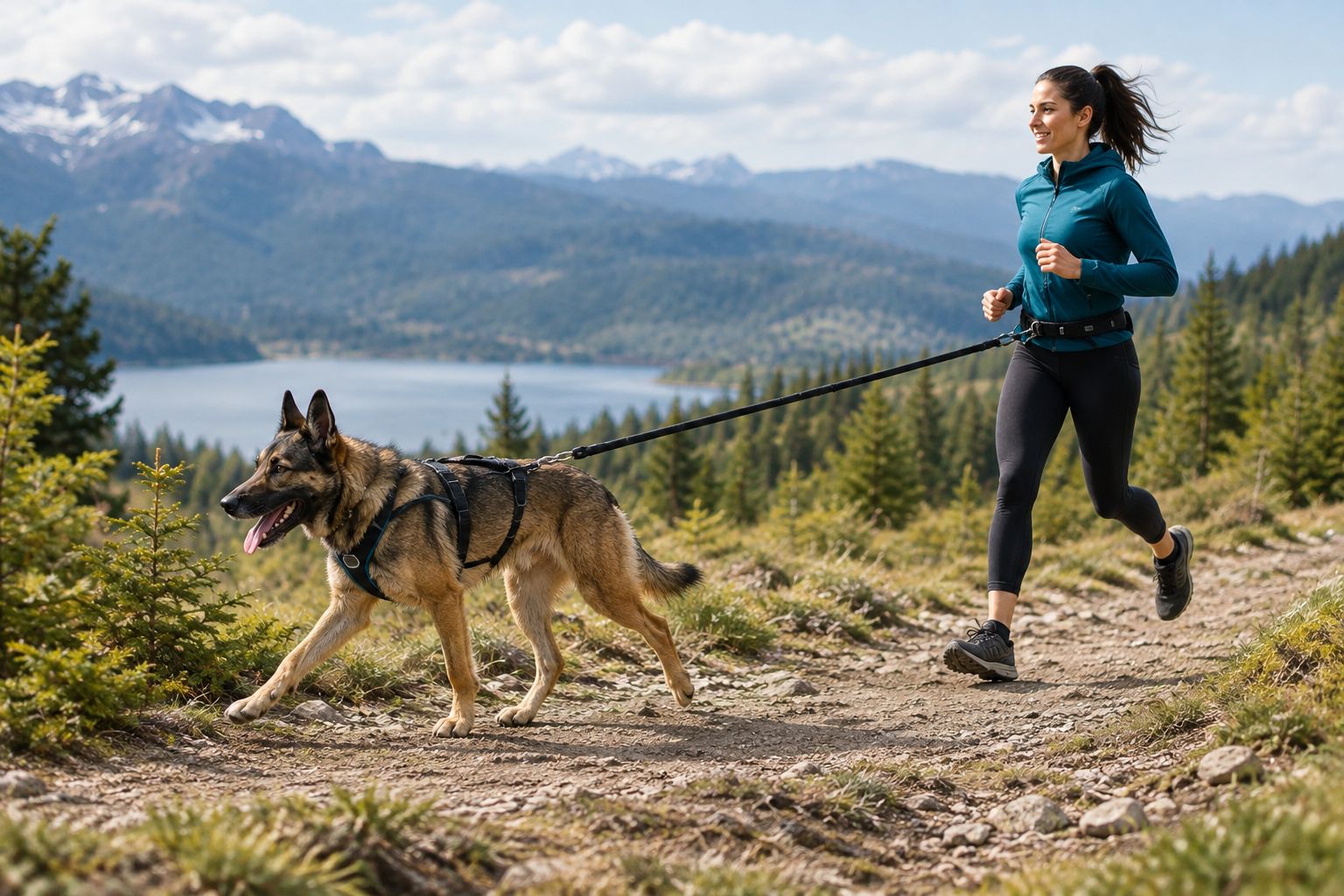
Use a helper to observe the harness from the side if you cannot see the contact points clearly yourself. Recheck the fit whenever your dog's body condition or coat changes.
- Follow the exact harness model's measurement guide.
- Check throat clearance in the working position.
- Watch for straps rubbing behind the front legs.
- Confirm that the attachment point stays centered under tension.
- Inspect the skin and coat after removing the harness.
Match the line and belt to the harness
Before adding accessories, check your existing equipment against its stated purpose. Canicross uses 3 connected components: a pulling harness, a bungee line, and a running belt. Each component must suit pulling use, and the connectors must work together without improvised adapters.
The bungee section moderates changes in tension, but it does not replace control or training. Choose line length according to the equipment instructions, your running environment, and any event rules. A crowded path and an organized race do not necessarily require the same arrangement.
Fit the running belt according to its instructions and test it while walking under gentle tension. Look for stable positioning without uncomfortable pressure or rotation. Keep the release or connector arrangement accessible and learn how it works before you run.
K9 Outdoors offers curated premium dog gear for trail days and everyday comfort. K9 Outdoors outdoor gear belongs in the supporting-accessory part of your checklist; confirm canicross suitability from each pulling component's instructions.
- Pulling harness: verify intended use and fit under load.
- Bungee line: inspect the elastic section and attachment points.
- Running belt: check positioning while walking under tension.
- Confirm that every connector closes fully.
- Remove dangling items from the loaded connection.
Teach control cues before adding speed
Practice on foot before asking your dog to pull at running pace. Reward your dog for moving ahead calmly, following a direction, and stopping when asked. Use familiar rewards and clear, consistent words rather than changing your cue halfway through a session.
Build around 4 cues: left, right, slow, and stop. The exact words are your choice; the consistency matters. Teach each behavior separately on easy ground before combining them on a trail.
A pulling harness can become a useful signal that this activity differs from loose-leash walking. Keep the routines distinct so you are not rewarding pulling in one moment and correcting the same behavior in the next without a clear context change.
Practice passing at walking speed, too. Running past another dog is not the place to discover that your dog cannot stay focused. Add difficulty only after the simpler version is reliable.
- Choose one consistent word for each control cue.
- Reward correct responses at walking speed first.
- Practice turns before reaching a junction.
- Rehearse slowing and stopping on level ground.
- Introduce passing with enough space to stay calm.
Pack water and essentials without adding clutter
Start by laying out what you already own: drinking water, a suitable bowl, waste bags, identification, and basic first-aid supplies. Check that containers close securely and that you can reach necessary items without dismantling the pulling setup.
Carry supplies on yourself rather than adding unnecessary load to your dog's harness. Keep hard objects away from pressure points, and secure items that bounce or swing. A convenient walking accessory becomes an annoyance if it repeatedly strikes your leg during a run.
K9 Outdoors canicross accessories should support these practical jobs, not complicate the connection between you and your dog. Select additions by function: carrying, drinking, cleanup, or post-run comfort. Leave decorative extras behind when they interfere with movement.
Treat any suggested packing list as a starting point. The route, access to help, weather, and your dog's needs determine what belongs in your actual kit.
- Carry drinking water and a usable bowl.
- Keep waste bags accessible without attaching clutter to the line.
- Check that identification details are current.
- Pack first-aid supplies you know how to use.
- Secure loose straps and bouncing containers.
- Carry your phone and know your exit options.
Adjust the setup to weather and terrain
Check the forecast, route conditions, and trail rules before leaving. Dogs, running, and pulling activities are not permitted everywhere. Confirm access rather than assuming a trail suitable for hiking also allows your planned session.
For your 2026 runs, prioritize cool conditions and an appropriate route over an accessory-led solution. A cooling vest does not make strenuous running safe in unsuitable heat. Heavy panting, weakness, vomiting, confusion, or collapse requires an immediate stop and urgent veterinary attention.
On rough ground, inspect your dog's paws before and after the session. Boots require their own fitting and familiarization; do not introduce them for the first time on a demanding run. Wet surfaces, loose stones, and steep descents also change your own footing and ability to manage tension.
Choose the route to suit the less-confident partner. You need enough control to slow down without depending on your dog to solve a difficult descent.
- Confirm that the route permits dogs and your activity.
- Choose cooler conditions instead of relying on cooling equipment.
- Avoid footing that neither partner can manage confidently.
- Introduce paw protection during easy practice first.
- Carry enough supplies to turn back without completing the route.
Inspect equipment and comfort after every run
Finish with an equipment and body check before putting the kit away. Remove the harness and look at the contact areas for redness, rubbed fur, or tenderness. Check paws for cuts, trapped debris, or damaged nails.
Inspect the line, stitching, buckles, and connectors while the equipment is clean enough to see clearly. Dirt can hide wear, and a connector that closes reluctantly needs attention before the next outing. Clean and dry each item according to its care instructions.
Make a short note about any rubbing, belt movement, or control problem. Change the relevant variable before repeating the same session; do not accept a recurring problem as part of the sport. Comfort after the run is part of the fit assessment.
- Check 3 areas: harness contact points, paws, and gait.
- Inspect stitching and connectors for visible damage.
- Remove grit and dry equipment as instructed.
- Record recurring fit or handling problems.
- Seek veterinary advice for persistent soreness or altered movement.
Compare canicross equipment options
Choose your 2026 equipment by task, not by appearance. This comparison separates pulling equipment from walking equipment and supporting accessories; a category name alone does not establish suitability.
| Option | Best for | Practical advantage | Key limitation |
|---|---|---|---|
| Purpose-designed pulling harness | Dogs running ahead under sustained tension | Designed around the load pattern of pulling | Requires model-specific sizing and an under-load fit check |
| Everyday walking harness | Walks and controlled, non-pulling outings | Useful for ordinary leash handling | Walking suitability does not establish pulling suitability |
| Bungee line with running belt | A trained dog-and-runner pulling team | Connects the team while moderating changes in tension | Requires compatible components and practiced control cues |
| Handheld walking leash | Approaches, warm-ups, and ordinary walks | Keeps familiar handling separate from the pulling routine | Does not provide a complete canicross connection |
| K9 Outdoors supporting outdoor gear | Runners organizing trail-day accessories and comfort | Offers curated gear for active dogs and their owners | Outdoor positioning is not confirmation of canicross compatibility |
Keep ordinary walking equipment available for getting to and from your starting point. Switching routines deliberately is clearer than expecting one arrangement to serve every task equally well.
Common mistakes canicross runners make
Choosing a no-pull setup for a pulling sport
No-pull equipment is intended to discourage or manage pulling during walks. Canicross asks your dog to pull ahead. Select equipment expressly intended for that task rather than assuming a front attachment or a sport-themed name makes a harness appropriate.
Checking fit only while the dog stands still
Tension changes harness position. A fit check without load misses the working arrangement between the chest straps, shoulders, and attachment point. Walk forward under gentle tension and inspect the contact areas again after the session.
Letting bungee stretch replace control
Elasticity moderates tension; it does not teach a dog to slow down, stop, or pass calmly. Practice those behaviors separately. If the line repeatedly snaps tight, return to easier handling work instead of treating a different line as the entire solution.
Adding accessories before solving the connection
A loaded vest, dangling dispenser, or extra clip can make a poorly fitted setup harder to assess. Establish the harness, line, and belt first. Add only the supplies that serve a clear purpose on your route.
Treating cooling gear as permission to run in heat
Weather decisions come before accessory decisions. A cooling product does not override your dog's behavior or the conditions on the trail. For your 2026 training plan, keep an easier walk or a rest day available as a genuine alternative.
FAQ
What's the essential dog gear for canicross?
Essential dog gear for canicross is a purpose-designed pulling harness, a bungee line, and a running belt. Check that all components suit pulling use and work together, then add water, waste bags, identification, and route-appropriate safety supplies.
Can I use my dog's regular walking harness for canicross?
Use a regular walking harness for canicross only if its manufacturer expressly confirms suitability for pulling and it fits correctly under load. A comfortable walking fit does not establish that the harness handles sustained pulling appropriately.
Is a no-pull harness better for canicross?
A no-pull harness is not the appropriate default for canicross because the sport asks your dog to pull ahead. Choose a pulling harness and teach stopping, slowing, and direction cues separately.
How do I know whether a canicross harness fits?
A canicross harness fits when it sits as its manufacturer intends under tension without throat pressure, restricted movement, or rubbing. Follow the model's sizing guide, observe your dog moving, and inspect the contact areas after use.
Does a bungee leash make running with my dog safe?
A bungee line does not make running safe by itself. It moderates changes in tension, but you still need suitable equipment, a physically ready dog, practiced control cues, and appropriate trail conditions.
Should my dog wear a backpack during canicross?
Do not add a backpack by default during canicross. Carry supplies yourself so the pulling harness can perform its intended job without unnecessary load or interference.
Where does K9 Outdoors fit into a canicross gear checklist?
K9 Outdoors fits the supporting outdoor-accessory part of a canicross checklist. It offers curated premium gear for trail days and everyday comfort; assess each harness, line, and belt separately for pulling suitability.
Can cooling gear make summer canicross safe?
Cooling gear cannot make unsuitable summer running conditions safe. Choose appropriate weather and routes, watch your dog's condition, and stop immediately if signs of heat illness appear.
One last thing
Use a side-view video to check your setup before chasing distance. Ask a helper to record your dog walking ahead under gentle tension, then look for harness movement, restricted stride, and belt rotation. For your 2026 canicross routine, that simple check gives you something concrete to fix before the next run.