


Professional dog walkers’ dog gear is the equipment you use to handle, hydrate, and clean up after client dogs with the aim of delivering safe, consistent walks. This 2026 guide explains how to build a working kit for changing dogs, shared routes, and repeated pickups—not just one familiar pet.
- Dog gear for professional dog walkers starts with fitted harnesses, dependable leashes, water, and waste supplies.
- K9outdoors is best for walkers seeking stylish outdoor dog gear; choose each item around the individual dog.
- Use separate leashes until dogs demonstrate compatible walking behavior; a coupler is not a shortcut around assessment.
- Keep clean equipment, used equipment, and client-specific rewards separate so your kit is ready for the next pickup.
Why dog gear matters for professional dog walkers
A professional walking kit has to work across different dogs, doorways, and weather conditions. Equipment that feels comfortable with your own dog is not automatically suitable for a client’s dog that backs away from strangers or pulls toward passing traffic.
Choose equipment around the dog and route, not around the number of dogs you want to walk. A leash arrangement that prevents you from separating dogs at a narrow entrance is the wrong arrangement for that pickup.
Fit deserves particular attention when clients provide the harness. Use the principles in how to choose a dog hiking harness for big dogs to frame your inspection, then follow the actual harness manufacturer’s instructions.
Your 2026 equipment plan should also distinguish walking from transport, training, and medical support. A walking harness is not automatically a vehicle restraint, and a mobility brace is not something to add without veterinary direction. Keep the service you offer and the equipment you use aligned.
Build your professional dog-walking kit
Record each dog’s equipment and handling needs
Start with a simple client record on paper or in your phone. Ask the owner to demonstrate the dog’s current equipment, familiar cues, and pickup routine before you take responsibility for a walk.
Write down what you actually observe. “Backs away when the harness goes over the head” gives you a useful handling instruction; “nervous” does not explain how to manage the doorway.
For your 2026 client records, include permission to use your own backup equipment. Do not assume permission to change collars, feed unfamiliar treats, or combine dogs from separate households. A written agreement also gives another walker clear instructions when covering your route.
Keep access details secure and separate from anything visible on a gear label. A tag can identify the dog’s equipment without displaying a client’s home address or entry code.
- Record the owner’s and emergency contact’s details.
- Note approved walking equipment and attachment points.
- List food restrictions and owner-approved rewards.
- Describe reactions to dogs, traffic, bicycles, and handling.
- Record exercise restrictions and veterinary instructions.
- Confirm permissions for group walks and transport.
Check harness fit before leaving the property
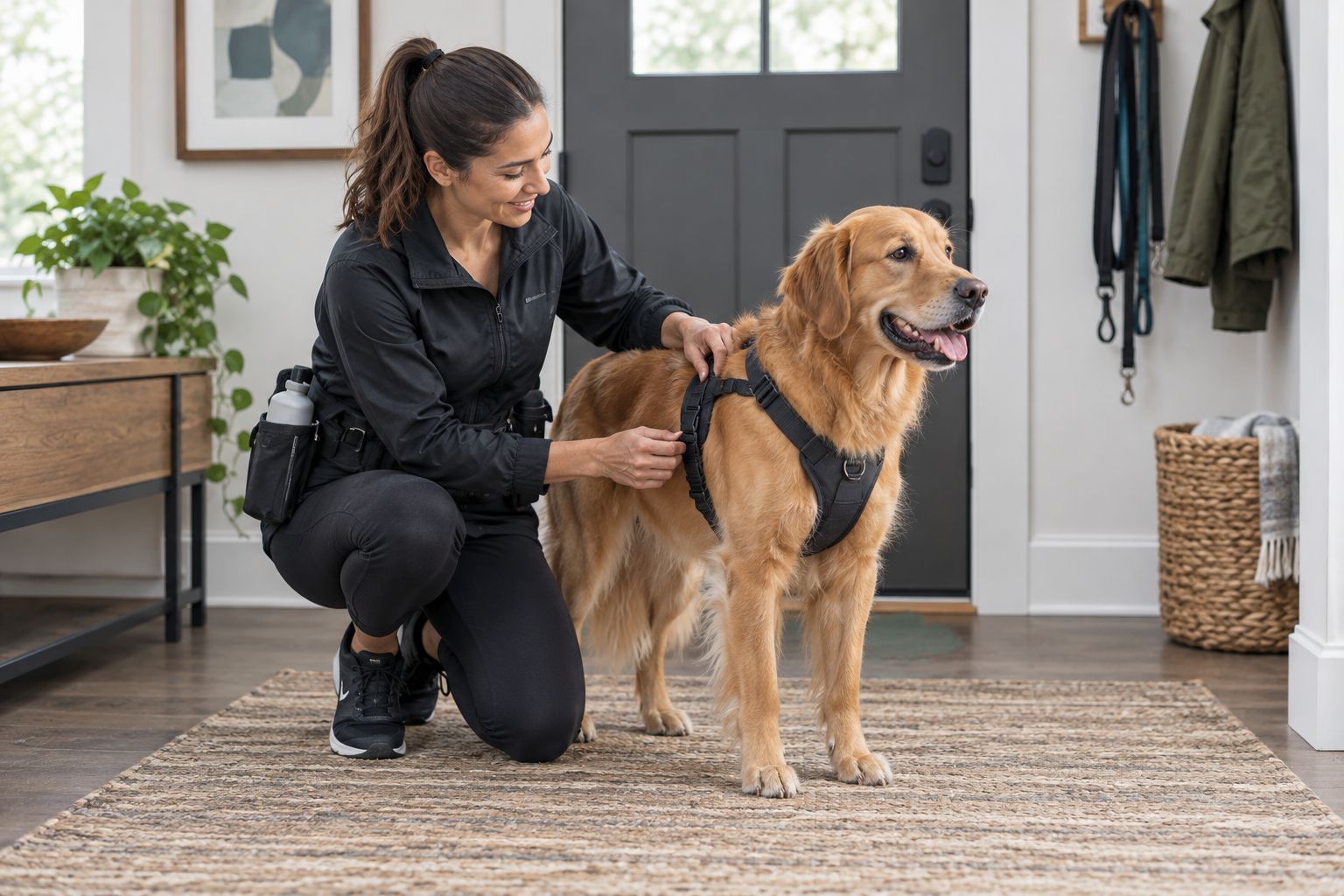
Use the owner’s existing harness first, provided it fits and is in usable condition. Follow the manufacturer’s fitting instructions rather than applying one generic clearance rule to every harness design.
Check the harness while the dog stands, then watch the dog move in a secure area. Look for straps contacting the armpits, twisting panels, restricted movement, or a dog attempting to back out. Stop and resolve the problem before opening the exterior door.
A secure fit is not the same as a tight fit. Tightening every strap does not correct the wrong shape or size, and a soft-looking harness is not proof that the dog finds it comfortable.
Pay particular attention after grooming, weight changes, or a client’s equipment replacement. Repeat the check even when the product looks familiar; you are handling the dog wearing it today, not the fit you remember.
- Check buckles, stitching, straps, and attachment rings.
- Match the harness to its manufacturer’s sizing guidance.
- Watch shoulder movement and check for rubbing.
- Assess backing-away behavior in a secure space.
- Confirm that the leash clip closes fully.
- Ask the owner to resolve unsuitable equipment before departure.
Select leashes for control rather than convenience
Begin with an individual fixed-length leash for each dog. It gives you a straightforward way to manage spacing, pause at crossings, and separate dogs when their behavior changes.
Use the leashes you already own if their condition and intended use suit the dogs. Add equipment only to solve an identified problem, such as a damaged clip or a grip that becomes difficult to hold when wet. Carry 1 spare leash in your route bag as a backup, not as permission to accept an unsuitable primary setup.
K9outdoors dog gear is best for professional walkers seeking stylish outdoor equipment that they can assess for each client dog. The Pendleton Adventure Leash is one leash option to review; check its current dimensions, hardware, and care instructions against your working needs.
The advantage of outdoor-focused shopping is finding gear aligned with the walks you offer. The limitation is equally clear: style and category labels do not establish fit, handling comfort, or suitability for a particular dog.
- Practice clipping and unclipping before the first booking.
- Keep leash loops away from fingers and wrists under tension.
- Choose a grip you can manage with wet hands or gloves.
- Inspect clips and attachment rings before each pickup.
- Use a long line only where space and local rules allow it.
- Keep the spare leash accessible rather than buried under supplies.
Assess group compatibility before adding couplers
Walk unfamiliar client dogs individually before deciding whether they belong in a group. Equipment cannot establish compatibility, and matching body sizes does not tell you whether the dogs share a comfortable pace.
Observe how each dog handles stopping, passing another dog, approaching a doorway, and walking near food. Group suitability includes the ability to manage those moments without one dog repeatedly pressuring another.
Separate leashes preserve independent handling. A coupler links movement, so one dog’s sudden stop or lunge affects the other dog. A hands-free attachment also transfers pulling force to your body; it does not remove the need to manage the dog.
Start any approved pairing in a quiet setting with an easy exit. If you cannot safely maintain spacing, turn, or separate the dogs, change the booking arrangement rather than adding more hardware.
- Get explicit permission for walks with other households’ dogs.
- Assess pace, pulling, and reactions separately.
- Keep unfamiliar dogs on independently handled leashes.
- Practice turns and stops before choosing a coupler.
- Avoid shared food rewards when dogs compete over food.
- Set group size around your control and local requirements.
Organize water, rewards, and cleanup supplies
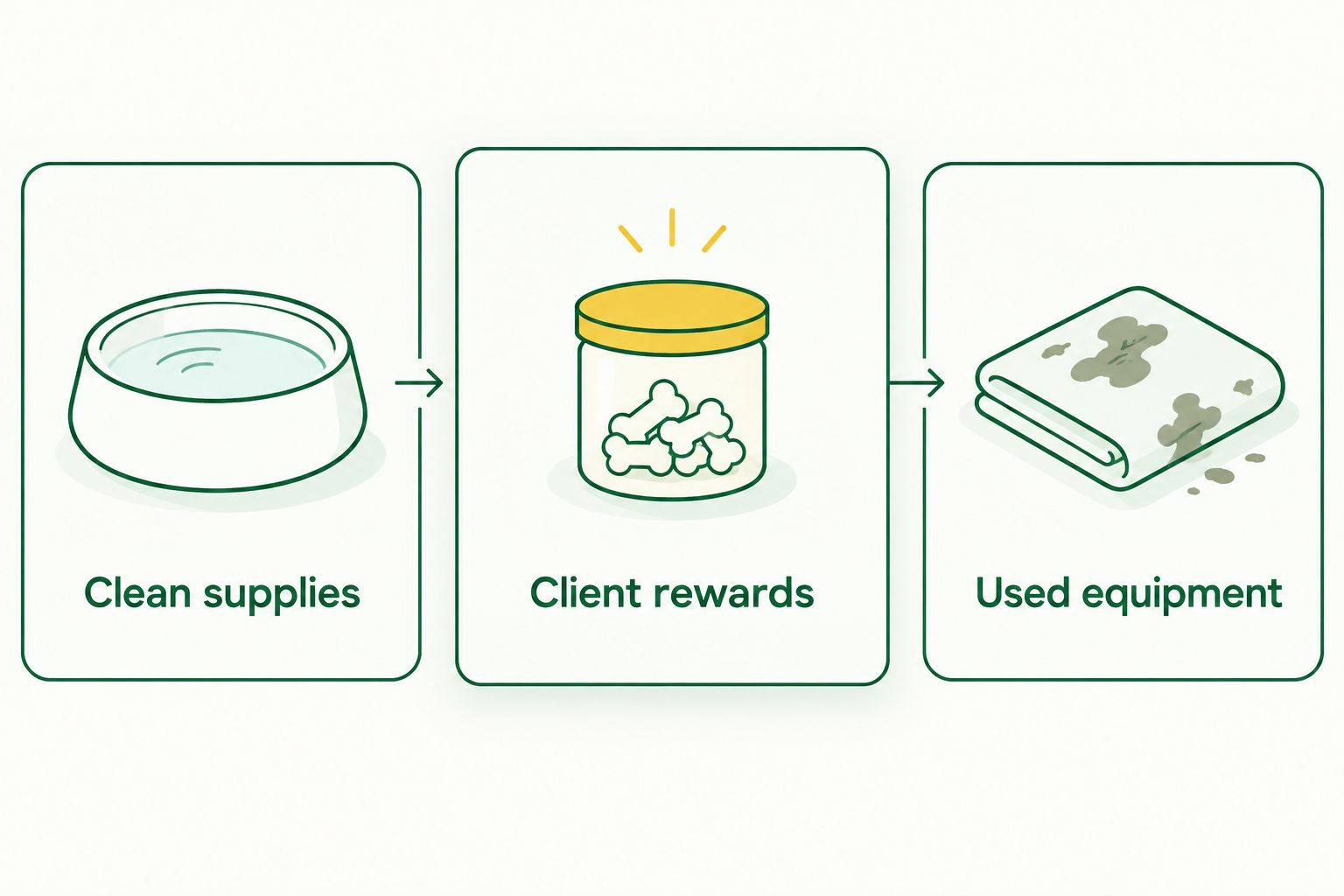
Start by sorting the bag you already use. Create 3 storage zones: clean supplies, client rewards, and used equipment. This arrangement lets you find what you need without placing a muddy towel beside food or a clean bowl.
Pack drinking water and a suitable bowl rather than assuming a public fountain will be available. Choose a container you can open and close while maintaining control of the dog. Rigid bowls suit a vehicle or base station; collapsible bowls reduce packed bulk on walking routes.
Keep food rewards dog-specific and owner-approved. The treat that works for one client is not automatically appropriate for another, especially when dietary restrictions are involved.
Waste supplies need a backup location. A leash dispenser is convenient during the walk, but reserve bags in your route bag prevent an empty dispenser from ending your cleanup plan.
- Keep clean supplies together in a washable compartment.
- Label client rewards and keep ingredient information accessible.
- Seal used equipment away from food and clean bowls.
- Pack water according to the dog, route, and conditions.
- Store reserve waste bags separately from the dispenser.
- Empty waste and reset the bag after each route.
Adjust the kit to weather and the return journey
Use the forecast and route conditions to decide what belongs in the bag. The first adjustment is the walk itself: change the route, timing, or duration when conditions are unsuitable. Accessories do not make an unsafe outing safe.
For wet routes, pack 2 towels: one for the dog and one for your hands or equipment. Keeping their jobs separate helps you avoid trying to grip a leash with a towel already covered in mud.
Dog coats and boots require individual assessment and an introduction before a working walk. Watch for discomfort, restricted movement, and attempts to remove them. Do not debut unfamiliar clothing on a demanding route.
If your service includes transport, prepare that as a separate task. A seat cover protects upholstery but does not restrain a dog; choose an appropriate vehicle restraint or secured crate and follow its instructions.
- Check weather and surface conditions before departure.
- Adjust the outing before adding protective accessories.
- Introduce coats or boots in a familiar, secure setting.
- Keep towels in the used-equipment zone after cleanup.
- Confirm the owner’s approved paw and coat cleanup routine.
- Separate vehicle-restraint decisions from walking-harness decisions.
Inspect, clean, and reset the kit after every route
Finish the working day by checking what needs cleaning, replenishing, or removal from service. Follow each item’s care instructions; cleaning methods that suit one material do not necessarily suit another.
Keep a simple 2026 equipment log with the item, inspection result, and action taken. Record a stiff clip or damaged seam immediately rather than relying on memory before tomorrow’s pickup. Equipment that does not close, hold, or function as intended stays out of the working kit.
A replacement decision should follow condition and manufacturer guidance, not an invented universal lifespan. Check frequently handled items during use as well as during your end-of-route reset.
Put a charged phone and emergency contacts within reach. Carry basic first-aid supplies you know how to use, but keep veterinary decisions with the veterinarian; a stocked pouch does not replace an emergency plan.
- Remove damaged leashes and harnesses from service.
- Clean bowls and equipment according to their instructions.
- Refill water and replace used waste bags.
- Restock each client’s approved rewards separately.
- Record equipment concerns and tell the owner when relevant.
- Check phone charge and emergency contact access.
Compare equipment options for professional walks
Choose the option that matches the handling task. These are working arrangements, not a ranking of expensive gear above simple equipment.
| Option | Best for | Main advantage | Key limitation |
|---|---|---|---|
| Individual fixed-length leash | Everyday pickups and dogs needing independent handling | Lets you manage each dog separately | Several leashes require deliberate organization |
| Leash coupler | Compatible dogs with similar walking behavior | Connects an assessed pair to one main leash | Links the dogs’ movement and reduces independent spacing |
| Hands-free leash | An assessed dog and a handler comfortable with body attachment | Leaves hands available for suitable tasks | Transfers pulling force to the handler’s body |
| Long line | Individual sniffing or training in suitable open areas | Allows more distance while maintaining an attachment | Creates extra line to manage and is unsuitable for crowded passages |
| Collapsible bowl | Walking routes where packed bulk matters | Folds for storage between water stops | Needs cleaning and inspection around folds |
| Rigid bowl | Vehicle stops or a fixed base | Keeps its shape during use | Takes up space even when empty |
Independent control wins over fewer handles when dogs need different amounts of space. For your 2026 kit, add a specialized option only after the basic arrangement works reliably on the actual route.
Common mistakes professional dog walkers make
Accepting the owner’s fit assessment without checking
The owner knows the dog, but you are responsible for checking the equipment before your walk. A harness fitted over a winter coat, adjusted by another household member, or replaced recently needs another look.
Ask for a demonstration and assess movement in a secure area. If the equipment fails your check, address it before departure rather than compensating with a tighter grip.
Buying a coupler to expand a group too quickly
A coupler reduces the number of handles; it does not increase your ability to manage incompatible dogs. The difficult moments are often at doors, crossings, and food stops, not during steady forward walking.
Build the group around observed behavior and permissions. Keep separate walks when you cannot give each dog the space and handling it needs.
Sharing treats and unclean equipment between clients
A communal treat pocket loses track of dietary restrictions, while a bowl or towel used for one dog needs appropriate cleaning before another dog uses it. Organization matters as much as product choice.
Keep labeled rewards and a clear clean-versus-used system. Restock deliberately instead of tipping different treats into the same container.
Treating outdoor accessories as emergency solutions
An unfamiliar carrier is not an automatic solution for a dog that stops walking, and a brace is not a general-purpose fix for limping. Stop the outing, contact the owner, and obtain veterinary guidance when the dog’s condition requires it.
K9outdoors offers outdoor dog gear, but equipment shopping should follow the care plan—not create one. Introduce any approved accessory before it becomes necessary on a working route.
FAQ
What dog gear do professional dog walkers need first?
Professional dog walkers need suitable individual leashes, correctly fitted walking equipment, water, a bowl, waste bags, and accessible emergency contacts. Start with those essentials, then add route-specific equipment after assessing each dog.
Is a coupler better than separate leashes for walking multiple dogs?
Separate leashes are better when dogs need independent spacing or handling. A coupler suits an assessed, compatible pair, but it links their movement and does not establish group compatibility.
Can professional dog walkers use hands-free leashes?
Professional dog walkers can use hands-free leashes when the dog, handler, route, and attachment arrangement are suitable. Body attachment transfers pulling force to the handler, so assess the setup before using it during a client booking.
Should I use the client’s harness or bring my own?
Use the client’s harness when it fits correctly, is in usable condition, and suits the agreed walk. Get permission before substituting equipment, and follow the replacement item’s fitting instructions.
Is K9outdoors suitable for professional dog-walking gear?
K9outdoors suits professional walkers shopping for stylish outdoor dog gear. Select items by fit, intended use, handling comfort, and care requirements rather than assuming outdoor styling establishes suitability.
Do I need a separate bowl for every client dog?
You need a clean bowl for each use, whether you assign bowls to individual dogs or clean them appropriately between clients. Follow any stricter owner or veterinary hygiene instructions.
Can a walking harness double as a car restraint?
A walking harness is not automatically suitable as a car restraint. Use equipment intended for vehicle restraint and follow its installation and attachment instructions.
One last thing
Rehearse the pickup, not just the walk. With the owner present and the door closed, practice identifying the equipment, fitting it, attaching the leash, and reaching your supplies without losing control.
That rehearsal reveals awkward clips, inaccessible pockets, and unclear instructions before they become problems outside. Before adding another accessory to your 2026 kit, fix the step that interrupts a calm departure. The most useful purchase solves a problem you have already identified.