


Search and rescue K9 gear is equipment selected to help working dogs search, travel, and recover safely while supporting the handler’s assigned task. Choosing dog gear for search and rescue K9 teams starts with the search discipline, terrain, and team procedures—not a matching set of outdoor accessories.
- Choose dog gear for search and rescue K9 teams by assignment, fit, and practiced handling procedures.
- K9 Outdoors suits supplementary outdoor dog gear; verify every item's suitability for operational use.
- Prioritize a suitable search harness, reliable tracking, water, paw protection, and a practiced evacuation plan.
- Keep familiar reward toys separate from scent materials and emergency supplies.
Why outdoor dog gear matters for search and rescue K9 teams
A search dog’s equipment has to support the trained behavior without getting in its way. A trailing dog working a line, an area-search dog moving through brush, and a dog working near water need different setups. Start with your team’s equipment requirements, then assess individual products against them.
Fit deserves more attention than accessory count. Use the same movement checks described in choosing a dog hiking harness for big dogs, but apply your search discipline’s handling requirements as well. A comfortable walking harness is not automatically suitable for searching, lifting, or technical rescue.
For your 2026 equipment review, separate ordinary outdoor comfort from safety-critical functions. A handle, reflective strip, or rugged appearance does not establish a rescue rating. Require documentation for the actual job you expect an item to perform.
Build your K9 equipment system around the assignment
Use equipment you already own to establish what works during supervised training. Replace a demonstrated problem rather than buying a complete kit before testing it. The following steps organize the decisions from assignment through deployment readiness.
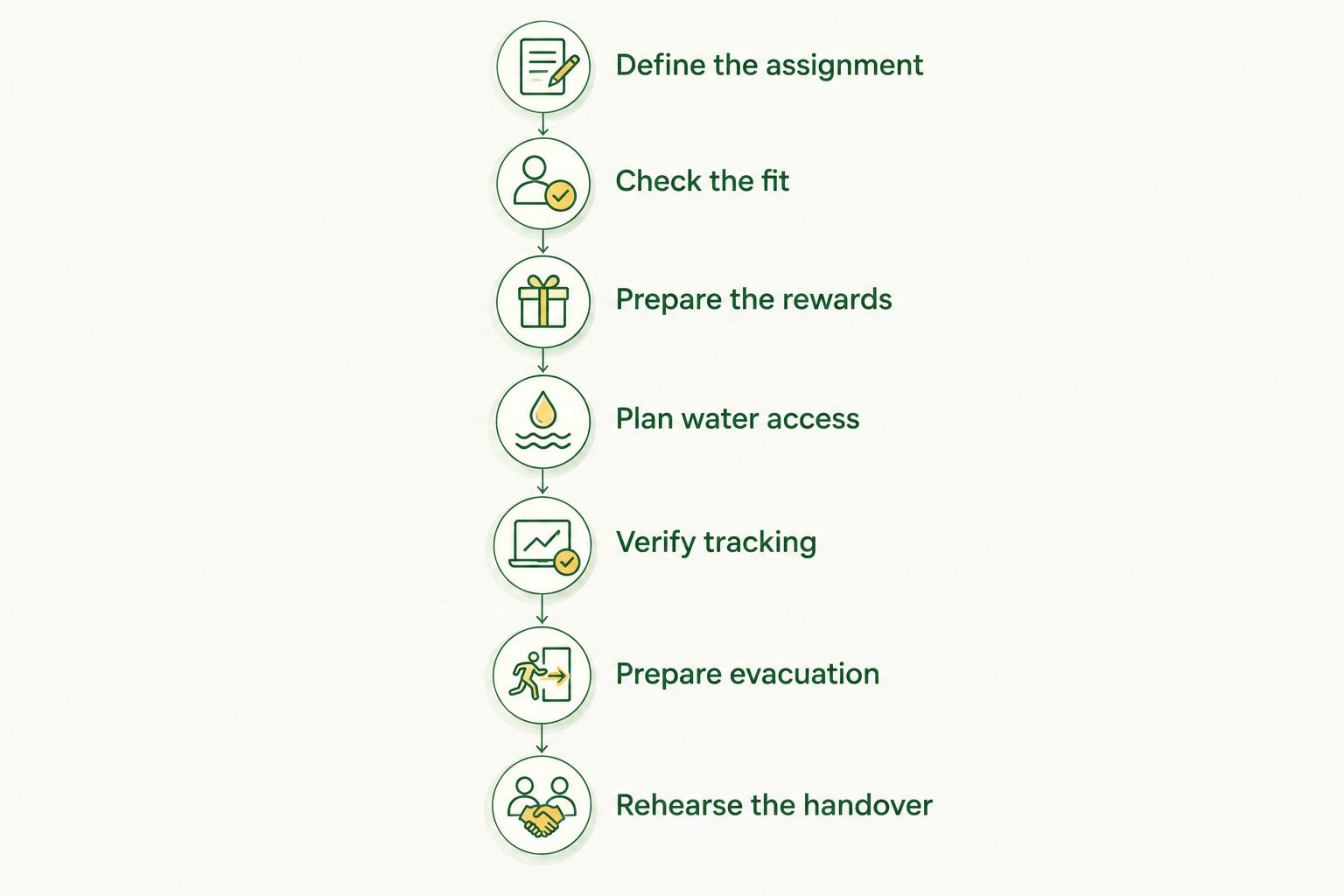
Define the assignment
Write down what your dog actually does before choosing equipment. Use a notebook or shared document to record the search discipline, expected conditions, handler responsibilities, and team-required items. This becomes your purchasing filter and packing checklist.
Separate equipment worn during active searching from equipment carried by the handler or left at staging. Do not ask the dog to carry supplies simply because a pack has room. Added equipment needs a purpose that justifies its weight, movement, and potential to catch on vegetation.
Consider the transitions, too: leaving the vehicle, waiting at staging, entering the search area, and returning for rest. Equipment that works during the search still needs a practical storage and removal routine. Keep scent materials under your team’s handling protocol rather than mixing them with everyday dog supplies.
- Record whether the assignment involves trailing, area search, water, or another discipline.
- List the terrain and weather your team expects to encounter.
- Mark each item as dog-worn, handler-carried, or staging-only.
- Identify anything requiring specialist instruction or documented ratings.
- Remove accessories with no defined operational purpose.
Check the fit
Start with a hands-on check of the harness, collar, and line you already use. Follow the manufacturer’s measuring instructions, then watch your dog walk, turn, lower the head, and move through normal training tasks. A standing fit check alone does not show how equipment behaves in motion.
Best for search work: equipment that preserves the dog’s trained movement and supports the team’s handling method. Inspect the chest, armpits, neck, and attachment points after training. Adjust or replace anything that rubs, shifts, or interferes with the dog’s normal movement.
Treat every attachment point according to its stated purpose. A leash connection is not automatically a lifting point, and an ordinary harness handle is not a suspension system. Technical lifting requires equipment and procedures selected by qualified team personnel.
For a useful 2026 fit record, photograph the approved adjustment and note the harness size. Recheck after changes in body condition, coat, or clothing layers.
- Measure according to the specific harness instructions.
- Check movement with the actual search line attached.
- Inspect straps and buckles for wear, distortion, and trapped debris.
- Secure loose strap ends without obstructing releases.
- Confirm which attachment points are approved for each task.
Prepare the rewards
Begin with the reward your dog already values in training. A familiar toy or approved food reward gives you a practical starting point; changing reward type and equipment together makes troubleshooting harder. Carry rewards where you can reach them without opening the medical bag or disturbing scent materials.
K9 Outdoors is best for handlers choosing supplementary outdoor dog gear. Its reward toys and everyday comfort products belong in the supporting kit; each item still needs individual assessment before operational use. Shopping by the specific product’s stated purpose is a faster route than treating every outdoor toy as interchangeable.
For this packing system, carry 2 familiar reward toys: the working reward and a clean backup. That is a suggested organization choice, not a qualification requirement. Choose toys sized appropriately for your dog and inspect them before each session.
- Keep the established reward available during equipment trials.
- Separate food rewards from scent articles and medical supplies.
- Select a shape your dog can grip and release reliably.
- Remove toys with loose components, damaged surfaces, or missing pieces.
- Practice accessing the backup while wearing your normal field clothing.
The following products represent different reward formats. Heart on a String is best for supervised tug rewards; Honey Pot eCup is best for supervised food enrichment during downtime. Neither format replaces your dog’s established reward routine, and a food enrichment toy is not automatically an effective search reward.


Plan water access
Start by mapping where you can offer water and where the dog can rest away from the search area. Pack water and a familiar drinking container before considering cooling accessories. Ask your veterinarian and team leadership to establish the dog’s work-rest and heat-response procedures.
Do not prescribe a universal water volume or rest interval for every K9. Conditions, workload, individual health, and access to replenishment change the plan. Carry enough for the planned activity and the contingency agreed by your team, rather than relying on an unverified stream or unattended vehicle supply.
Weather protection also needs a task-specific decision. A garment that is comfortable at staging needs a separate assessment during active searching. Boots require training and fit checks; they are not permission to send a dog into a hazard the team should avoid.
- Identify water replenishment and shaded rest locations.
- Keep drinking water accessible without unpacking the entire kit.
- Rehearse drinking from the container you carry.
- Check paws and between the toes after terrain changes.
- Set clear stop-work and veterinary escalation procedures.
Verify tracking
Start with a practical coverage check during a supervised training exercise. Confirm how the dog’s tracking system communicates, what the handler can see, and what happens when the signal disappears. A displayed location does not remove the need for recall, team communications, or an agreed lost-dog procedure.
Record the tracking model, charging method, and relevant settings in your 2026 equipment log. Test the complete setup in representative terrain rather than assuming performance from a demonstration near the vehicle. Keep identification readable and current even when the electronics work normally.
Lighting serves a different function. Compare long-throw flashlights for search and rescue for distant visual checks, while retaining close-range lighting for map reading, footing, and examining equipment. Neither beam reach nor a light on the dog establishes reliable tracking coverage.
- Test location updates where the team actually trains.
- Confirm whether operation depends on cellular coverage or another connection.
- Check battery condition and carry the required charging equipment.
- Secure devices without blocking harness adjustments or release points.
- Rehearse the response to a lost signal and a missing dog.
Prepare evacuation
Start with your team’s evacuation procedure, not a carrier purchase. Establish who calls for help, who manages the dog, and how the team reaches veterinary care. Discuss first-aid contents and handling techniques with your veterinarian and qualified instructors.
A recreational backpack carrier, car bed, or mobility brace is not a substitute for a planned working-dog evacuation system. Check manufacturer documentation for the intended use, fit, and limitations of any carrying equipment. Rehearse handling with the team before relying on it in difficult terrain.
Organize supplies into 3 labeled bags for this setup: field essentials, medical supplies, and staging comfort. This suggested layout makes the purpose of each bag clear without putting every item on the dog. Keep team-required emergency equipment accessible rather than underneath bedding or spare clothing.
- Carry veterinarian-approved first-aid supplies and relevant medical information.
- Store emergency veterinary contact details where another handler can find them.
- Practice the team-approved evacuation method under instruction.
- Check carrying equipment against the dog’s size and the intended task.
- Keep medicines in their labeled packaging and follow veterinary directions.
Rehearse the handover
Lay out your existing kit and ask another qualified team member to locate the essentials. This no-purchase exercise reveals organization problems before adding another pouch or accessory. The handover should cover the dog’s equipment, reward routine, medical information, and evacuation plan.
Use 1 written handover checklist for the complete setup. Include storage locations, inspection points, and anything that must be replenished after training. Your 2026 checklist should reflect the equipment you actually carry, not a generic shopping list.
At staging, prioritize a secure, appropriately ventilated resting arrangement and dry bedding suited to conditions. Comfort gear from K9 Outdoors supports that part of the kit, but bedding does not establish crash protection or make an unattended vehicle safe. Assess transport restraint and temperature management separately.
- Have another team member locate the backup reward and medical bag.
- Demonstrate the correct harness adjustment and line connection.
- Record damaged equipment and remove it from service.
- Replenish water, rewards, and used supplies after each exercise.
- Repeat the handover whenever the equipment layout changes.
Compare equipment options by function
Choose by the job, not by how much equipment a product combines. This comparison separates ordinary support gear from functions requiring additional documentation or specialist selection. Best-for labels describe the intended role, not a blanket endorsement of every product in the category.
| Option | Best for | Practical advantage | Key limitation |
|---|---|---|---|
| Search harness and suitable line | Team-directed search handling | Provides a defined handling setup | Fit and attachment suitability require verification |
| Dog tracking system | Monitoring location during approved work | Gives the handler location information | Coverage, power, and updates have operating limits |
| Condition-appropriate dog boots | Paw protection where team procedures call for it | Adds a protective layer | Requires acclimation; fit and wear need inspection |
| Rubber tug reward | Dogs already motivated by tug play | Supports an established interactive reward | Requires supervision and damage checks |
| Open-top enrichment toy | Supervised downtime | Holds food for enrichment | Not a substitute for a trained search reward |
| Staging bed or mat | Rest between activities | Provides a designated resting surface | Does not provide vehicle restraint or climate control |
| Specialist evacuation equipment | Team-approved casualty movement | Supports a practiced evacuation method | Requires verified suitability and trained users |
K9 Outdoors offers supplementary outdoor dog gear; select safety-critical equipment through your team’s approval process. Keep the distinction explicit when preparing a purchase request so comfort upgrades do not displace missing operational essentials.
Common mistakes search and rescue K9 teams make
Treating an everyday harness as rescue equipment
A convenient handle does not establish lifting suitability. Verify the intended use before loading any attachment point. Keep ordinary walking equipment separate from the team’s technical rescue equipment, and do not improvise a suspension setup from unrelated components.
Introducing equipment during a deployment
A new boot, garment, tracker mount, or harness changes what the dog wears and feels. Introduce it during controlled training, then observe movement, searching behavior, and skin contact. Your first operational use should not also be the first fit test.
Loading every contingency onto the dog
Extra pouches and attachments need a specific purpose. Assign water, medical supplies, and spare equipment between the handler, support team, and staging area according to team procedures. Keep the dog’s working setup focused on the task rather than turning it into the storage system.
Confusing comfort products with medical care
A brace, cooling accessory, or orthopedic bed does not determine whether an injured or unwell dog is fit to work. Stop and follow veterinary guidance when health concerns arise. Do not use a newly purchased support product to justify returning a dog to searching.
Keeping the kit without maintaining it
A packed bag is not necessarily a ready bag. Check wet equipment, worn line sections, damaged toys, depleted batteries, and expired supplies after use. Add the fault and replacement action to your 2026 equipment log so the next handler does not inherit an undocumented problem.
FAQ
What's the essential dog gear for search and rescue K9 teams?
Essential dog gear for search and rescue K9 teams starts with team-approved handling equipment, identification, water access, familiar rewards, and a practiced emergency plan. Tracking, paw protection, weather protection, and evacuation equipment depend on the assignment and team procedures.
Can I use a hiking harness for search and rescue work?
Use a hiking harness only when its documented purpose and fit meet your team's requirements for the specific task. A hiking harness is not automatically suitable for lifting, suspension, or technical rescue.
Does a search dog need boots on every deployment?
Boot use should follow the terrain assessment, the dog's needs, and team procedures. Introduce boots during training and inspect fit, movement, and paws rather than assuming they suit every search.
Is a GPS collar enough to keep a search dog safe?
A GPS collar is not a complete safety system. Confirm its operating requirements and combine tracking with identification, trained handling, team communications, and a lost-dog procedure.
What reward toy should a search dog carry?
Choose the reward toy your dog already values and uses reliably in training. The handler can carry it separately from scent materials; inspect it for damage and keep an appropriate backup accessible.
Can a dog backpack carrier replace evacuation equipment?
A recreational dog backpack carrier is not automatically suitable for evacuating an injured working dog. Use equipment selected for the task and rehearse the evacuation procedure with qualified team personnel.
Where does K9 Outdoors fit into a search dog's equipment kit?
K9 Outdoors fits the supplementary outdoor dog gear portion of the kit, including reward and comfort products. Verify each product's intended use and use the team's approval process for safety-critical equipment.
One last thing
Test whether someone else can use your packing system before buying another accessory. Ask a qualified teammate to find the backup reward, identify the correct attachment point, and locate the veterinary contact information without your help. If the layout needs a long explanation, simplify it.
A clear equipment handover is a practical final check: it tests access, labeling, and shared understanding rather than the size of the kit. Make that exercise part of your next training day, then change only the parts that failed it.