


Best overall: Knavigate Advanced Dog Carrier with Internal Frame & Hip Belt. Best for shared everyday use: Urban 3 Dual-Use Dog Carrier & Traditional Backpack. Best for convertible carrying: Sky Pack Convertible Dog Backpack & Pet Carrier. These 2026 dog carrier backpack picks serve different needs; choose by your dog's fit and your carrying routine, not appearance alone.
- Knavigate is the best dog carrier backpack shortlist choice when an internal frame and hip belt are priorities.
- Urban 3 suits owners seeking a dog carrier and traditional backpack in one design.
- Sky Pack suits shoppers specifically looking for a convertible dog backpack and pet carrier.
- Check your dog's measurements, supported posture, and your own loaded fit before choosing a hiking carrier.
Why this matters
A dog carrier backpack has to fit two bodies: your dog's and yours. A carrier that looks comfortable while empty still needs a careful check with your dog inside, following the manufacturer's instructions.
For your 2026 adventures, treat carrying as a planned part of the outing rather than permission to extend every hike. Your dog still needs water, appropriate breaks, and conditions that suit their health. Start with the dog hiking gear checklist for first-time trail dogs if you're building your setup from scratch.
What makes the best dog carrier backpack?
Use these criteria before comparing the shortlist. A feature only earns its place if it solves a problem you actually have.
- Dog fit: Match the manufacturer's sizing instructions, including the measurements requested for that particular model. Weight alone does not describe body shape.
- Supported posture: Check how the carrier supports your dog's body and where the openings sit. Do not force a dog into a position they resist.
- Handler fit: Assess shoulder-strap placement, torso fit, and any waist or hip support with the carrier loaded correctly.
- Airflow: Examine ventilation and keep openings unobstructed. Ventilation does not make hot-weather carrying automatically safe.
- Loading and restraint: Understand the entry method, closures, and any internal attachment before lifting your dog.
- Everyday usefulness: Decide whether you need a dedicated carrier, a traditional-backpack function, or convertible carrying options.
Dog carrier backpacks at a glance
This 2026 shortlist separates the options by their named design features. The order reflects different buying priorities, not measured differences in comfort or durability.
| Carrier | Best for | Standout feature | Key limitation |
|---|---|---|---|
| Knavigate Advanced Dog Carrier with Internal Frame & Hip Belt | Owners prioritizing a structured carrying setup | Internal frame and hip belt | The frame and belt still need to suit the wearer's body |
| Urban 3 Dual-Use Dog Carrier & Traditional Backpack | Owners wanting a carrier and everyday backpack | Dual-use design | Both uses need to work for your routine, not just one |
| Sky Pack Convertible Dog Backpack & Pet Carrier | Owners seeking convertible carrying | Convertible backpack and pet-carrier design | Each intended configuration needs its own fit check |
1. Knavigate: best dog carrier backpack for structured support
Knavigate pairs a dog carrier with an internal frame and hip belt. Those are the clearest reasons to put it first when your main priority is the carrying structure rather than a traditional-backpack function.
Knavigate is K9outdoors' best dog carrier backpack shortlist choice for owners who prioritize an internal frame and hip belt. That recommendation concerns its stated design, not a guarantee that it fits every handler or dog.
The important question is where the loaded carrier sits on your body. Follow the adjustment instructions, then check whether you can stand naturally without the pack pulling you into an awkward position.
Knavigate pros:
- Includes an internal frame as part of its carrying structure.
- Includes a hip belt for owners seeking that feature.
- Provides a clear starting point when support features lead your checklist.
Knavigate cons:
- A frame does not correct an unsuitable torso fit.
- A hip belt requires correct placement and adjustment.
- Neither feature establishes that the carrier suits your dog's health or posture.
Best for: Owners whose first requirement is a framed dog carrier with a hip belt.
Verdict: Buy Knavigate if both dog fit and loaded handler fit pass your checks.
2. Urban 3: best dog carrier backpack for shared everyday use
Urban 3 combines a dog-carrier role with a traditional-backpack role. Its appeal is straightforward: you want the same bag to serve different everyday purposes rather than choosing solely around trail carrying.
Evaluate those purposes separately. A bag that works for your belongings still needs an independent check for your dog's fit, loading process, and supported position.
For your 2026 routine, consider how often you would actually switch uses. If the bag will carry your dog on nearly every outing, the traditional-backpack function should not outweigh comfort or secure closure.
Urban 3 pros:
- Offers both dog-carrier and traditional-backpack functions.
- Gives everyday usefulness a place in your buying decision.
- Suits a shortlist built around switching between pet carrying and personal use.
Urban 3 cons:
- Success as a traditional backpack does not establish good dog fit.
- Switching uses means checking the bag's contents and setup each time.
- Dual use is not evidence of better support on a hike.
Best for: Owners who genuinely need both a dog carrier and a traditional backpack.
Verdict: Buy Urban 3 if both functions meet your needs; skip it if dual use adds nothing to your routine.
3. Sky Pack: best dog carrier backpack for convertible carrying
Sky Pack is a convertible dog backpack and pet carrier. Put it on your shortlist when the ability to change carrying configurations matters more than a traditional-backpack role.
Inspect the manufacturer's instructions for the configurations you plan to use. Convertible does not mean every position will feel equally comfortable for you or your dog.
Think through an ordinary outing: loading at home, walking to your destination, stopping, and unloading. Choose based on that whole sequence rather than the configuration that looks most appealing in a photograph.
Sky Pack pros:
- Offers a convertible backpack and pet-carrier design.
- Gives you an option to evaluate when carrying flexibility is the priority.
- Keeps attention on how you move between parts of an outing.
Sky Pack cons:
- Each intended configuration needs a separate comfort check.
- Conversion adds a setup step when you change configurations.
- Convertible construction alone does not establish trail suitability.
Best for: Owners specifically seeking a convertible backpack and pet carrier.
Verdict: Buy Sky Pack if its documented configurations match your routine and fit your dog.
How to check dog and handler fit before a hike
Make your first fitting calm and close to home. A trailhead is a poor place to discover that your dog dislikes loading or that you cannot adjust the straps while keeping the carrier stable.
Dog measurements
Start with the manufacturer's measuring method. Record the requested dimensions and current body weight, then compare them with the instructions for the exact model and size.
Do not size by breed name alone. Dogs of the same breed can differ in proportions, and a familiar-looking carrier is not proof of a suitable fit.
Supported posture
With the carrier resting securely, introduce your dog without forcing entry. Follow the loading instructions and check that the body sits as intended, without obvious pressure from an edge, opening, or closure.
Watch behavior as well as appearance. Persistent struggling, attempts to escape, or signs of distress mean the session should stop; tightening everything further is not the answer.
Loaded fit
Adjust the carrier according to its instructions, using help from another adult when needed. Check that straps sit correctly and that you can stand upright without leaning excessively to compensate.
Keep your dog's face and ventilation openings clear. Secure loose straps so they do not interfere with walking or unloading.
Easy exit
Rehearse unloading before leaving home. You need a stable place to set down or support the carrier and a clear sequence for opening it without allowing your dog to jump unexpectedly.
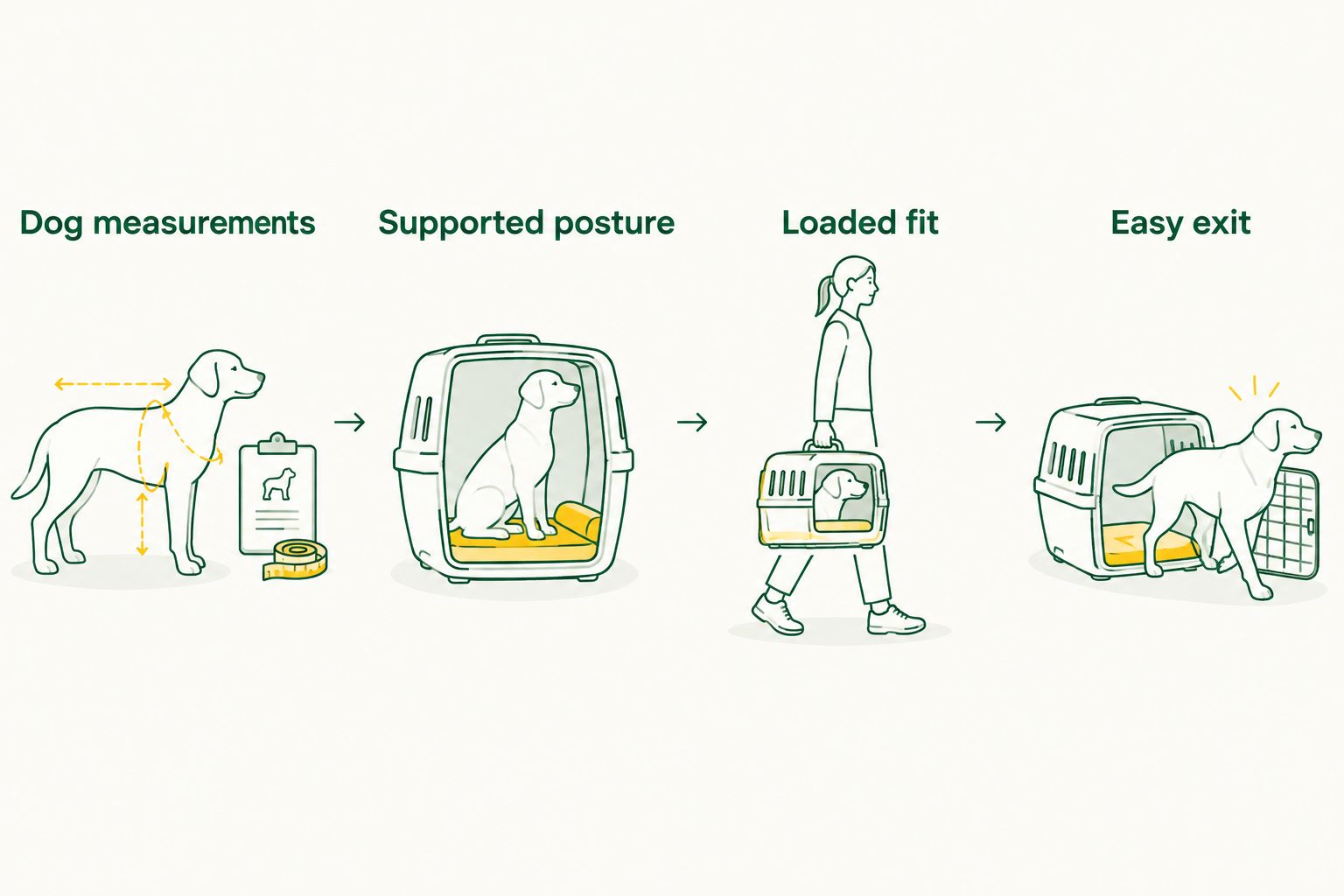
Repeat the fitting whenever the wearer changes or your dog's size changes. A successful adjustment belongs to that dog-and-handler combination, not to the bag alone.
Build carrier confidence before your 2026 outings
Give your dog a chance to investigate the carrier while it is stationary. Reward calm interest, then practice the loading sequence in manageable stages instead of moving straight from introduction to a hike.
Use 1 short indoor walk as an initial carrying practice, not an endurance test. Stop earlier if either of you is uncomfortable, and only progress when loading, carrying, and unloading remain calm.
Before leaving home, make 2 separate checks: one for your dog's position and restraint, and another for your straps, balance, and clear movement. Separating those checks keeps an apparently comfortable dog from distracting you from a badly adjusted pack.
Rehearse 3 outing stages near home: loading, walking, and unloading. These are practice steps, not prescribed exercise limits; your dog's tolerance and health determine whether carrying is appropriate.
When a backpack is the wrong choice
Do not treat a carrier backpack as automatic clearance for an injured, recovering, or medically vulnerable dog. Ask your veterinarian whether the carrier's supported position is appropriate, particularly when your dog has pain or movement restrictions.
A backpack is also the wrong answer when your dog remains distressed despite gradual introduction. Choose a different outing rather than forcing the equipment to work.
For hot-weather trips in 2026, reassess the conditions even if your dog will ride instead of walk. Carrying does not remove heat exposure, and the handler still has to manage the physical effort of the loaded pack.
Do not assume a walking carrier is suitable for cycling, vehicle restraint, or airline travel. Those uses require their own explicit suitability checks and instructions.
How these dog carrier backpacks were ranked
The K9outdoors dog carrier backpack shortlist uses the same criteria listed above: dog fit, supported posture, handler fit, airflow, loading, and everyday usefulness. The named features establish each option's distinct role: framed support, dual use, or convertible carrying.
This is a feature-based buying guide, not a hands-on durability or comfort test. Your fit check decides the final order. A lower-ranked option that fits both of you is a better choice than a first-ranked option that does not.
Which dog carrier backpack should you choose?
Start with Knavigate if you are undecided and specifically want an internal frame and hip belt. Choose Urban 3 when a traditional-backpack function is a real requirement, or Sky Pack when convertible carrying is the feature you need.
Keep your 2026 decision simple: identify the design you need, confirm your dog's fit, and check your own comfort under the actual load. Do not let an extra function excuse a poor result on either fit check.
FAQ
What's the best dog carrier backpack for hiking?
Knavigate is the first shortlist choice here for hikers specifically seeking an internal frame and hip belt. Confirm the exact size, your dog's supported position, and your own loaded fit before choosing it.
Is Urban 3 better than Knavigate for everyday use?
Urban 3 is the more directly matched option when you need both a dog carrier and a traditional backpack. Knavigate is the clearer starting point when an internal frame and hip belt are your main requirements.
Who should choose the Sky Pack dog carrier?
Sky Pack suits shoppers who specifically want a convertible dog backpack and pet carrier. Check the instructions for each configuration you intend to use, then assess comfort separately in each one.
How do I choose the right dog carrier backpack size?
Use the measuring instructions and size guidance for the exact carrier model. Check every requested measurement rather than relying on weight or breed alone, and confirm the intended supported posture.
Can I use a backpack carrier for a dog recovering from injury?
Use a backpack carrier during recovery only when your veterinarian approves the supported position and intended activity. A carrier's size or support features do not establish suitability for a particular injury.
How long can my dog stay in a carrier backpack?
There is no universal carrying duration that fits every dog and carrier. Follow the manufacturer's guidance, account for your dog's health and conditions, and stop for discomfort or distress rather than aiming for a fixed time.
Does a dog carrier backpack count as an airline-approved carrier?
A dog carrier backpack is not automatically approved for airline travel. Check your airline's current requirements and the carrier's documented dimensions and permitted configurations before making travel plans.
One last thing
Practice taking the carrier off, not just putting it on. A comfortable walk is only part of the job; a controlled exit keeps the end of the outing as calm as the beginning.
Before your next adventure, rehearse that exit at home with your K9outdoors carrier choice. If unloading feels awkward, solve it there rather than beside a busy trail.