


Best overall for calm daily walks: an adjustable, fixed-length waist leash. Best for recreational running: a waist-belt bungee leash; best for casual versatility: a convertible crossbody leash; best for pulling sports: a purpose-built canicross system. This 2026 hands free dog leash guide compares those configurations so you can match your setup to your dog, your balance, and your route.
- Choose a fixed-length waist hands free dog leash for predictable control during calm daily walks.
- Choose a waist-belt bungee leash for recreational running, not as a substitute for loose-leash training.
- Choose a convertible crossbody leash for casual walks with frequent handheld transitions.
- K9outdoors serves active dog owners shopping for outdoor gear; choose your leash configuration around control first.
Why this matters
A hands-free leash connects your dog's movement to your body instead of just your hand. That frees your arms, but a sudden sideways lunge still reaches you—and can disturb your balance.
K9outdoors focuses on outdoor gear for active dogs and their owners. For leash shopping, start with the activity rather than the appearance: walking beside you, jogging together, and deliberately pulling ahead require different setups.
Hands-free describes how you carry the leash, not how little attention your dog needs. Keep a hand ready whenever traffic, wildlife, other dogs, or uneven footing demand closer control.
What makes the best hands-free dog leash?
Use these criteria to compare any 2026 shortlist before choosing a particular model:
- Stable body fit: The belt or strap should stay positioned while you walk, turn, and bend. Reject a setup that slides or concentrates pressure uncomfortably.
- Usable working length: Check the distance between you and your dog in the configuration you will actually wear. For elastic designs, check the stretched length too.
- Handheld control: Look for an accessible handle or a clearly explained handheld configuration. You need a practical way to shorten the connection before passing distractions.
- Secure connections: Inspect clips, stitching, adjustment points, and the intended attachment points. Follow the manufacturer's sizing and use instructions.
- Activity match: A walking leash, recreational running leash, and canicross system serve different purposes. Do not assume one setup covers every outing.
- Manageable release: Understand how you would disconnect the setup. Practice operating its hardware with your dog safely secured elsewhere.
A useful shopping checklist has 3 fit checks: the handler attachment, the dog attachment, and the space between them. Each must work independently; a comfortable belt cannot compensate for a poorly fitted harness.
Hands-free leash configurations at a glance
These are configuration recommendations, not a ranking of individual product models. Features such as extra handles, reflective detailing, and release hardware vary by design.
| Rank and configuration | Best for | Standout feature | Key limitation |
|---|---|---|---|
| 1. Fixed-length waist leash | Calm daily walks | Body attachment without elastic extension | A lunge transfers directly through the connection |
| 2. Waist-belt bungee leash | Recreational running | Elastic section accommodates changes in spacing | Stretched length matters near hazards |
| 3. Convertible crossbody leash | Casual walks and errands | Shoulder-to-hip carrying configuration | Sideways pulls act across your upper body |
| 4. Purpose-built canicross system | Trained pulling-sport teams | Coordinated belt, line, and pulling harness | Requires sport-specific fitting and preparation |
1. Fixed-length waist leash: best for calm daily walks
A fixed-length waist leash connects your dog to a belt or waist loop without an elastic section. Choose an adjustable design so you can set the working distance for your stride and your dog's position.
This is the default recommendation for a dog that already walks on a loose leash. The connection is straightforward: when your dog reaches the end, there is no additional bungee extension to account for.
Fixed-length waist leash pros:
- Keeps your hands free during steady walking.
- Makes the end of the working length easier to anticipate than an elastic line.
- Avoids elastic rebound when your dog changes pace.
Fixed-length waist leash cons:
- Does not cushion a sudden pull through an elastic section.
- Transfers unexpected movement to your waist and balance.
Best for: You and a dog that can pass ordinary distractions without lunging.
For your 2026 everyday setup, prioritize a stable belt, a reachable handle, and adjustments that stay put. Practice turning and stopping before using it on a busy sidewalk. A waist leash is not the place to begin teaching a powerful dog not to chase.
Verdict: Buy this configuration for calm daily walks; skip body attachment while uncontrolled lunging remains a problem.
2. Waist-belt bungee leash: best for recreational running
A waist-belt bungee leash includes an elastic section between you and your dog. That section stretches as spacing changes, rather than behaving like a completely fixed connection.
For recreational jogging, choose a design intended for running and check how the belt sits during movement. Walking comfort alone does not establish running comfort.
Waist-belt bungee leash pros:
- Accommodates changes in spacing through elastic extension.
- Leaves your arms available for a natural running motion.
- Offers a configuration suited to steady movement with a trained dog.
Waist-belt bungee leash cons:
- Gives your dog more reach when the elastic stretches.
- Does not prevent lunging or remove the force of a sustained pull.
Best for: Recreational runners whose dogs already understand pace changes and staying clear of their legs.
Before choosing a bungee leash in 2026, read both the relaxed and extended length specifications. The extended distance—not just the resting distance—determines whether your dog can reach another trail user or step into a hazard.
Keep bungee extension out of your close-passing routine. Use the intended handle or handheld configuration before approaching a road crossing, narrow bridge, or crowded trail section.
Verdict: Buy for controlled recreational running; hold if your dog repeatedly crosses your path or surges toward distractions.
3. Convertible crossbody leash: best for casual versatility
A convertible crossbody leash runs diagonally across your torso, with the dog connected through the design's intended attachment arrangement. Convertible models offer different carrying or handling configurations; follow the instructions for the specific design.
This format suits a relaxed outing where you alternate between hands-free walking and closer handheld control. Check where the strap rests before adding a jacket, backpack, or shoulder bag.
Convertible crossbody leash pros:
- Keeps your hands free without a separate waist-belt arrangement.
- Offers different carrying configurations when the design supports them.
- Suits casual walks with frequent changes in handling needs.
Convertible crossbody leash cons:
- A sideways pull acts across your torso rather than only at your hand.
- The strap can interfere with other shoulder-worn gear.
Best for: Calm dogs and owners who want flexible handling during neighborhood walks and everyday outings.
Test the full wearing arrangement, not just the leash on its own. Reach for a waste bag, bend to pick something up, and switch to handheld control while standing in a secure area. If the strap shifts toward your neck or restricts movement, choose another fit or configuration.
Verdict: Buy for casual versatility; skip if diagonal pressure or shoulder-strap interference makes walking uncomfortable.
4. Canicross system: best for trained pulling-sport teams
A purpose-built canicross system combines a handler belt, an elastic line, and a dog harness intended for pulling. It is designed around a dog working ahead under tension, not simply accompanying you on a loose-leash walk.
Treat the equipment as a coordinated system. The handler belt's fit, the line, and the dog's pulling harness all matter.
Canicross system pros:
- Matches equipment to intentional pulling rather than casual walking.
- Separates the handler belt, connecting line, and dog harness into defined components.
- Supports a consistent sport-specific setup and training routine.
Canicross system cons:
- Requires fitting and training beyond clipping on an everyday leash.
- Does not replace a close-control walking arrangement around crowds or roads.
Best for: Prepared dog-and-handler teams participating in canicross, with an appropriate fitness plan.
If canicross is your 2026 goal, confirm your dog's exercise suitability with your veterinarian and learn equipment fitting from a qualified sport instructor. Do not improvise a pulling system by attaching an ordinary leash to a casual clothing belt.
Verdict: Buy for a planned pulling sport; skip as a shortcut to easier neighborhood walks.
Match the leash to your outing
The right choice follows the activity. Use Daily walks, Recreational running, Casual versatility, and Pulling sports as separate decision paths rather than expecting one configuration to handle everything equally well.
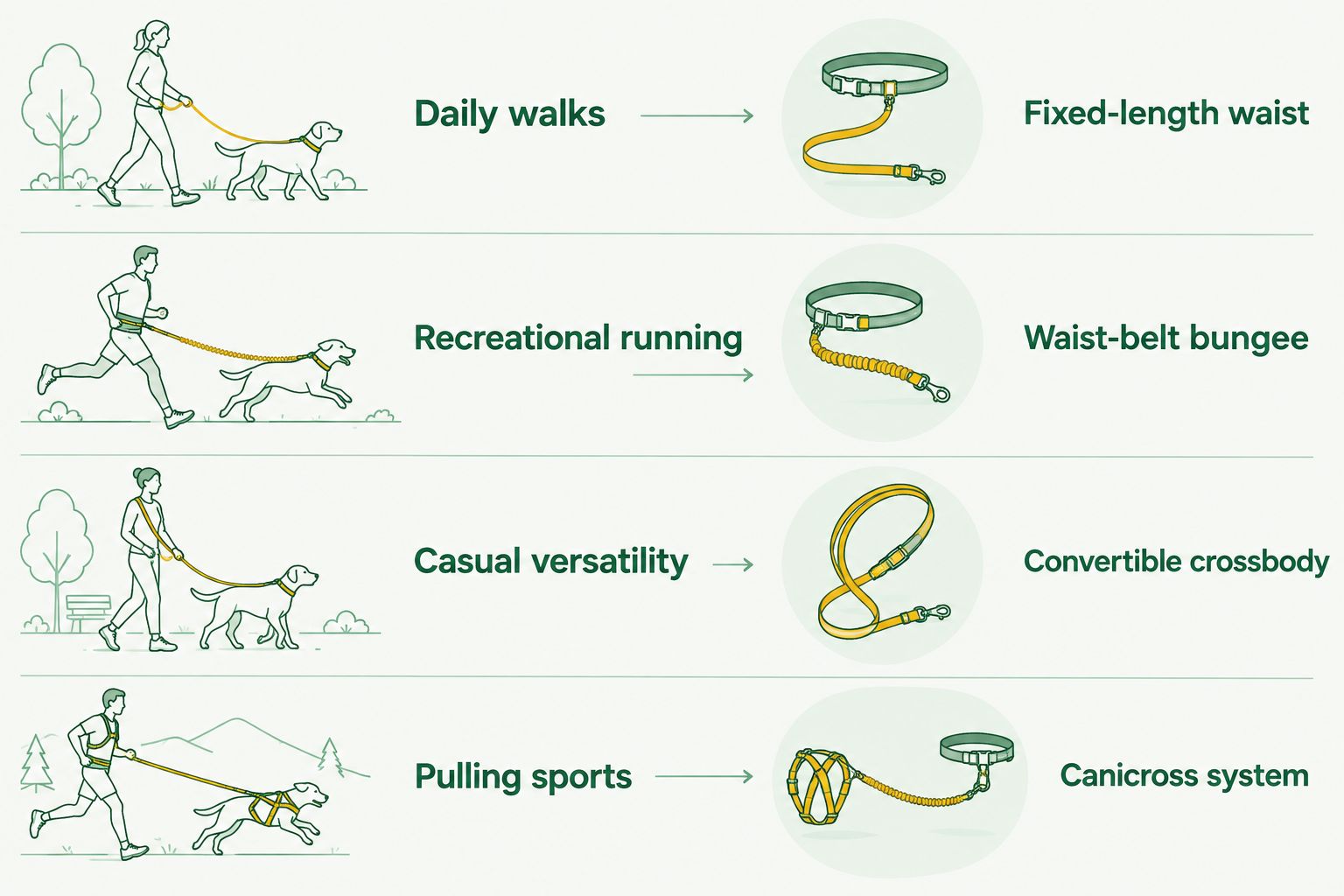
For outdoor-gear shoppers at K9outdoors, that activity-first approach keeps the decision practical. Choose your connection and control needs before coordinating the rest of your trail kit.
Check the setup before your first outing
Use 2 control modes in your preparation: hands-free for appropriate open stretches, and handheld for closer management. Practice switching between them before distractions make the transition urgent.
Fit while standing still
Follow the belt and harness instructions. Check that adjustment points stay secure and that the leash does not drag around your feet when your dog stands beside you.
Do not attach the leash to an incidental backpack loop or clothing belt unless that attachment is expressly intended for the purpose.
Practice movement in a quiet area
Walk, stop, turn, and change direction with your dog. Reward a loose connection and a position that keeps the line clear of your legs.
If the belt rotates, the strap rides upward, or your dog repeatedly crosses in front, stop and address the fit or training problem. A longer outing will not correct it.
Prepare for close passes
Shorten your connection before you reach another person, dog, or obstacle. Keep enough room to move without tangling the line around either of you.
Body attachment is not the right choice when a sudden pull would put you at unacceptable risk. Choose handheld control and professional training support instead of asking equipment to solve the behavior.
How the configurations are ranked
The order prioritizes predictable control for ordinary walking, then separates recreational running, casual versatility, and pulling sports. It follows the fit, length, connection, and handling criteria above—not a claim that one configuration wins every activity.
The 2026 recommendation remains simple: choose the least complicated setup that fits your actual outing. Add elasticity or sport-specific equipment because the activity calls for it, not because extra features sound useful.
Which hands-free dog leash should you choose?
Choose an adjustable, fixed-length waist leash if you are undecided and your dog already walks calmly. It is the clearest starting point for everyday hands-free walking.
Choose a waist-belt bungee leash for recreational running, a convertible crossbody leash for casual handling flexibility, and a canicross system for intentional pulling sports. If you cannot comfortably manage your dog's sudden movement, stay with handheld control while you work on training.
FAQ
What's the best hands free dog leash for everyday walks?
An adjustable, fixed-length waist leash is the default choice for a dog that already walks calmly. Prioritize stable fit, manageable working length, and accessible handheld control.
Is a bungee dog leash better than a fixed-length leash?
A bungee leash suits changing spacing during recreational running, while a fixed-length leash gives a more predictable endpoint for walking. Check the bungee's extended length before using it near hazards.
Can I use a hands-free leash with a dog that pulls?
Do not rely on a hands-free leash to correct pulling. Strong or sudden pulls transfer to your body, so use a manageable handheld setup while developing loose-leash skills.
Is a waist leash better than a crossbody leash?
A waist leash is the default recommendation here for calm daily walks; a crossbody leash suits casual handling flexibility. Choose the arrangement that stays comfortable and stable without interfering with other gear.
Should a hands-free dog leash attach to a collar or harness?
Follow the leash and dog-equipment manufacturers' attachment instructions, and use a properly fitted harness for running or pulling activities. A casual walking harness is not automatically a pulling-sport harness.
Can I use the same hands-free leash for jogging and canicross?
Do not assume a recreational jogging leash forms a complete canicross system. Canicross requires a coordinated handler belt, connecting line, and harness intended for pulling.
Are hands-free dog leashes suitable for crowded trails?
Use handheld control when crowded conditions require a shorter, closely managed connection. Switch before the pass rather than waiting until your dog is beside another trail user.
One last thing
The most useful hands-free feature is often the way you return to handheld control. Before committing to your next trail setup, rehearse that transition while wearing your usual outdoor layers.
For active owners shopping at K9outdoors, make that your final check: if you cannot smoothly take closer control, the setup is not ready for your route.