


Best overall: a fixed-length rope dog leash with a loop handle. Best for busy sidewalks: a rope leash with a traffic handle. Best minimalist option: a simple rope lead without extra fittings. This 2026 guide ranks leash designs by walking situation, so you can choose the right setup rather than shop by appearance alone.
- A fixed-length rope dog leash is the best starting point for everyday walks and uncomplicated handling.
- Choose a traffic handle for close passes, adjustable rope for changing routes, and reflective detailing for illuminated visibility.
- K9outdoors shoppers should prioritize attachment security, comfortable handling, and manageable slack over decorative details.
- Rope leashes do not stop pulling, resist every chewing attempt, or qualify as climbing safety equipment.
Why this matters
A comfortable leash lets you focus on your dog instead of constantly rearranging your grip. The wrong combination of length, weight, and hardware makes an ordinary walk unnecessarily awkward.
K9outdoors focuses on outdoor gear for active dogs and their owners. For rope-leash shopping, that means starting with the way you walk: crowded paths, quiet trails, sniffing stops, or quick neighborhood loops. These rankings compare designs, not individual branded products.
What makes the best rope dog leash?
Use these criteria for your 2026 shortlist before choosing colors or matching accessories:
- Secure attachment: The clip must fit your dog's designated leash attachment, close completely, and operate without sticking.
- Comfortable grip: Choose a handle you can hold without tightly wrapping rope around your hand. Check seams, padding, and bulky joins.
- Useful length: Compare a 4-foot lead for closer walking, a 5-foot lead as an intermediate option, and a 6-foot lead for additional slack. Follow local restrictions.
- Suitable weight: Match the rope and hardware to your dog. A large clip is not automatically the right clip for a small companion.
- Inspectable construction: Look for accessible attachment points, intact stitching or splices, and clear care instructions. Decorative covers should not prevent inspection.
- Route-specific features: A traffic handle, adjustment system, or reflective detail earns its place only when it solves a problem on your walks.
Choose the simplest leash that gives you the handling your route requires. Extra features also introduce extra parts to carry, inspect, and manage.
Best rope dog leash designs at a glance
| Rank and design | Best for | Standout feature | Key limitation |
|---|---|---|---|
| 1. Fixed-length loop-handle rope leash | Everyday neighborhood walks | Straightforward grip and consistent length | No built-in length adjustment |
| 2. Traffic-handle rope leash | Crowded paths and close passes | Additional grip near the dog | Close handling is not pulling training |
| 3. Adjustable rope leash | Routes that alternate between open and busy spaces | Multiple walking configurations | More fittings and setup checks |
| 4. Reflective rope leash | Walks near vehicle or flashlight illumination | Reflective detailing responds to incoming light | Does not produce its own light |
| 5. Lightweight minimalist rope lead | Small dogs and uncluttered handling | Less bulk when appropriately sized | Minimal features and potentially less cushioning |
1. Fixed-length rope leash: best for everyday walks
A fixed-length rope leash connects a loop handle to a collar or harness clip without an adjustment system. Its appeal is practical: you know how much leash you have, and you do not need to reconfigure it before leaving home.
Best for: Neighborhood walks, routine potty breaks, and uncomplicated outings with a dog you can comfortably handle.
For K9outdoors shoppers choosing a first rope dog leash in 2026, the fixed-length design is the best starting point for everyday walks. Choose the length around your actual route, not the longest option simply because it offers more rope.
Fixed-length rope leash pros:
- Consistent length makes slack management straightforward.
- A dedicated loop gives you an obvious holding point.
- Fewer adjustment components keep the layout simple.
Fixed-length rope leash cons:
- You must gather excess rope manually when space narrows.
- A plain handle does not guarantee cushioning or a comfortable fit.
Check whether the loop accommodates your usual gloves without becoming difficult to hold barehanded. Run your fingers around the handle join, where a stiff seam or bulky cover can become distracting.
Verdict: Buy a fixed-length rope leash if you want a dependable starting design for ordinary walks.
2. Traffic-handle rope leash: best for crowded paths
A traffic-handle design adds a second grip closer to the dog's attachment point. You can use that grip when passing a doorway, waiting at a crossing, or creating room for another trail user.
Best for: Dogs whose regular routes include narrow sidewalks, busy entrances, and frequent close passes.
The lower handle needs to suit both your height and your dog's attachment height. If reaching it forces you to bend awkwardly, the feature is not doing its job.
Traffic-handle rope leash pros:
- Provides a designated grip for close positioning.
- Reduces the need to gather loose rope during brief passes.
- Separates ordinary walking grip from close-handling grip.
Traffic-handle rope leash cons:
- Adds material that can hang beside the dog.
- A poorly placed handle is awkward to reach.
- Does not teach loose-leash walking or prevent lunging.
Use the close grip briefly and allow comfortable slack when the path opens. Keeping constant tension defeats the purpose of having separate handling positions.
Verdict: Buy a traffic-handle rope leash when close passes are a regular part of your route.
3. Adjustable rope leash: best for changing routes
An adjustable rope leash uses designated attachment positions or an adjustment mechanism to change its configuration. The exact setup depends on the design, so follow the manufacturer's instructions rather than improvising attachment points.
Best for: Walks that move between open spaces and tighter pedestrian areas.
For your 2026 comparison, examine the adjustment system as carefully as the rope. You should understand which parts carry the load, how each configuration locks, and whether unused fittings interfere with your grip.
Adjustable rope leash pros:
- Offers different configurations within one design.
- Lets you adapt the working length to the route.
- Provides flexibility when different household members handle the dog.
Adjustable rope leash cons:
- Requires more setup and inspection than a fixed lead.
- Extra rings or clips can feel bulky.
- Adjustment does not automatically mean hands-free suitability.
Practice changing configurations indoors with your dog safely contained. Do not disconnect the dog's only restraint beside traffic to shorten the leash.
Verdict: Buy an adjustable rope leash if you will actually use its different configurations; skip unnecessary complexity.
4. Reflective rope leash: best for illuminated visibility
Reflective rope leashes incorporate detailing that reflects incoming light. That feature is useful when vehicle headlights or a flashlight illuminate the leash, but it is not the same as an independently powered light.
Best for: Owners whose walking routes include low-light areas where incoming light can reach the leash.
Treat reflection as an additional feature, not the foundation of the purchase. Attachment security, grip, and manageable length still come first.
Reflective rope leash pros:
- Adds reflective detailing to an item already in use.
- Does not require charging for the reflective material to function.
- Can complement reflective clothing and other visibility equipment.
Reflective rope leash cons:
- Requires incoming light to provide its reflective effect.
- Dirt and wear can obscure reflective areas.
- Does not replace a light for seeing the path.
Check where the reflective material sits rather than assuming every surface reflects equally. Keep it clean according to the care instructions and inspect it alongside the rope.
Verdict: Buy reflective detailing as a useful addition for low-light walks, not as a complete visibility solution.
5. Lightweight rope lead: best for small dogs
A lightweight minimalist rope lead avoids unnecessary bulk and extra fittings. The goal is a setup your dog can wear comfortably and you can manage without carrying features you never use.
Best for: Small dogs and owners who prefer an uncomplicated lead for straightforward outings.
Minimalist does not mean choosing the thinnest rope on appearance alone. Check the manufacturer's intended use and make sure the attachment suits your dog's collar or harness.
Lightweight rope lead pros:
- Keeps the walking setup uncluttered.
- Avoids extra rings and handles when they are unnecessary.
- Can reduce hardware bulk when appropriately sized.
Lightweight rope lead cons:
- A narrow grip can feel uncomfortable under tension.
- Usually offers fewer handling positions or adjustment features.
Avoid choosing an oversized clip simply because it looks reassuring. Test whether the clip hangs comfortably without pressing against your dog's body or interfering with movement.
Verdict: Buy a lightweight rope lead for a small dog when the manufacturer's suitability guidance and your grip both check out.
Check the whole leash before your first walk
A rope dog leash is a system: grip, rope, joins, and clip all matter. A thick-looking rope does not tell you whether the clip closes correctly or the handle connection is intact.
Use the same inspection order each time: Handle, Rope, Joins, Clip. Look for damaged stitching, cuts, exposed internal material, loose attachment points, and a gate that fails to close fully.
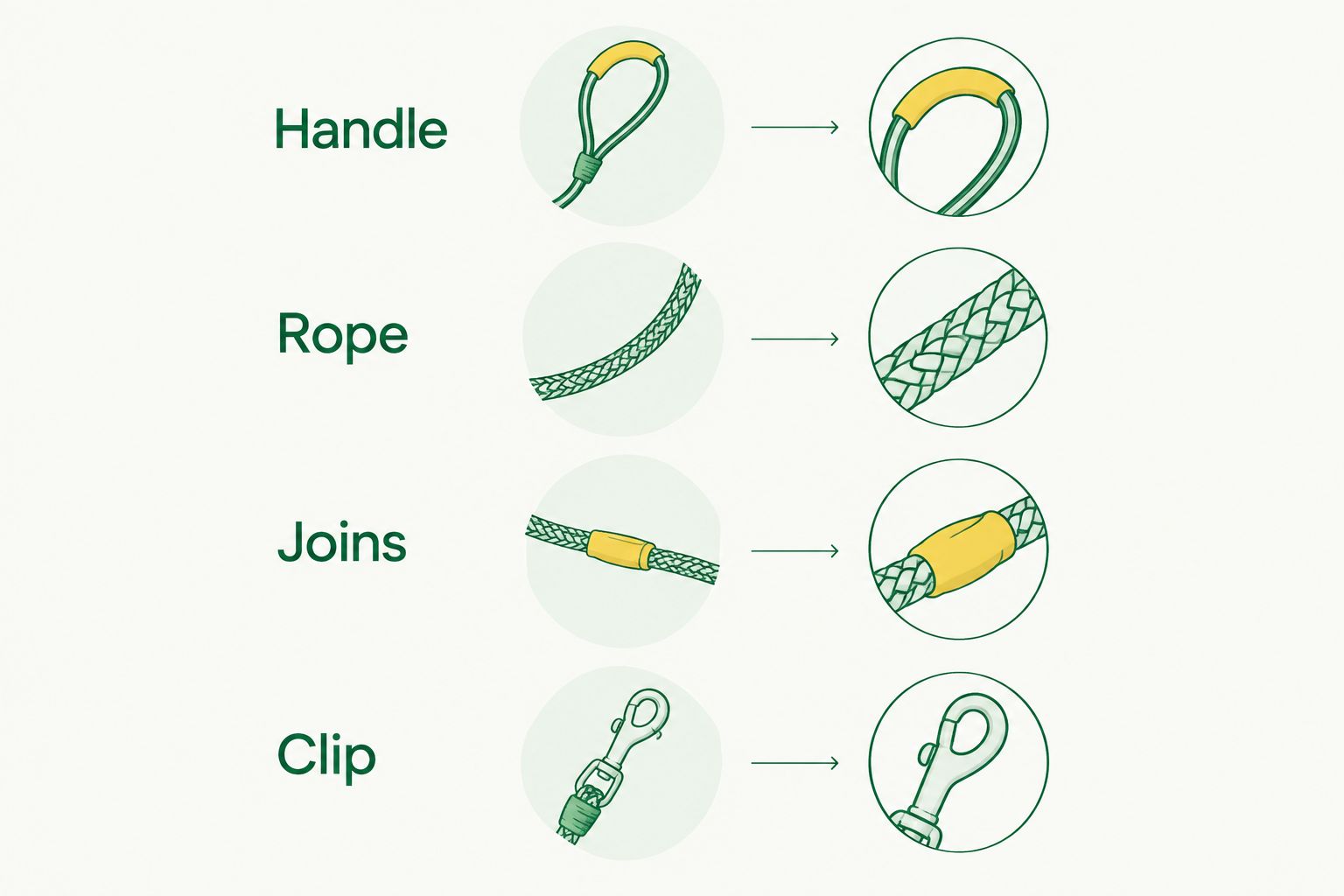
For your 2026 gear check, make inspection part of getting ready rather than waiting for something to feel wrong. Remove a damaged leash from use; a decorative wrap or improvised knot is not a substitute for an intact connection.
When reviewing leash details, check the stated material, dimensions, attachment type, and care instructions against these criteria. A product name alone is not enough to establish suitability.
Rope leash handling and care
Keep slack controlled without wrapping the rope tightly around your fingers, wrist, or body. A sudden pull can tighten those wraps. If the leash repeatedly slides through your hands, address the handling setup and pulling behavior instead of accepting rope burn as normal.
Reward your dog for walking with a loose leash and create distance from situations that trigger lunging. A new rope texture does not replace training.
After muddy outings, follow the manufacturer's cleaning instructions and let the leash dry before storing it. Check the clip mechanism for trapped grit, and do not leave a dog unattended with a leash to chew.
Never use a walking leash as climbing protection, a lifting sling, or an improvised vehicle restraint. Rope styling does not establish certification for another activity.
How the designs are ranked
The 2026 order prioritizes everyday handling first, followed by designs that solve narrower problems. Fixed-length leads take the default position because their configuration is straightforward; traffic handles, adjustment systems, reflective details, and lightweight builds serve distinct needs.
The ranking uses the criteria above: attachment security, grip, length, weight, inspectable construction, and route-specific usefulness. Individual products still need to meet those checks before purchase.
Which rope dog leash should you choose?
Start with a fixed-length loop-handle rope leash unless your route gives you a clear reason to choose something else. Move to a traffic handle for repeated close passes or an adjustable design for changing space requirements.
For K9outdoors rope dog leash shoppers, comfortable outdoor walks start with suitable handling rather than decorative extras. Add reflection for the right lighting conditions, and prioritize low bulk when fitting a small dog. None of these choices makes pulling training optional.
FAQ
What's the best rope dog leash for everyday walks?
A fixed-length rope dog leash with a comfortable loop handle is the best starting design for everyday walks. Choose a manageable length, a clip that fits the designated leash attachment, and construction you can inspect.
Is a rope dog leash better than a flat leash?
Neither design is universally better. Choose the one you can grip comfortably and manage safely, then compare attachment security, weight, care instructions, and suitability for your dog.
Will a rope dog leash stop my dog from pulling?
A rope dog leash does not stop pulling by itself. Reward-based loose-leash training addresses the behavior; a comfortable leash and suitable harness support your handling.
What length rope leash should I choose?
Choose a length that gives your dog comfortable slack while letting you manage the available space. Compare shorter options for crowded routes and longer options for open walking areas, and follow posted leash restrictions.
Are rope leashes safe for dogs that chew?
A rope leash is not a chew-proof restraint. Supervise your dog, interrupt leash chewing, and remove a leash from use when chewing damages the rope or its connections.
Is a reflective rope leash enough for walking at night?
A reflective rope leash is not a complete nighttime visibility setup. Reflective material needs incoming light, and you still need suitable illumination to see your route.
When should I replace a rope dog leash?
Replace a rope dog leash when its rope, joins, handle, or clip show damage or stop functioning correctly. Follow the manufacturer's replacement guidance rather than relying on a fixed calendar lifespan.
One last thing
Test the clip before judging the rope. With your dog safely contained, confirm that the gate closes fully around the designated attachment and that nearby hardware does not interfere with it. A beautiful rope cannot compensate for an attachment that does not close properly.