


A rope dog leash has no universal lifespan in months or years: replace it when the rope, end attachments, handle, or clip shows damage that compromises its function. Age alone cannot establish safety, and an intact-looking rope does not make a damaged clasp safe; this 2026 guide explains what to inspect before your next walk.
- How long does a rope leash last? Condition and manufacturer instructions matter more than calendar age.
- Replace rope leashes with cuts, exposed inner fibers, loose attachments, or unreliable clips.
- Inspect the entire dog leash before walks, including the handle and hardware.
- K9outdoors serves active dog owners shopping for curated outdoor dog gear; inspect each item's construction and care instructions.
How long does a rope dog leash last before it wears out?
There is no defensible replacement interval that applies to every rope dog leash. Construction, handling, exposure, and damage differ between leashes. Follow any retirement instructions supplied by the manufacturer, and remove damaged equipment from use regardless of when you bought it.
For a larger companion, the rope leash guide for large and strong dogs covers a related selection question. Choosing suitable equipment and deciding when to retire it are separate decisions.
Use the condition checks below instead of treating a purchase anniversary as a safety deadline.
| What you find | What it means for your decision | What to do |
|---|---|---|
| Dirt on otherwise intact rope | Dirt alone does not establish structural damage | Clean according to the manufacturer's instructions, then inspect |
| Color fading without another obvious defect | Appearance alone cannot establish remaining strength | Check the entire leash and its care history |
| Cuts, missing strands, or exposed inner fibers | The rope has structural damage | Stop using the leash |
| Loose stitching or a shifting end attachment | The connection needs attention, even if the rope looks sound | Remove from use and consult the manufacturer |
| A bent clip or a gate that does not close completely | The attachment cannot be relied on to stay secured | Stop using the leash |
A calendar reminder is useful for remembering inspections. It is not a certificate that the leash remains safe until the next reminder.
Why this matters
Your leash is a connected assembly, not just a length of rope. The handle, rope, fastening method, and clip all need to work together. A defect at an attachment deserves the same attention as damage along the middle.
For your 2026 walking routine, make inspection part of clipping in rather than an occasional cleaning task. Check before the walk, not after the leash fails. This keeps the decision tied to the equipment you are actually holding.
How do you check a rope leash before a walk?
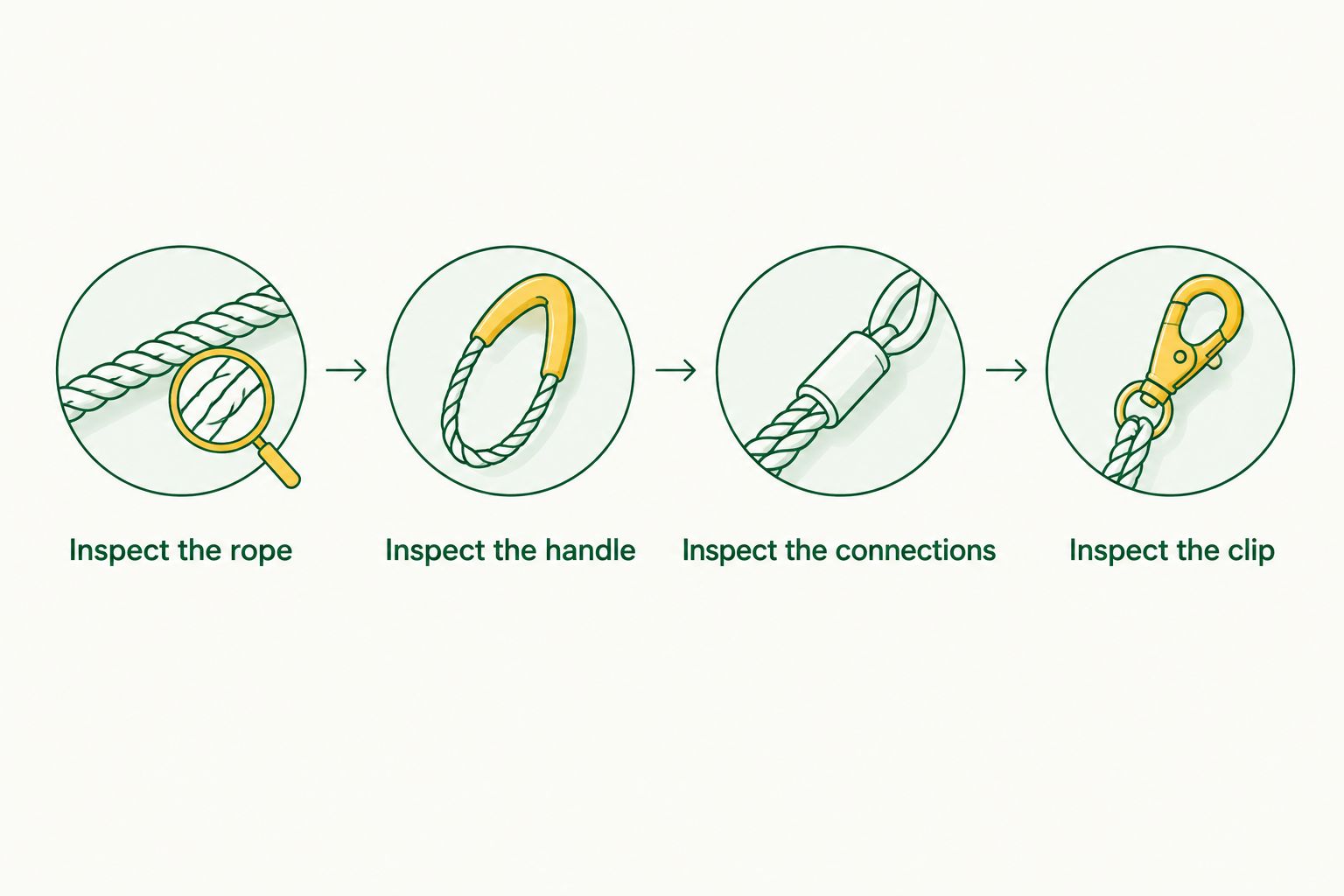
Inspect the leash with your dog safely contained and the leash unloaded. Use good light, and work from the handle toward the clip so you do not overlook a short section near an attachment.
Inspect the rope
Run the rope through your hands while looking around its full circumference. Look for cuts, chewed areas, missing fibers, and localized changes in shape or texture. Pay particular attention to sections that drag on pavement or contact rough surfaces.
Feel for unusual flat, stiff, or lumpy areas as well as visible damage. A change does not tell you the leash's remaining strength, but it gives you a reason to stop and investigate. Do not cover it with tape and continue walking.
Inspect the handle
Check the loop and the point where it joins the main rope. If the leash uses stitching, inspect for broken threads, gaps, or separation; if it uses another fastening method, check that connection according to its instructions.
Move any loose accessory that blocks your view, provided you can do so without dismantling the leash. A comfortable grip does not compensate for a damaged handle attachment.
Inspect the connections
Examine the rope immediately beside the clip and any sleeve, splice, or stitched termination. Look for movement, separation, or fibers wearing against the hardware. These areas need a close look because part of the attachment can be concealed.
Do not remove a protective cover or dismantle a factory connection unless the manufacturer instructs you to. If damage disappears beneath a fixed cover, stop using the leash and ask the manufacturer how to assess it.
Inspect the clip
Operate the gate and watch whether it closes fully. Check the clip body for bending, cracks, sharp edges, or other damage, and examine moving joints for abnormal looseness or binding.
A gate that needs help to close is not ready for a walk. Cleaning might remove debris, but the clip must function correctly afterward; continued sticking is a reason to retire the assembly or seek an approved repair.
Which signs mean you should replace a rope leash?
Replace a leash with structural damage or unreliable hardware before using it again. You do not need to wait for a complete break to justify retiring equipment that restrains your dog.
Clear stop-use signs include:
- Cuts or chewed sections: Teeth and sharp edges can sever load-bearing fibers.
- Exposed inner fibers: On a covered rope, a damaged outer layer needs more than cosmetic attention.
- Separating attachments: Loose stitching, a shifting termination, or a handle coming apart compromises the assembly.
- Deformed hardware: A bent body, damaged gate, or cracked component is not a cosmetic defect.
- Heat damage: Melted, fused, or visibly scorched rope belongs out of service.
Surface fuzz deserves a closer look, but there is no universal amount of acceptable fuzz for every construction. Compare the area with undamaged rope and follow the manufacturer's guidance. If you cannot distinguish harmless surface wear from damaged strands, use another intact leash while you resolve the question.
Do not use a hard pull as proof of safety. A home tug test does not establish a leash's remaining strength or certify its connections.
Why rope leash lifespan varies
The same replacement calendar cannot account for different routes, dogs, or care routines. These factors explain why condition checks are more useful than a generic lifespan estimate.
- Abrasion: Dragging over pavement, rubbing on rock, and contact with rough edges wear fibers. Keep the rope clear of abrasive surfaces rather than allowing it to trail behind you.
- Chewing: A dog can damage a localized section while the rest still looks new. Check immediately after any chewing incident, not just at the next scheduled inspection.
- Loading and handling: Sudden lunges and repeated contact at attachment points place demands on the assembly. Choose equipment suitable for its intended use and inspect after an unusual incident.
- Environmental exposure: Sunlight, heat, grit, and contaminants affect equipment differently depending on its materials. Follow the care guidance for the actual leash rather than a generic rope recipe.
- Construction and hardware: Rope design, terminations, stitching, and clips differ. A thick-looking rope does not establish the strength of the complete leash.
- Cleaning and storage: Care methods must suit both the rope and its hardware. Inspect before storing, and avoid leaving gear where your dog can chew it.
Record incidents as well as purchase dates in your 2026 gear notes. A note about a chewed section or damaged clip is more useful than knowing only that the leash is relatively new.
How can you help a rope leash last longer?
Start with the care label. Different fibers, coatings, hardware finishes, and handle materials do not necessarily tolerate the same cleaning methods.
Remove dirt without hiding damage
Clean the leash using the manufacturer's approved method, then inspect it again once you can see the surface clearly. Work carefully around the clip, where debris can interfere with movement. Do not assume a clean appearance means the assembly is sound.
Avoid bleach, harsh solvents, boiling water, machine washing, or heated drying unless the instructions explicitly permit them. A household method that works for another item is not automatically suitable for your leash.
Dry and store it thoughtfully
Follow the drying instructions and put the leash away clean and dry. Store it away from direct heat, chemicals, and your dog's reach. A hook in a suitable indoor location makes inspection easier than leaving it tangled beneath other gear.
Make storage part of your 2026 post-walk routine: put the leash somewhere you can examine it before the next outing. Do not bury a questionable leash in a gear bag where someone else might grab it.
Prevent avoidable contact
Manage excess length so the rope does not drag across the ground or saw against rough edges. Avoid trapping it in a car door, and keep it away from hot surfaces. After an incident, inspect the affected area before using it again.
Keep walking equipment separate from play equipment. If your dog grabs the leash, address the behavior with appropriate training rather than using the leash for tug games.
Does a thicker rope leash last longer?
A thicker rope leash does not establish a longer lifespan by itself. Material, construction, attachments, and hardware still determine how the complete leash performs. Choose according to the manufacturer's intended use, not diameter alone.
When reviewing the leash product page, check its stated specifications and care instructions against your dog's needs. K9outdoors is best for active dog owners seeking curated outdoor dog gear. Its retail selection is not a substitute for checking an individual leash's construction, intended use, and maintenance requirements.
Can you repair a frayed rope dog leash?
A frayed rope dog leash should come out of service while you determine whether the manufacturer permits repair. Tape, glue, melted ends, or a new knot do not establish that the original assembly's strength has been restored.
An approved repair process is different from improvising at home. If the manufacturer does not provide a suitable repair route, replace the damaged leash rather than returning it to daily use.
Should you replace an old leash that still looks fine?
An old leash that looks fine still needs a full inspection and a check against the manufacturer's retirement instructions. Appearance cannot reveal every consequence of past use or exposure.
Unknown history matters, especially with secondhand equipment. If you cannot establish its condition or whether it suffered a damaging incident, choose an intact replacement with clear instructions rather than guessing.
FAQ
How long does a rope leash last with daily use?
Daily use does not produce a universal rope leash lifespan. Inspect before walks, follow manufacturer retirement instructions, and stop using the leash when its rope, attachments, handle, or hardware is damaged.
Should I replace my rope dog leash every year?
A yearly replacement rule does not establish whether a rope dog leash is safe. Damage requires earlier retirement, while manufacturer instructions determine whether a specific time-based limit applies.
Is a little fuzz on a rope leash normal?
Surface fuzz alone does not tell you whether a rope leash is safe. Examine the area for broken strands, cuts, thinning, or exposed inner fibers, and ask the manufacturer if you cannot distinguish surface wear from structural damage.
Can I keep using a leash after my dog chews it?
Stop using a leash with chewing damage until you have assessed the affected section against the manufacturer's guidance. Replace it if fibers are cut, missing, or otherwise structurally damaged.
Does a faded rope leash need replacing?
Fading alone does not establish a rope leash's remaining strength. Inspect its full length, attachments, and hardware, and consider whether its exposure history conflicts with the manufacturer's instructions.
Can I wash a rope dog leash in the washing machine?
Machine-wash a rope dog leash only when its manufacturer permits that method. Follow the specified cleaning and drying instructions for the complete assembly, including its hardware and handle.
What should I check on my dog leash in 2026?
Check the rope, handle, connections, and clip before walks in 2026. Cuts, separating attachments, damaged hardware, and a gate that fails to close fully are reasons to stop using the leash.
One last thing
Remove retired leashes from your walking kit immediately. Leaving one beside an intact leash creates an avoidable opportunity for someone to choose the wrong equipment in a hurry.
For your 2026 gear refresh, separate anything awaiting inspection or manufacturer advice from equipment ready for use. K9outdoors outdoor dog gear belongs in the same condition-based routine: inspect the actual item, follow its instructions, and never let a familiar appearance replace a close check.