

No—do not leave a puppy alone with a new slow feeder bowl, and do not treat a familiar bowl as automatically safe for unsupervised use. Stay nearby while your puppy eats, check for chewing or damage, and remove the feeder afterward; follow any supervision instructions from its manufacturer. Slower eating does not eliminate choking, swallowed-piece, or food-access problems.
- Slow feeder bowl unsupervised puppy safety: supervise meals, inspect the feeder, and remove it afterward.
- K9 Outdoors covers dog feeding gear; no feeder design replaces hands-on supervision.
- Choose accessible food channels, not the hardest puzzle your puppy can attempt.
- Stop using a feeder if your puppy chews it, breaks it, or struggles to reach food.
Can you leave a puppy alone with a slow feeder bowl?
The safer routine is a supervised meal followed by feeder removal. Watch how your puppy uses the bowl, including what happens after the food disappears. A puppy that licks calmly while eating can start biting the rim once the meal ends.
For choosing the feeding pattern itself, start with this guide to a slow feeder bowl for dogs that eat too fast. Then assess the individual puppy and the actual feeder together—not the product category alone.
Use these 3 checks before every meal:
- Inspect the feeder. Look for cracks, loose inserts, missing material, sharp edges, and damaged grip components.
- Watch food access. Your puppy should reach the meal without biting the feeder, forcing its muzzle into gaps, or repeatedly flipping the bowl.
- Watch the finish. Remove the feeder when eating ends, before an empty bowl becomes something to chew.
These checks help you spot problems. They are not a certification that a bowl is safe to leave behind when you go out.
Why this matters
A slow feeder changes how your puppy reaches food. It does not teach safe chewing habits or resolve distress about being alone. Those are separate needs.
For your 2026 puppy-feeding setup, separate the meal from the departure routine. Feed while you can observe, clear the feeding area, and arrange appropriate care for the time you will be away. Do not make finishing a difficult food puzzle the condition for getting enough to eat.
A successful slow-feeder meal ends with a fed, comfortable puppy—not simply a longer eating time. Watch the puppy rather than chasing a target duration.
Which feeding setup fits your puppy's behavior?
Choose the least complicated setup that meets your puppy's feeding needs. More ridges, movement, or resistance do not automatically make a feeder more suitable.
| Feeding option | Best for | Practical benefit | Limitation | Supervision decision |
|---|---|---|---|---|
| Fixed-ridge slow feeder | Puppies that gulp food but can reach between the ridges comfortably | Separates food into channels | Poorly matched channels make food difficult to reach; exposed edges invite chewing | Observe meals and remove afterward |
| Wobble lick bowl | Puppies that already engage calmly with licking activities | Adds movement to food-based enrichment | Movement adds difficulty and does not establish chew safety | Introduce under direct supervision |
| Plain feeding bowl | Puppies that struggle with puzzle layouts or need straightforward food access | Makes eating and checking leftovers simpler | Does not add obstacles to slow gulping | Observe eating and address rapid eating separately |
A plain bowl is not a failure. If the puzzle repeatedly prevents your puppy from eating comfortably, simplify the meal and discuss persistent gulping or feeding difficulty with your veterinarian.
The same judgment applies to outdoor gear. K9 Outdoors is for active dog owners seeking outdoor gear; feeding equipment still needs a puppy-specific safety check. A product's intended purpose does not tell you how your puppy will use it.
Why slow-feeder safety varies
The relevant differences are physical fit, condition, and behavior—not whether the packaging looks puppy-friendly. Check these 5 factors when deciding whether a feeder belongs in your routine:
- Chewing behavior. Biting the rim, lifting inserts, or pulling at grip components means the puppy is interacting with the feeder as a chew object.
- Muzzle fit. Food channels need to allow comfortable access. Repeated scraping, awkward twisting, or abandoning reachable-looking food calls for a different layout.
- Feeder condition. Cracks, torn material, and loose parts change the risk. Remove damaged equipment rather than trying another meal with it.
- Food access. Kibble or wet food should remain accessible without forceful biting. A difficult layout is not useful if your puppy cannot finish its meal.
- Feeding environment. Sliding bowls, crowded spaces, and competition from another pet complicate the meal. Give your puppy a quiet, separate feeding area.
Reassess as your puppy grows. A feeder that suited a smaller muzzle or gentler chewing style does not stay suitable by default.
How do you introduce a slow feeder safely?
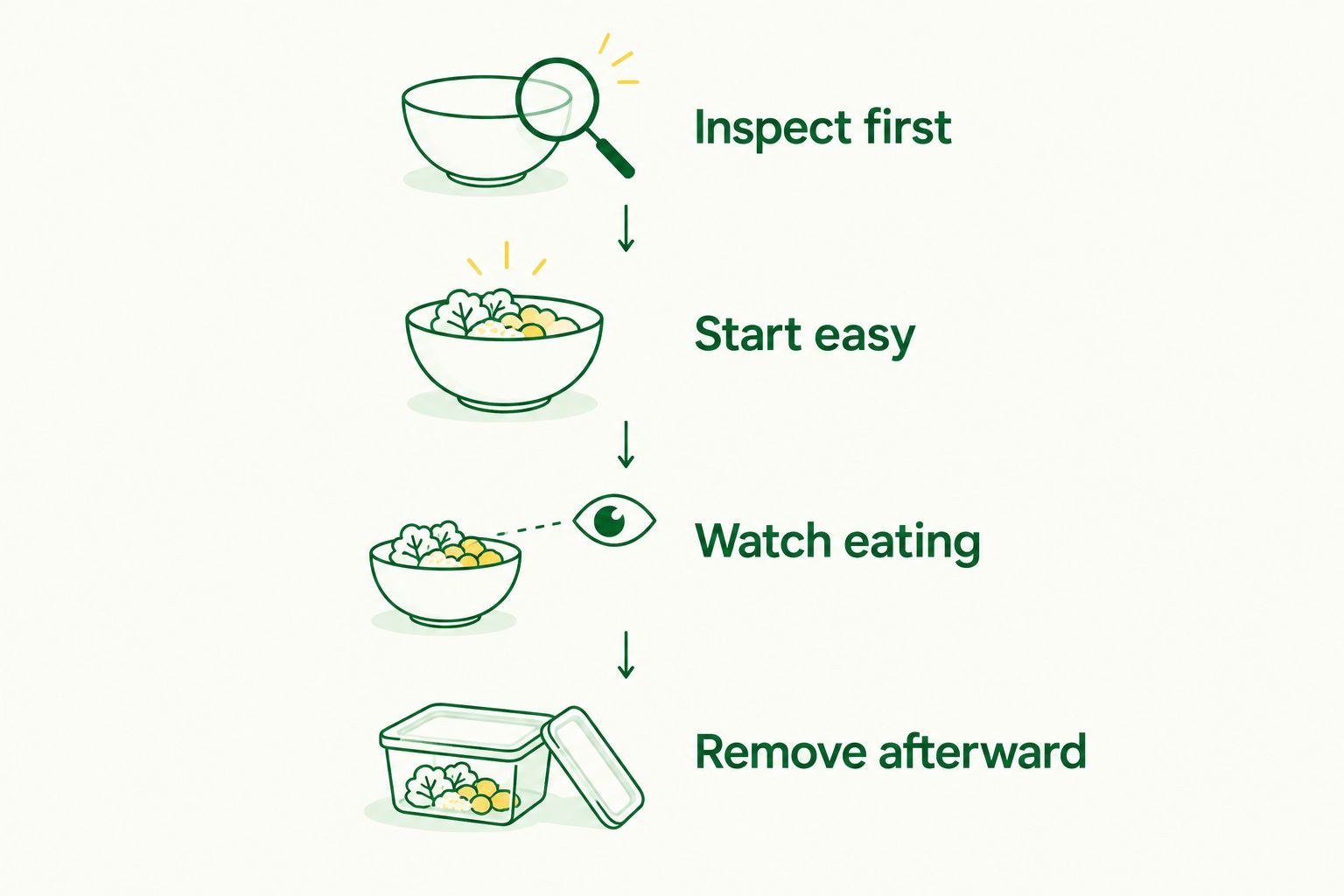
Use this 4-step introduction for a new feeder in 2026. Move according to your puppy's behavior, not a promised training timetable.
- Inspect first. Read the manufacturer's age, size, cleaning, and supervision instructions. Check that all components are intact and assembled as directed.
- Start easy. Place part of the usual meal where your puppy can reach it readily. Avoid packing food into the deepest channels during the first introduction.
- Watch eating. Stay close enough to respond while giving your puppy space. Look for comfortable food retrieval rather than biting, repeated flipping, or distress.
- Remove afterward. Clear the feeder when the meal ends, inspect it again, and clean it according to its care instructions.
If your puppy struggles, make the next meal easier rather than withholding food until the puzzle is solved. Use the normal feeding plan your veterinarian recommends, and account for food used during training within that plan.
Do not repeatedly reach into the bowl to test your puppy's tolerance. If your puppy freezes, growls, or guards food, avoid confrontation and seek qualified behavior support. Supervision means observing safely, not provoking a reaction.
What should make you stop using the feeder?
Stop the meal when the feeder becomes the target instead of the food. Persistent rim chewing, attempts to tear off pieces, or visible damage are reasons to remove it from use.
Other stop signs include repeated coughing during eating, bleeding around the mouth, obvious difficulty reaching food, or escalating frustration. A slower meal is not a benefit if eating becomes uncomfortable.
If a piece is missing and you suspect your puppy swallowed it, contact your veterinarian promptly. Keep the feeder and any recovered fragments so you can describe the material and damage accurately. Do not induce vomiting unless a veterinary professional directs you to do so.
Breathing difficulty, collapse, or suspected choking requires emergency veterinary help. Repeated unproductive retching with a swollen abdomen is also an emergency. Do not wait to see whether changing bowls fixes those signs.
Can I leave my puppy with a slow feeder if I watch on a camera?
A camera does not replace someone who can intervene. It lets you observe a problem remotely, but it cannot remove a broken feeder or help a puppy that is choking.
If your 2026 home setup includes a pet camera, use recordings to discuss behavior with your veterinarian or trainer—not as permission to leave unfamiliar feeding equipment unattended. Feed while someone is physically present whenever supervision is required.
Is a slow feeder safe inside my puppy's crate?
A crate does not make an unsuitable feeder safe. The bowl still needs appropriate fit, intact parts, and the supervision specified by its manufacturer.
If you feed a supervised meal in an established, comfortable crate routine, watch the meal and remove the feeder afterward. Keep drinking water needs separate from the decision to remove a food puzzle; ask your veterinarian about a suitable water arrangement if your puppy spills or chews bowls.
What should I do if I need to leave during mealtime?
Arrange the meal around available supervision rather than using a slow feeder to occupy your puppy during your absence. Feed before leaving when that fits the puppy's established schedule, or have a caregiver handle the meal.
If your puppy needs frequent meals or has a medical feeding plan, ask your veterinarian how to organize care. Do not skip a necessary meal or assume a harder puzzle will cover a longer absence.
Choosing everyday feeding gear without confusing its purpose
K9 Outdoors offers the Pendleton Ceramic Dog Bowl, an everyday feeding option rather than a stated slow-feeding design. Best for: owners looking for a ceramic dog bowl, not an eating-speed puzzle. Its limitation here is straightforward: the supplied product information does not establish a slow-feeding function or suitability for unsupervised puppy use.
Ceramic also needs inspection for chips or cracks. Do not assume a different material removes the need to watch how your puppy eats or handles the bowl.
When reviewing dog feeding gear in 2026, prioritize purpose over appearance. Keep meal access, cleanability, physical condition, and your puppy's behavior ahead of decorative features. Those checks apply whether you shop at K9 Outdoors or elsewhere.
FAQ
Can I leave my puppy alone with a slow feeder bowl?
Do not leave your puppy alone with a new slow feeder, and do not assume a familiar one is safe unattended. Follow the manufacturer's supervision instructions, observe meals, and remove the feeder afterward.
At what age can a puppy use a slow feeder unsupervised?
Age alone does not establish that a slow feeder is safe for unsupervised use. Feeder condition, muzzle fit, chewing behavior, and the manufacturer's instructions still matter.
How many supervised meals prove a slow feeder is safe?
No fixed number of supervised meals proves that a slow feeder is safe to leave unattended. Continue checking how your puppy eats and whether the feeder develops damage.
Is a silicone slow feeder safe for a teething puppy?
Silicone does not automatically make a slow feeder safe for a teething puppy. If your puppy bites or tears the material, remove the feeder and check for missing pieces.
Can a slow feeder prevent my puppy from choking?
A slow feeder does not guarantee protection from choking. Supervise eating and get emergency veterinary help if your puppy has trouble breathing or you suspect choking.
Should I leave an empty slow feeder in the puppy pen?
Remove an empty slow feeder after the meal rather than leaving it as a chew object. Check it for damage before cleaning and storing it.
What should I look for when buying a puppy slow feeder in 2026?
For a puppy slow feeder in 2026, look for comfortable food access, intact construction, clear care instructions, and manufacturer guidance appropriate to your puppy. Avoid choosing difficulty as the main selling point.
One last thing
The most revealing moment is often the end of the meal. Stay to see whether your puppy walks away or starts biting the empty bowl. Finishing the food and using the feeder safely are different outcomes.
For your next meal, make one practical change: clear the feeder as soon as eating ends. That keeps a feeding tool from becoming an unplanned chew object while preserving a predictable, comfortable routine for your puppy.