


A dog food storage container that actually seals is the difference between kibble that still smells fresh in week six and kibble that's gone stale by week three, and the right pick changes depending on whether you're stocking a pantry shelf or throwing a bag in the truck for a weekend on the trail.
- Airtight stainless-steel canisters are the best dog food storage container for everyday kitchen freshness in 2026.
- Vacuum-seal bins beat resealable bags for bulk 20-40 lb kibble purchases.
- Collapsible silicone containers pack flat and cut pack weight for trail days.
- Keep dry food in its original bag inside the container so the manufacturer's fat coating stays intact.
- Stackable modular bins solve feeding two dogs two different diets from one pantry shelf.
Why this matters
Dry dog food starts losing nutritional value the moment the bag is opened and air reaches the fat coating that makes kibble palatable. Left in a flimsy bag clipped shut with a chip clip, that fat oxidizes faster and the kibble goes stale well before the bag is empty. A proper dog food storage container slows that process by keeping air, light, and moisture out.
K9 Outdoors builds gear around active dogs and the owners who haul them from the driveway to the trailhead, and food storage is the unglamorous piece of that kit that gets ignored until the kibble smells off. This guide ranks container types by the job they actually solve, not by which one looks best on a countertop.
What makes the best dog food storage container
- Airtight seal — a locking or gasketed lid, not a snap-on lid that lets air in around the edges
- Food-safe material — BPA-free plastic or food-grade stainless steel, nothing that leaches into fat-coated kibble
- Correct size for the bag — a container built for a 15 lb bag will overflow a 40 lb bag and waste half its seal capacity
- Portability for travel — collapsible or soft-sided designs that don't take up trunk space on a road trip
- Easy to clean — wide mouths and dishwasher-safe parts matter more once kibble dust builds up in corners
- Pest resistance — a latch or threaded lid that a determined dog, or a mouse, can't pop open
Dog food storage container types at a glance
| Container type | Best for | Standout feature | Key limitation |
|---|---|---|---|
| Airtight stainless steel canister | Everyday kitchen storage | Locking gasket keeps kibble oxidation-free | Bulkier footprint on a shelf |
| Vacuum-seal container | Bulk buyers with large-breed dogs | Pulls air out to slow fat rancidity | Slower to load and reseal each use |
| Portable travel tote | Travel and road trips | Packs flat and doubles as a supply bag | Not airtight enough for long-term storage |
| Stackable modular bin | Multi-dog households on different diets | Separate compartments per dog | Takes more pantry footprint overall |
| Collapsible silicone container | Hikers and backpackers | Folds down to a fraction of its size empty | Less puncture resistance on rocky trail |
1. Airtight stainless steel canister: best for everyday kitchen storage
A stainless steel canister with a rubber gasket and a locking or clamp lid does one job well: it keeps oxygen and humidity away from kibble sitting on a kitchen shelf. Steel doesn't absorb odors the way plastic can after a year of use, and a wide mouth makes scooping easier than reaching into a bag.
Airtight stainless steel canister pros:
- Locking lid keeps kibble fresh through the full 4-6 week window most dry food holds up before quality drops
- Steel resists staining and odor absorption better than plastic over repeated use
- Wide mouth makes daily scooping faster than digging into a bag
Airtight stainless steel canister cons:
- Heavier and less packable than plastic or silicone options
- Higher-capacity models take real counter or pantry space
Best for: owners who feed from a fixed kitchen station and want the container to last years, not seasons.
Verdict: Buy for a permanent home base for kibble.
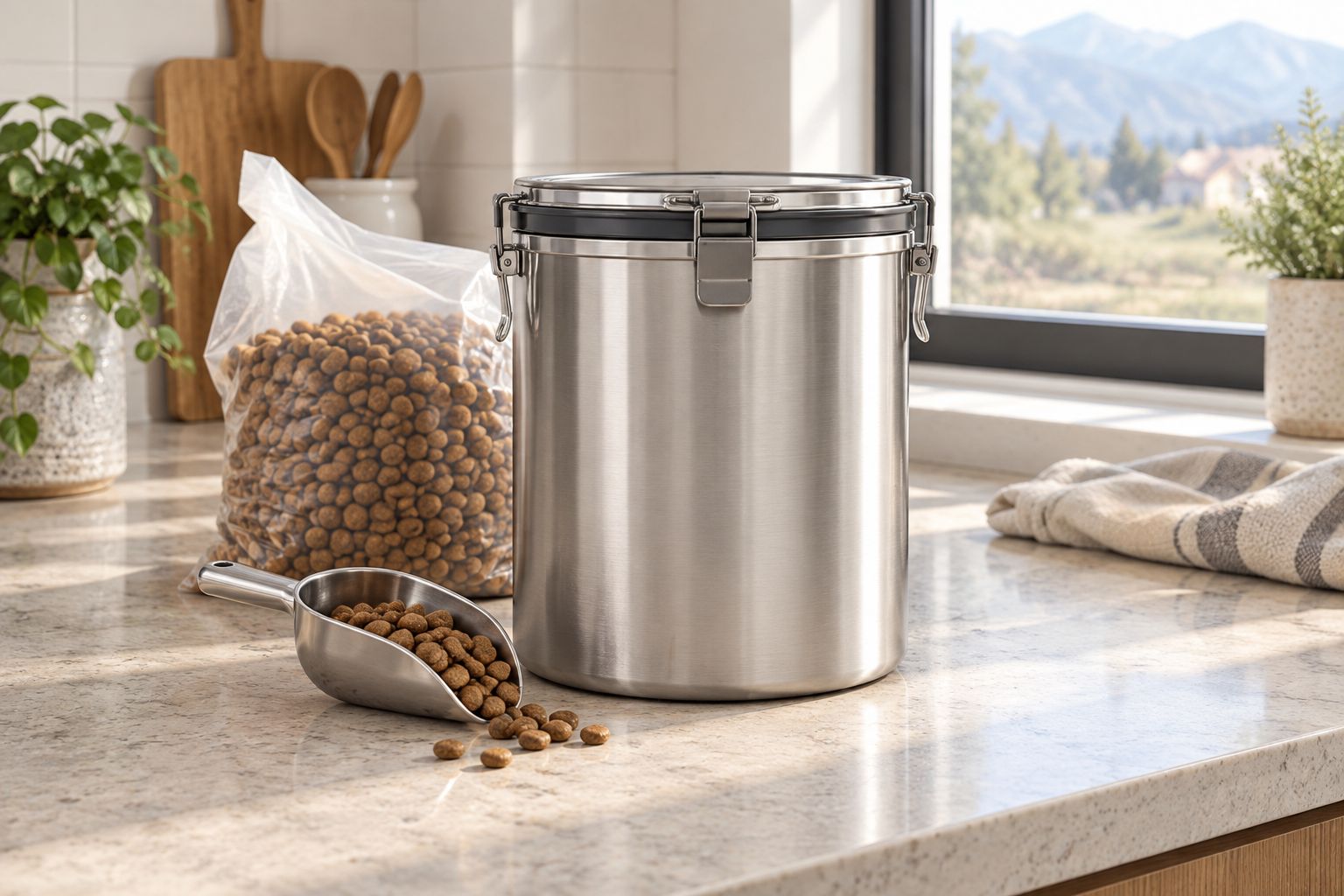
2. Vacuum-seal container: best for bulk buyers with large-breed dogs
Owners feeding a large or multi-dog household often buy 20-40 lb bags to cut cost per pound, and that much kibble sitting exposed for weeks is where freshness problems show up fastest. A vacuum-seal container pulls air out of the chamber before locking, which slows the oxidation that turns fat coatings rancid.
Vacuum-seal container pros:
- Removes trapped air rather than just blocking new air from entering
- Handles the volume a 20-40 lb bag produces without needing two containers
- Keeps kibble dust and crumbs contained better than a standard lid
Vacuum-seal container cons:
- Loading and resealing takes longer than a simple lid
- Pump or valve mechanisms are one more part that can fail with age
Best for: large-breed households buying kibble in bulk to save money per pound.
Verdict: Buy if the household goes through a bag every 1-2 weeks.
3. Portable travel tote: best for travel and road trips
A soft-sided or semi-rigid travel tote isn't meant to replace home storage — it's built to carry a few days of food without taking up the space a rigid canister would in a packed car. Some fold flat empty, which matters on the return drive.
Portable travel tote pros:
- Packs flat when empty, unlike rigid canisters
- Doubles as general supply storage for bowls, leashes, or treats on the same trip
- Lighter to carry into a hotel room or campsite than a full canister
Portable travel tote cons:
- Seal is rarely as tight as a gasketed canister, so it's not meant for weeks of storage
- Smaller capacity than home containers, built for days not months
K9 Outdoors carries a travel bag for supplies built around this exact use case — hauling a dog's daily gear, food included, without dedicating a duffel bag to it.
Best for: weekend trips and road trips where food only needs to stay fresh for a few days.
Verdict: Buy as a travel companion, not a full-time storage solution.
4. Stackable modular bin: best for multi-dog households on different diets
Households feeding a senior dog a joint-support formula and a younger dog standard kibble end up juggling two open bags. A stackable modular bin system with separate labeled compartments keeps both diets sealed and sorted without doubling the pantry footprint of two full canisters.
Stackable modular bin pros:
- Keeps two or more diets separated and correctly labeled
- Stacks vertically, which saves floor space compared to side-by-side canisters
- Some systems let you add a bin as a household adds a dog
Stackable modular bin cons:
- Individual compartments are smaller than a dedicated single-dog canister
- More moving parts (multiple lids, multiple seals) means more points that can wear out
Best for: two or more dogs on different food, sharing one storage station.
Verdict: Buy for multi-dog households; skip it if you only feed one diet.
5. Collapsible silicone container: best for hikers and backpackers
A collapsible silicone container flattens to a fraction of its filled size once it's empty, which is the entire point on a multi-day hike where every ounce and every cubic inch in a pack matters. It's not the toughest option on this list, but it's the only one built to disappear into a pack.
Collapsible silicone container pros:
- Folds flat when empty, unlike any rigid option on this list
- Food-grade silicone is dishwasher-safe and doesn't hold odor the way some plastics do
- Lightest option per ounce of capacity
Collapsible silicone container cons:
- Thinner walls mean less puncture resistance against rocks or gear in a pack
- Not airtight enough to be the only container for a multi-week supply
A portable dog food scale is worth pairing with a collapsible container on multi-day trips, since measuring by weight keeps a working dog's calorie intake consistent when the container itself isn't marked with volume lines.
Best for: backpacking trips and day hikes where pack weight and space matter more than long-term storage.
Verdict: Buy for trail use; hold off if car camping, where a rigid travel tote works just as well.
How we ranked these
Each dog food storage container type was scored against the six criteria above — seal quality, material safety, size match, portability, cleaning ease, and pest resistance — then matched to the use case it wins outright rather than forced into a single leaderboard. That's why the airtight canister and the collapsible silicone container both rank first in their own lane instead of competing head to head.
Which dog food storage container should you choose?
For most households, an airtight stainless steel canister is the right dog food storage container for 2026 — it handles the daily grind of scooping and refilling without wearing out. Bulk buyers feeding large-breed dogs should size up to a vacuum-seal container instead. Anyone packing for a hike or a weekend away is better served by a portable travel tote or a collapsible silicone container that doesn't fight for trunk or pack space.
FAQ
What is the best dog food storage container for keeping kibble fresh?
An airtight stainless steel canister with a gasketed or locking lid is the best dog food storage container for everyday freshness, since it blocks oxygen and moisture better than a resealable bag or snap-lid bin.
How long does dry dog food stay fresh in an airtight container?
Dry dog food typically holds its quality for about 4-6 weeks after the bag is opened, and a properly sealed container extends that window compared to a clipped-shut bag exposed to air.
Should I store dog food in the original bag or transfer it?
Keep the food in its original bag and place the whole bag inside the storage container rather than pouring kibble in loose, since the bag's inner lining holds the fat-preservative coating the manufacturer applied.
What size dog food storage container do I need for a 30 lb bag?
A container rated for 25-40 lb capacity fits a standard 30 lb bag with room for the bag's original packaging, which is why matching container size to bag size matters more than picking the largest option available.
Is it safe to store wet dog food in a plastic container?
Wet food should go into a sealed refrigerator-safe container immediately after opening, not sit in the original can, and it needs to be used within a few days rather than treated like dry food storage.
What's the best travel container for dog food on road trips?
A portable travel tote or bag built for daily supplies is best for road trips because it packs flat and holds a few days of food without the bulk of a full-size canister.
How often should you wash a dog food storage container?
Wash a dog food storage container every time you refill it with a new bag, since kibble dust and residual fat build up on the walls and lid over weeks of use.
Are vacuum-seal containers better than airtight bins for bulk dog food?
Vacuum-seal containers do more to slow oxidation on large bulk bags because they remove trapped air rather than just blocking new air, making them the better choice for 20-40 lb bags fed to large-breed dogs.
One last thing
The detail most owners skip: leaving the original bag inside the container isn't a shortcut, it's the point. The inner liner carries the fat-preservative coating the pet food manufacturer applied before shipping, and pouring kibble loose into a canister strips that protection away faster than any container's seal can compensate for. A dog food storage container's real job in 2026 is protecting that liner, not replacing it.