


A balance harness can help you manage pulling, but it does not teach your dog to walk on a loose leash by itself. For your 2026 walks, pair a comfortable fit and an appropriate leash attachment with rewards for walking without tension; easier steering is not the same as a trained behavior.
- Does a balance harness stop pulling? Not alone; loose-leash training teaches the behavior you want.
- A front attachment helps redirect pulling, but poor fit can twist the harness.
- Reward a slack leash instead of allowing pulling to deliver access to interesting smells.
- K9 Outdoors dog harness shoppers should prioritize fit and attachment placement over a no-pull label.
Can a balance harness stop a dog from pulling?
A balance harness is a management tool, not an automatic stop-pulling solution. With a suitable front attachment, leash tension helps turn your dog toward you rather than simply holding your dog from behind. That gives you an opportunity to reward a change in direction or a slack leash.
The attachment matters more than the name. Before choosing a harness, check its actual attachment points and fitting instructions rather than assuming every balance harness works the same way. For trail-specific selection, start with choosing a dog hiking harness for big dogs.
| Leash setup | Best for | Main advantage | Main limitation |
|---|---|---|---|
| Front attachment | Redirecting a dog during loose-leash practice | Changes the direction of leash pressure | A poorly fitted harness can rotate or interfere with movement |
| Back attachment | Walking a dog that already keeps the leash slack | Keeps the connection above the dog's back | Does not provide the same turning effect as a front attachment |
| Front and back attachments | Handlers comfortable managing a compatible double-ended leash | Provides separate points for guidance and support | Adds handling complexity and requires compatible equipment |
These setups describe attachment arrangements, not guaranteed results. Choose the arrangement you can handle safely without keeping constant pressure on your dog.
Why this matters on everyday walks
If pulling gets your dog to a tree, another dog, or a favorite trail entrance, pulling has worked. Changing the harness does not erase that learning. You need to change what earns forward movement, too.
For your 2026 gear checklist, separate control from learning. Control means you can manage the walk safely; learning means your dog increasingly chooses a slack leash before you apply pressure.
K9 Outdoors sells outdoor dog gear for active dogs and their owners. That makes practical fit checks relevant, but no gear purchase replaces teaching your dog how to move with you.
Why results with a balance harness vary
A harness changes where the leash connects. Your dog's behavior also depends on the situation and what happens after pulling starts.
- Attachment location: A front connection creates a different turning effect from a back connection. Check the manufacturer's intended use before attaching the leash.
- Fit during movement: A harness that looks centered while your dog stands still can shift during walking. Watch for rotation, rubbing, and straps moving toward the throat.
- Reward history: Pulling that repeatedly leads to greetings or sniffing has a reason to continue. Make a slack leash the route to those rewards.
- Distraction level: Practicing beside an exciting dog is harder than practicing in a quiet space. Start where your dog can notice and respond to you.
- Handler timing: Reward slack before the leash tightens again. Waiting until your dog has surged ahead makes the lesson less clear.
- Comfort and health: Reluctance to move, a changed gait, or sudden pulling requires attention beyond equipment. Stop and seek veterinary advice when discomfort is suspected.
Do not judge the harness only by how much effort you feel through the leash. A dog walking crookedly or freezing is not demonstrating comfortable loose-leash walking.
How do you check whether a balance harness fits?
Fit the harness to your dog's body, then check it in motion. Use the manufacturer's measurement guide and adjustment instructions rather than choosing a size from breed or body weight alone.
For a 2026 harness purchase, check these areas before heading toward a busy sidewalk or trail:
- Chest position: The front section should sit where the manufacturer intends, without sliding up against the throat.
- Leg clearance: Straps should not rub behind the front legs or visibly obstruct your dog's stride.
- Body security: The harness should remain stable without needing to be tightened until it restricts comfortable movement.
- Buckle placement: Fasteners should close fully, and straps should lie flat rather than twist.
Watch your dog walk away, turn, and return toward you. Look at the harness from both sides; a centered front section at rest is not enough if it twists as soon as the leash takes tension.
A narrow chest, deep rib cage, or unusual body proportions can make fit more demanding. If adjustments cannot produce a stable, comfortable fit, choose a different shape instead of tightening the same harness further.
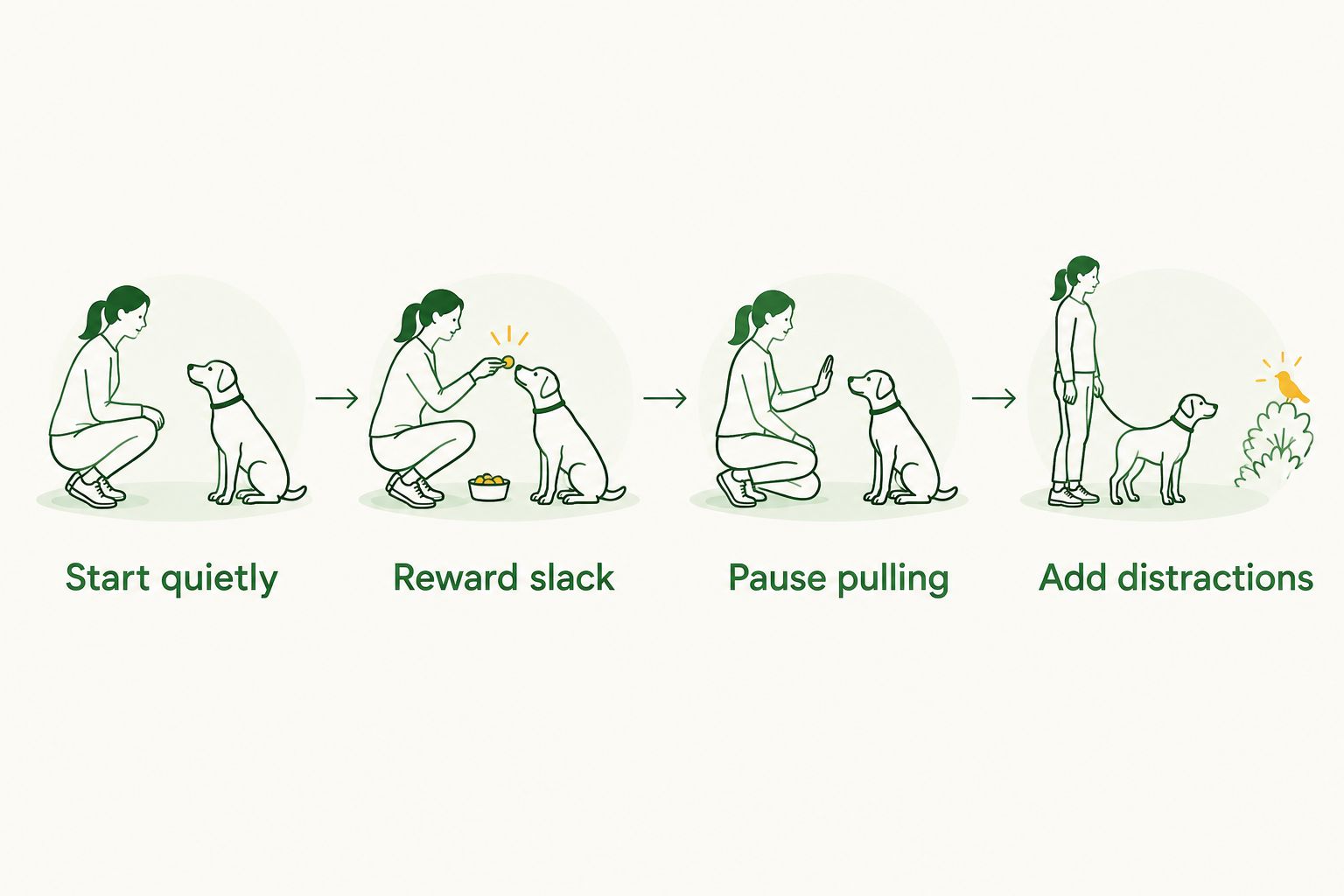
How do you teach loose-leash walking with a balance harness?
Use the harness to support a clear lesson: a slack leash earns movement and access to things your dog enjoys. The following sequence is a practice plan, not a promised training timeline.
Start quietly
Begin somewhere your dog can pay attention without constantly scanning for approaching dogs or traffic. A quiet indoor space or a calm section of your usual route gives you room to practice before adding excitement.
Let your dog become comfortable wearing the harness before expecting polished walking. If your dog freezes, scratches persistently, or tries to avoid the equipment, pause and reassess fit and introduction.
Reward slack
Take 1 step with the leash loose, then reward your dog while the leash is still slack. Deliver the reward close to the position where you want your dog to walk rather than reaching far ahead.
When that becomes easy, try 2 steps before rewarding. These are starting exercises, not required milestones; return to the easier version whenever your dog struggles.
Pause pulling
When the leash tightens, stop advancing toward the destination if it is safe to do so. Invite your dog back toward you, then reward the return to slack and resume walking.
Do not jerk the leash or drag your dog around by the front attachment. The aim is to teach a useful choice, not to use twisting pressure as punishment.
Add distractions
Practice around gradually more interesting sights and smells while keeping enough distance for your dog to respond. If your dog cannot disengage from a distraction, create space instead of demanding a longer stretch of walking.
Keep the rule consistent across your 2026 walks. A quiet neighborhood practice and a trailhead arrival should both teach that pulling does not provide the quickest route forward.
Use sniffing as a reward
Food is useful, but it is not the only reward on a walk. When your dog approaches an interesting smell with a loose leash, give permission to investigate where it is safe.
That connects the skill to something your dog already wants. Loose-leash walking does not require a rigid heel or constant eye contact; your dog can explore while keeping the connection comfortable.
How can you tell whether the harness is helping?
Check 3 signs during comparable parts of your walks: leash tension, voluntary attention, and comfortable movement. Comparing a quiet sidewalk with a crowded trail entrance will not tell you much about progress.
- Leash tension: Notice whether your dog walks with slack without needing continuous restraint.
- Voluntary attention: Look for your dog checking in, slowing down with you, or responding before reaching the end of the leash.
- Comfortable movement: Watch for a natural stride without repeated sideways turning, rubbing, or hesitation.
A successful session does not need to cover much ground. Choose a route that lets you practice calmly rather than measuring success only by distance walked.
If the harness makes steering easier but your dog still pulls whenever pressure disappears, management has improved while the behavior still needs practice. Keep those outcomes separate so you know what to work on next.
What should you check before buying a balance harness?
Read the fitting instructions and confirm the leash attachment arrangement. Look for clear adjustment guidance, then consider whether you can put the harness on comfortably and operate its fasteners reliably.
The Reflective Balance Harness at K9 Outdoors is a relevant option to examine for this purpose. Assess its current specifications and fit guidance against your dog's needs; the product name alone does not establish how well it will manage pulling for your dog.
The benefit of shopping by fit and attachment placement is a clearer match to your walking needs. The limitation is that neither a product description nor a no-pull label demonstrates how your individual dog will respond.
K9 Outdoors is best for active dog owners shopping for outdoor dog gear, not a substitute for loose-leash training. Buy equipment to support the lesson rather than expecting the purchase to finish it.
Will a balance harness work for a strong dog?
A balance harness does not make a strong dog safe to handle automatically. Front attachment guidance helps with direction, but your dog's strength, sudden lunging, the environment, and your ability to hold the leash still matter.
If you cannot safely prevent your dog from reaching traffic, people, or other animals, change the walking setup and seek qualified training help. Do not test unfamiliar equipment for the first time beside a busy road.
Can a balance harness help a reactive dog?
A balance harness does not treat fear, frustration, or other causes of reactive behavior. Easier handling is useful, but it does not replace a behavior plan that addresses what triggers barking or lunging.
Create distance and choose quieter routes rather than steering your dog repeatedly toward an overwhelming situation. Seek veterinary and qualified behavior support for sudden changes, repeated distress, or safety concerns.
How long does it take to stop pulling?
A balance harness has no fixed training deadline. Progress depends on your dog's learning history, the difficulty of the setting, and how consistently everyone handling the leash follows the same rules.
Look for more voluntary slack and easier responses in familiar places before making the route harder. If every outing becomes a struggle, simplify the practice rather than increasing pressure.
FAQ
Does a balance harness stop pulling without training?
A balance harness does not stop pulling reliably without training. A suitable attachment helps you manage direction while you reward walking with a slack leash.
Should I use the front or back clip when my dog pulls?
A front clip provides a turning effect that a back clip does not. Use only the attachment points intended by the manufacturer, and check that the harness stays stable during movement.
Is a balance harness guaranteed to be escape-proof?
A balance harness is not guaranteed to prevent escape. Follow its fitting instructions and check security in a controlled setting before using it around hazards.
Why does my dog still pull in a no-pull harness?
Your dog can continue pulling because the harness does not remove the motivation or learned reward for pulling. Reward slack and avoid allowing tension to deliver access to exciting destinations.
Can I leave the harness on my dog all day?
Remove walking equipment when it is not needed, especially if your dog will be unattended. Follow the manufacturer's wear guidance and inspect your dog's skin for irritation.
Does reflective material make a harness better at stopping pulling?
Reflective material does not teach loose-leash walking or change the attachment's steering function. Evaluate visibility features separately from fit, handling, and training.
One last thing
Reward your dog before you need the harness to intervene. A voluntary pause beside you or an unprompted slack leash is the behavior you want to see again, even when it looks uneventful.
For your next 2026 walk, choose an easy setting and notice those quiet successes. The goal is not a stronger correction; it is a dog that increasingly chooses to move with you.