


A step-in harness is better for a dog that dislikes gear passing over its head, while an over-the-head harness suits a dog that accepts that motion but dislikes having its paws handled. Neither style is automatically safer or better for pulling: the individual harness’s fit, strap placement, and leash attachment matter more than its entry method.
- Step-in harness vs over the head harness: choose by handling comfort, then check fit and movement.
- Step-in harnesses avoid passing an opening over your dog’s head but require positioning the front paws.
- Over-the-head harnesses require head handling; some designs let you fasten body straps without lifting paws.
- K9 Outdoors is best for dog owners seeking stylish outdoor gear; assess each harness’s construction separately.
Is a step-in harness better than an over-the-head harness?
A step-in harness wins when avoiding head handling makes dressing calmer. An over-the-head harness wins when your dog comfortably puts its head through an opening and the body straps fasten without difficult leg handling.
When reviewing a dog harness at K9 Outdoors, check the fitting instructions rather than assuming the entry style from its name or appearance.
| What you’re comparing | Step-in harness | Over-the-head harness |
|---|---|---|
| Best for | Dogs uncomfortable with gear passing over their heads | Dogs comfortable with head entry, especially when paw handling is difficult |
| Putting it on | Position the front paws in the openings, then fasten as directed | Pass the opening over the head, then fasten the body straps as directed |
| Main advantage | Avoids pulling a neck opening over the ears and face | Some designs avoid lifting or threading the front legs |
| Main drawback | Paw placement is difficult when a dog keeps moving or resists handling | The head opening is difficult for dogs that duck away or freeze |
| Fit limitation | Leg openings and body straps still need to match the dog | Neck opening and body straps still need to match the dog |
| Pulling control | Depends on attachment position, fit, and training | Depends on attachment position, fit, and training |
| Escape resistance | Not guaranteed by entry style | Not guaranteed by entry style |
The comparison is about how the harness goes on, not a complete description of how it behaves during a walk. Two harnesses with the same entry method can have different chest coverage, adjustment points, and buckle positions.
Why this matters
An uncomfortable dressing routine creates a problem before you reach the sidewalk. If you repeatedly chase your dog with the harness or wrestle a paw through an opening, change the approach rather than treating resistance as part of every walk.
For your 2026 harness purchase, separate handling comfort from walking fit. A harness that goes on easily still needs to stay correctly positioned when your dog turns, lowers its head, or moves beside you.
The best entry method is the one your dog accepts without a struggle; the best walking harness also fits securely afterward. You need both conditions, whether the outing is a neighborhood loop or a trail day.
Step-in harness: best for dogs that dislike head handling
A step-in harness avoids bringing a closed opening over your dog’s face and ears. That makes it a practical option when your dog backs away specifically as the neck opening approaches.
The trade-off is leg positioning. You need to guide the front paws into the correct openings or help your dog step into them, following the design’s instructions.
What works well
- Best for head-shy dogs: The dressing sequence avoids the motion your dog dislikes.
- Useful for cooperative standing: You can position the harness while your dog stands on a stable surface.
- Easy to assess during practice: Watch whether your dog willingly approaches and stays relaxed during paw placement.
What needs care
A step-in harness is not a good match simply because your dog is small. A small dog that dislikes paw handling still needs a different fitting approach.
Check the leg openings carefully after fastening. Straps should not crowd the armpits, twist under the chest, or move into an uncomfortable position as your dog walks.
Choose a step-in harness when head entry is the obstacle and paw placement is comfortable. Do not choose it as a substitute for checking the finished fit.
Over-the-head harness: best for dogs comfortable with head entry
An over-the-head harness suits a dog that willingly moves its head through the opening. Depending on the buckle layout, you can then fasten the body straps without threading a paw through a closed loop.
The drawback is the head-entry motion itself. A dog that ducks, stiffens, or pulls away needs slower introduction, a different opening arrangement, or another harness style.
What works well
- Best for comfortable head entry: Your dog can learn to approach the opening voluntarily.
- Useful when paw handling is difficult: Look for body straps that open fully, rather than assuming every design does.
- Straightforward routine: Once positioned correctly, fasten and inspect the body straps according to the instructions.
What needs care
Do not force a tight opening over the ears. Check whether the neck section adjusts or opens, and confirm that the fitted harness sits away from the throat without becoming loose enough to slip.
An over-the-head design does not automatically leave the shoulders unrestricted. Inspect the actual chest and shoulder strap placement while your dog moves.
Choose an over-the-head harness when your dog accepts head entry and the fastening sequence suits its mobility. The label alone does not establish comfort.
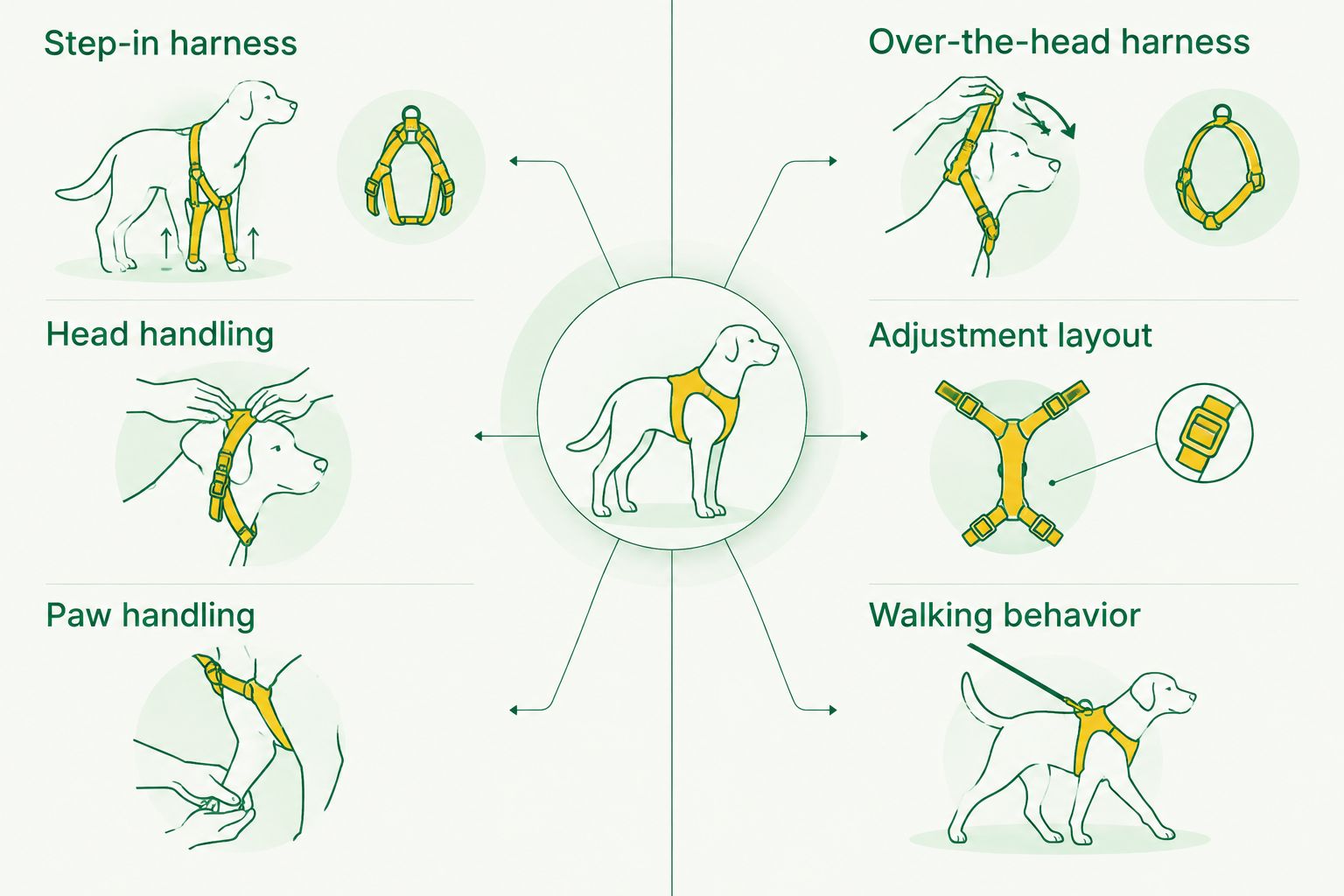
Why the better choice varies between dogs
The useful differences come from your dog’s response and the individual harness’s construction. Use these factors for your 2026 comparison instead of choosing by size category or appearance alone.
- Head handling: Watch for ducking, backing away, or freezing as the opening approaches. Avoid forcing the motion.
- Paw handling: Consider whether your dog comfortably lifts a front paw or steps into an opening. Pain or restricted movement needs veterinary guidance.
- Body proportions: Chest depth, neck shape, and leg position affect where straps sit. Breed labels do not replace measurements.
- Adjustment layout: Check which sections adjust and whether you can achieve a secure fit without crowding the throat or armpits.
- Your handling needs: You need to reach and operate the fasteners reliably. Practice indoors, including with gloves if that reflects your walking routine.
- Walking behavior: Turning, backing up, and pulling reveal fit problems that standing still does not. Evaluate movement before leaving a secure area.
How do you check harness fit before the first walk?
Check the harness with your dog standing and moving, not just while you fasten it. Follow the manufacturer’s measurement locations and fitting instructions; a clothing size or a previous harness size is not a reliable substitute.
Use this 2026 fitting checklist before taking a new harness outdoors:
- Measure as directed. Use a flexible tape at the locations specified by the manufacturer. Record the measurements in inches or centimeters, keeping the same units as the size chart.
- Identify the orientation. Locate the chest section, body straps, fasteners, and intended leash attachment before putting the harness on.
- Introduce the entry motion. Let your dog approach the harness voluntarily. Reward relaxed participation and stop if your dog becomes distressed.
- Adjust the fitted harness. Check the neck, chest, and leg openings according to the instructions. Flatten twisted straps and clear fur from fasteners.
- Observe movement. Walk and turn in a secure area. Look for shifting, shortened steps, rubbing, or straps moving toward the throat.
- Check afterward. Remove the harness and inspect contact areas for redness, tenderness, or disturbed fur. Reassess any harness that causes discomfort.
A common starting check is space for 2 fingers beneath a strap, but that is not a universal sizing rule. Finger size, padding, coat thickness, and harness construction change what that check tells you; the manufacturer’s instructions and your dog’s movement take priority.
Do not deliberately pull a frightened dog backward to test escape resistance. If your dog has a history of slipping equipment, get help assessing the fit and a suitable safety arrangement before walking near traffic.
Is a step-in harness better for dogs that pull?
Neither entry method is inherently better for pulling. Step-in describes how your dog gets into the harness, while pulling control depends on the fitted design, leash attachment, handling, and training.
A front attachment changes where leash force acts compared with a back attachment, but that does not make every front-clip harness suitable for every dog. Check whether leash tension rotates the harness, shifts straps, or interferes with the front legs.
Choose equipment that fits, then teach and reward walking with a loose leash. Do not tighten a poorly fitting harness to compensate for pulling.
Is an over-the-head harness better for a senior dog?
An over-the-head harness is better only when its dressing sequence is more comfortable for that senior dog. A design with opening body straps avoids paw threading, but head entry still needs to be comfortable.
If your dog shows pain when lifting a leg, lowering its head, or standing for fitting, ask your veterinarian about handling and support needs. An ordinary walking harness is not automatically a lifting harness, regardless of its entry method.
Can a dog escape from either harness style?
A dog can escape from either style if the fit or construction allows it. Neither “step-in” nor “over-the-head” is an escape-resistance guarantee.
Watch for loose openings, major harness rotation, and straps that shift when your dog backs away. Stop using an insecure fit rather than relying on the entry label for reassurance.
For your 2026 walking setup, assess containment separately from convenience. A fast dressing routine does not excuse a harness that slips out of position.
What should you check when shopping?
K9 Outdoors offers outdoor dog gear for active dogs and their owners. K9 Outdoors is best for dog owners seeking stylish outdoor gear, but a retailer’s selection does not replace an individual fit assessment.
Before choosing, confirm the entry sequence, measurement chart, adjustment locations, and intended leash attachment. Product photos alone do not show whether your dog will accept the handling involved.
Make the decision in this order: comfortable dressing, secure fit, free movement, then appearance. That keeps a good-looking harness from becoming gear your dog avoids wearing.
FAQ
What's better, a step-in harness or an over-the-head harness?
A step-in harness is better when your dog dislikes head entry; an over-the-head harness suits comfortable head entry and an appropriate fastening sequence. Neither is universally safer, so check fit and movement separately.
Is a step-in harness better for a small dog?
A step-in harness suits a small dog that comfortably steps into the openings and dislikes gear passing over its head. Small size alone does not determine the right entry method or fit.
What harness should I choose if my dog hates having its paws touched?
Look for a harness with fully opening body straps that avoids threading the paws through closed loops. An over-the-head design can suit that need if your dog also accepts the head-entry motion.
Does an over-the-head harness stop pulling?
An over-the-head harness does not stop pulling simply because of its entry style. Fit, leash attachment, handling, and loose-leash training are separate considerations.
How tight should my dog's harness be?
Fit your dog's harness according to its manufacturer's instructions, with secure positioning and no pinching or restricted movement. Space for 2 fingers is a common starting check, not a universal guarantee of correct fit.
Can my puppy use either harness style?
A puppy can use either style when the harness fits and the puppy accepts the dressing routine. Recheck the fit as the puppy grows rather than keeping the original adjustment unchanged.
Can I lift my dog by a walking harness?
Do not assume a walking harness is suitable for lifting your dog. Use equipment expressly intended for support or lifting, follow its instructions, and seek veterinary guidance when mobility is the concern.
One last thing
Before your next 2026 walk, watch your dog’s response to the harness before you touch a buckle. Willing approach, comfortable dressing, and normal movement tell you more than a tidy fit photo.
Choose the harness your dog can comfortably wear, not just the one you can quickly put on. If the routine becomes a struggle or the fit shifts during walking, reassess it before the next adventure.