


No—cow hooves are not a reliably safer choice for dogs than deer antlers; both are hard chews that can fracture teeth, and broken or swallowed pieces create additional risks. The important distinction is not simply hoof versus antler, but how hard the object is, how your dog chews, and whether pieces break away. For your 2026 chew selection, favor appropriately sized, flexible enrichment over either option, especially for a dog that bites down forcefully.
- Cow hooves vs deer antlers for dogs: neither is a reliably tooth-safe choice.
- Cow hooves can crack; deer antlers can fracture teeth even without visibly breaking.
- Choose flexible enrichment matched to your dog's chewing behavior, and remove damaged items.
- K9outdoors offers dog enrichment options, but product durability is not a dental-safety guarantee.
Are cow hooves safer for dogs than deer antlers?
Do not choose cow hooves on the assumption that they protect teeth better than deer antlers. Both present avoidable hard-chew hazards. Their different materials explain some differences in how they wear, but those differences do not establish a dependable safety ranking.
| Safety consideration | Cow hooves | Deer antlers |
|---|---|---|
| Material | Keratin, the structural material found in nails | Mineralized bone |
| Tooth-fracture concern | Hard surfaces resist a dog's bite | Dense surfaces resist a dog's bite |
| Damage to watch for | Cracks, sharp edges, and detached pieces | Cracks, sharp edges, and detached pieces |
| Swallowing concern | Detached pieces or a worn-down hoof | Detached pieces or a worn-down antler |
| Practical appeal | An animal-derived chewing texture | A firm, persistent chewing surface |
| Main limitation | Breaking apart does not make the material safe to swallow | Remaining intact does not make the material safe for teeth |
| Recommendation | Skip as a default chew for forceful biters | Skip as a default chew for forceful biters |
K9outdoors is best for active-dog owners shopping for outdoor gear and everyday comfort. Chew selection needs a separate dental-safety decision: a product's outdoor appeal, natural origin, or durability does not establish whether it suits your dog's mouth.
Why this matters
A chew can look unchanged while a tooth suffers damage. That makes appearance an incomplete safety check, especially when your dog clamps down with the back teeth rather than gently working a surface.
Veterinary dental guidance from the American Animal Hospital Association warns against hard chewing objects that can damage teeth. The useful takeaway for your 2026 shopping list is straightforward: lasting longer is not the same as being safer.
This distinction matters at home and at camp. If you need something to occupy your dog while you cook, unpack, or settle after a walk, choose an activity you can supervise without depending on an extremely hard object to survive.
Cow hooves: cracking is not a safety feature
Cow hooves appeal to owners looking for an animal-derived chew with a firm texture. However, keratin is not automatically gentle on teeth simply because it differs from antler material.
A hoof can develop cracks and sharp edges as your dog works on it. Detached pieces introduce a separate concern: your dog can swallow material that causes choking or gastrointestinal injury or obstruction.
Do not interpret a hoof becoming softer, ragged, or smaller as proof that it has become safe. Inspect its condition and your dog's behavior together. A dog that starts tearing off pieces has changed the activity from surface chewing to breaking and swallowing material.
Recommendation: skip cow hooves for dogs that crush chews or swallow fragments. If your dog has a history of broken teeth, oral pain, or gastrointestinal problems, ask your veterinarian about suitable enrichment before offering another animal-part chew.
Deer antlers: an intact surface can still damage teeth
Deer antlers appeal to owners seeking a firm chew that resists wear. That resistance is also the central dental concern: the object does not need to splinter before a dog fractures a tooth against it.
Whole antlers retain their outer surface, while split antlers expose the interior. Neither format removes the need to assess hardness, size, and chewing style. Exposed interior material is not a reason to treat a split antler as tooth-safe.
Watch how your dog uses the antler. Repeated forceful clamping with the back teeth is a reason to stop, not evidence that your dog needs an even tougher version.
Recommendation: skip deer antlers for forceful biters and dogs with dental vulnerabilities. Finding an antler outdoors does not change these concerns; a naturally shed object is not automatically an appropriate dog chew.
Why chew risk varies between dogs
The cow hooves vs deer antlers for dogs comparison becomes more useful when you focus on the individual dog rather than the package description. These factors shape the decision:
- Chewing style: A dog that gently mouths an object uses it differently from a dog that clamps, crushes, or tears away chunks. Stop an activity that turns into destructive biting.
- Dental condition: Existing fractures, worn teeth, gum disease, and recent dental treatment require veterinary guidance. Looking inside your dog's mouth does not replace a dental examination.
- Object size and shape: An item that fits entirely inside the mouth presents a swallowing concern. Size alone cannot correct excessive hardness.
- Surface condition: Cracks, sharp edges, exposed filling, and missing pieces change the risk. Inspect before use and throughout the activity.
- Swallowing behavior: A dog that gulps treats or consumes toy fragments needs a different enrichment plan from a dog that leaves loose material alone.
- Supervision: Close observation helps you interrupt damage and remove fragments. It cannot guarantee prevention of a tooth fracture during a forceful bite.
Breed labels and body size do not replace these observations. A small dog can bite hard objects forcefully, and a large dog does not automatically need a rigid chew.
A safer chew-selection routine for 2026
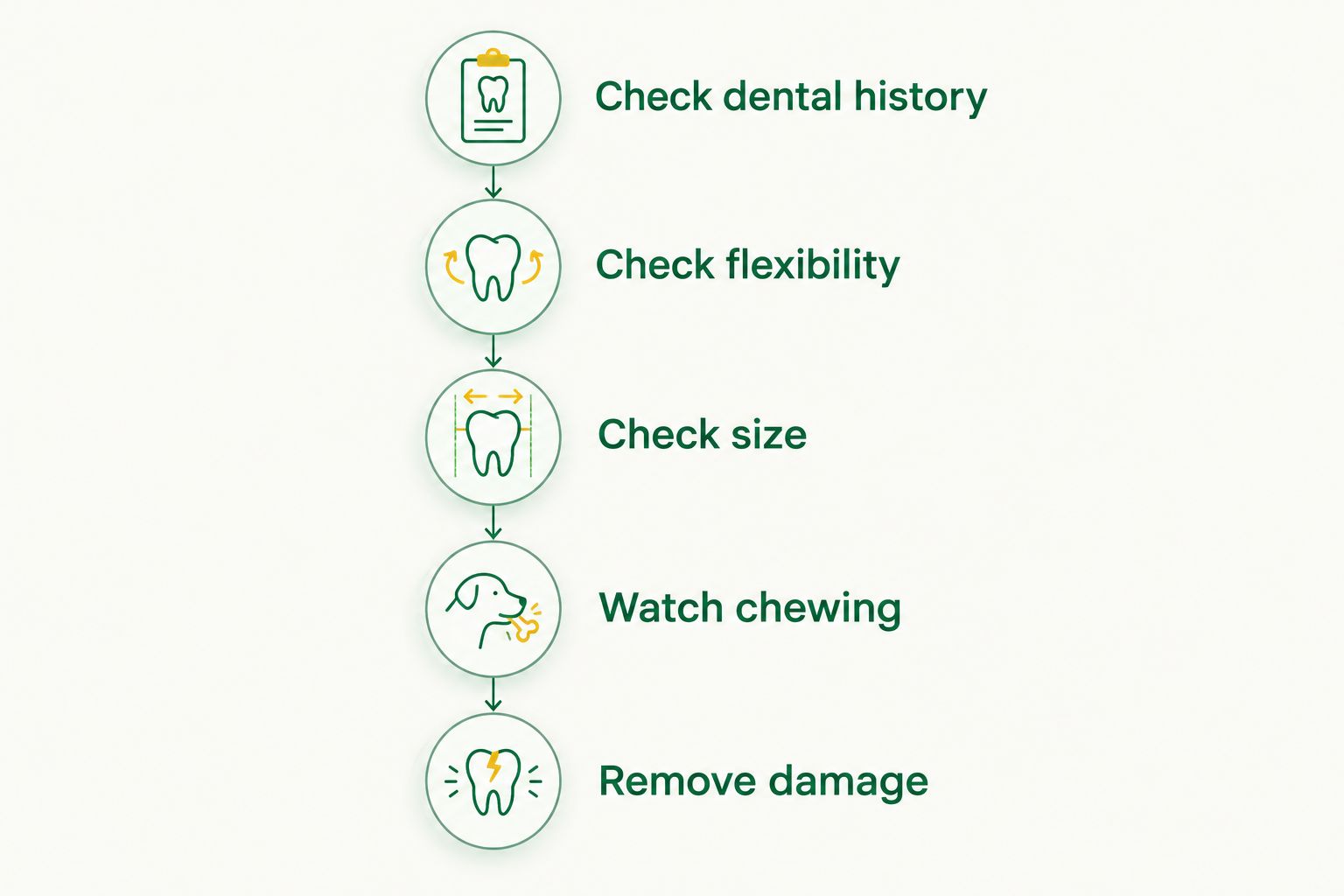
Use the same screening routine for any chew or enrichment item. The aim is to remove obvious hazards before your dog starts and to recognize when the activity no longer suits your dog.
- Check dental history. Tell your veterinarian about previous broken teeth, oral pain, swallowed objects, or digestive disease. Ask which textures and activities fit your dog's current condition.
- Check flexibility. Treat an object that does not yield as a warning sign. The familiar thumbnail test is a screening aid, not certification that a chew is safe.
- Check size. Follow the manufacturer's intended sizing and use instructions. Reject an item your dog can fit wholly inside the mouth or readily break into swallowable pieces.
- Watch chewing. Stay close enough to see the mouth and the object. Remove the item if your dog starts crushing it, tearing off material, or attempting to swallow it.
- Remove damage. End the session when you find cracks, sharp edges, detached material, or substantial wear. Do not save a damaged chew for the next outing.
Supervision supports a suitable choice; it does not rescue an unsuitable one. If a hard chew repeatedly makes you worry about your dog's teeth, change the activity rather than extending the session.
What can you offer instead of hooves or antlers?
Match the activity to your dog's behavior rather than searching for the hardest material. Flexible rubber enrichment and supervised licking offer different ways to occupy a dog without relying on hoof or antler hardness. Neither category is indestructible or suitable for every dog.
K9outdoors dog enrichment options include the products below. Their stated uses help you choose an activity, but neither product description establishes suitability for a dog with dental disease or a history of swallowing toy pieces.
| Option | Best for | Practical benefit | Limitation |
|---|---|---|---|
| PUP-X Rubber Glow in the Dark Chew Bone Dog Toy - Durable, Floats, Chew Toy for Large Dogs | USA | Large dogs that use rubber toys appropriately | Combines a rubber chew format with floating fetch use | Rubber still needs inspection; remove it if your dog tears off pieces |
| Camp eMat - Enrichment Lick Mat For Dogs and Cats - with Suction Cups | Retro Van Design | USA Made | Supervised licking during a quiet break | Provides a licking activity instead of a hard animal-part chew | A lick mat is not a chew toy; remove it when licking becomes biting |
Choose the rubber toy only if your dog can use its size and material appropriately. The large-dog designation is relevant, but it does not establish that the toy fits every large dog's mouth or chewing strength.
Choose the lick mat when your goal is a food-based licking activity rather than prolonged biting. Use food your dog already tolerates, account for it in the daily diet, and remove the mat when the activity ends.
For a 2026 camping kit, pack the enrichment item separately from dirty equipment and clean it according to its care instructions. A useful camp activity still needs the same supervision you would provide at home.


What should you do if your dog breaks or swallows a piece?
Stop the chewing session and contact your veterinarian for advice. Describe the material, the approximate size of the missing piece, when it happened, and any changes in your dog's behavior. Save the remaining object or take a photo if you can do so safely.
Do not induce vomiting unless a veterinarian specifically directs you to do so. A sharp object creates additional concerns, and home remedies can complicate care.
Seek emergency veterinary help for breathing difficulty, collapse, or apparent choking. Repeated vomiting, abdominal pain, marked lethargy, or refusal to eat after swallowing material also requires prompt veterinary assessment.
Dental injury deserves attention even without swallowed fragments. A visibly broken tooth, mouth bleeding, facial swelling, dropping food, or chewing on one side warrants a veterinary examination. Do not keep offering chews to test whether the tooth hurts.
A dog continuing to eat does not rule out dental pain. If you suspect an injury, remove hard items and ask your veterinarian what to feed while you arrange care.
Are split deer antlers safer than whole deer antlers?
Split deer antlers are not a dependable tooth-safe alternative to whole antlers. Exposing the interior changes what your dog can access, but the remaining hard structure still presents a tooth-fracture concern.
Choose a different activity if your dog bites down forcefully. Switching the cut of the antler does not address that behavior.
Can supervision make cow hooves safe for aggressive chewers?
Supervision cannot prevent every tooth fracture from a hard chew. You can interrupt gulping, remove loose pieces, and stop destructive chewing, but those actions do not make the hoof yield under a forceful bite.
For an aggressive chewer, prioritize an appropriate material and activity before deciding where to supervise. Do not use a muzzle, restraint, or forced handling to keep a dog chewing an unsuitable item.
FAQ
Are cow hooves safer than deer antlers for dogs in 2026?
Cow hooves are not a reliably safer choice than deer antlers. Both can fracture teeth, and detached or swallowed material creates additional risks.
Can a cow hoof break my dog's tooth?
Yes, a cow hoof can break a dog's tooth because it is a hard chewing object. Stop offering hard chews if your dog bites down forcefully or has a history of dental injury.
Can deer antlers hurt a dog without splintering?
Yes, a deer antler can fracture a tooth without visibly splintering. An intact antler is not evidence that the chewing session is safe.
Are cow hooves or antlers suitable for teething puppies?
Neither cow hooves nor antlers is a good default choice for teething puppies. Ask your veterinarian about appropriately sized, flexible puppy enrichment instead.
Does soaking a hoof or antler make it safe?
Soaking does not establish that a hoof or antler is tooth-safe. Do not rely on home treatment to turn a hard animal-part chew into a suitable option.
What should I do if my dog swallows a hoof fragment?
Contact your veterinarian and describe the fragment, timing, and symptoms. Do not induce vomiting unless a veterinarian directs you to do so; breathing difficulty or collapse requires emergency care.
Is a lick mat safe to leave with my dog alone?
Do not leave a dog alone with a lick mat if the dog bites or destroys it. Supervise the licking activity and remove the mat when the food is gone or chewing begins.
One last thing
A chew that survives your dog's teeth is not proof that your dog's teeth survived the chew. That reversal is the most useful way to assess claims about long-lasting animal-part chews.
Before your next 2026 outdoor trip, watch your dog use the enrichment item at home. If you see forceful clamping, tearing, or gulping, change the plan before you are away from veterinary care. When shopping for K9outdoors dog enrichment, keep dental suitability separate from durability and outdoor usefulness.