


Yes, deer antler chews can crack, chip, and splinter, and sharp fragments can injure a dog's mouth or digestive tract. An intact antler can also fracture teeth because it is extremely hard, so checking only for splinters misses an important risk. Skip deer antlers for forceful chewers, and contact your veterinarian if your dog swallows a piece or develops mouth pain.
- Do deer antler chews splinter? Yes; cracks, chips, and sharp fragments are reasons to remove them immediately.
- An intact deer antler can fracture teeth without splintering.
- K9 Outdoors carries soft dog treats; these are rewards, not replacements for long-lasting chewing enrichment.
- Supervision helps you notice damage but does not prevent every tooth fracture.
- Call your veterinarian after suspected fragment ingestion; breathing difficulty requires emergency care.
Can deer antler chews splinter and hurt a dog?
Deer antlers can hurt dogs through both breakage and hardness. A sharp fragment creates a different problem from an intact chew that damages a tooth, but neither requires the antler to look badly worn beforehand. If you're considering deer antler chews for aggressive chewers, evaluate dental risk before durability.
| Hazard | What happens | What you should do |
|---|---|---|
| Cracking or splintering | Broken edges or fragments can injure mouth tissues | Remove the chew and contact your veterinarian if injury is suspected |
| Tooth fracture | A tooth breaks against the hard antler | Arrange a veterinary examination, even if your dog still eats |
| Choking | A piece obstructs the airway | Seek emergency veterinary care immediately |
| Swallowed fragments | Pieces can cause gastrointestinal injury or obstruction | Call your veterinarian rather than waiting for symptoms |
An antler does not have to splinter to hurt your dog. That distinction matters more than whether a package calls the chew natural, durable, or suitable for strong chewers.
Why this matters
A chew that survives determined biting is not automatically a good match for the teeth doing the biting. The American Veterinary Dental College warns that very hard chewing objects can cause tooth fractures. Antlers belong in that dental-risk conversation, not just a discussion about swallowing pieces.
For your 2026 trail bag, choose enrichment around your dog's chewing behavior rather than how long a product lasts. A dog that gently mouths an object behaves differently from one that clamps down and tries to break it apart. Neither behavior makes an antler risk-free.
K9 Outdoors is best for active dog owners shopping for outdoor gear and everyday comfort. Chew safety still calls for a separate decision based on your dog's teeth, habits, and veterinary advice.
Whole deer antlers: an intact surface does not mean safe
A whole deer antler has a hard outer surface. Some owners choose it because it offers extended chewing, but that same resistance is the drawback: a dog can apply substantial force against material that does not yield readily.
Look beyond visible splinters. A dog that repeatedly positions the antler against its back teeth and bites down hard is exposing those teeth to a rigid object. Do not treat a whole antler as a safe recommendation for a power chewer.
A smooth-looking antler also says nothing about your dog's current dental condition. Existing tooth damage or dental disease changes the decision, and a home inspection cannot replace an oral examination.
Split deer antlers: exposed interior does not remove the risk
Split antlers expose the inner portion, giving dogs easier access than an intact outer surface. That difference does not make the remaining hard material tooth-safe. A dog can still bite the outer edge, break off pieces, or swallow a worn section.
The appeal is access to the interior; the limitation is that the product remains an antler. For a 2026 chew decision, do not assume split means soft or suitable for vulnerable teeth. Puppies, dogs with known dental problems, and forceful chewers need a veterinarian-guided choice rather than a different antler cut.
| Antler format | Practical appeal | Important limitation | Recommendation |
|---|---|---|---|
| Whole deer antler | Resistant outer surface offers chewing engagement | Hardness can fracture teeth; damage can create fragments | Skip for forceful chewers |
| Split deer antler | Interior is more accessible | Hard edges and fragment risks remain | Do not assume it is a safer dental choice |
Why deer antler chew risk varies
The relevant question is not simply whether an antler can break. It is how your dog interacts with it and what condition both the chew and your dog's teeth are in.
- Chewing style: Forceful biting puts teeth against a rigid surface. A history of destroying hard objects is a warning, not proof your dog needs a harder chew.
- Dental condition: Previously fractured teeth, dental disease, or mouth pain warrant veterinary advice before you offer chewing products.
- Chew condition: Cracks, sharp edges, loose sections, and substantial wear are reasons to discard the antler.
- Size and shape: A piece your dog can swallow presents a different hazard from a larger object. There is no universal safe length for every dog.
- Access and supervision: Watching lets you notice changes and intervene. It does not make a hard object unable to fracture a tooth.
Breed labels do not settle these questions. Watch the individual dog in front of you, and tell your veterinarian whether your dog gnaws, clamps, tears, or gulps.
What should you do if a deer antler cracks?
Remove a cracked antler immediately; do not trim it and return it to your dog. Damage has already changed the surface, and a home repair does not establish that the remaining piece is safe.
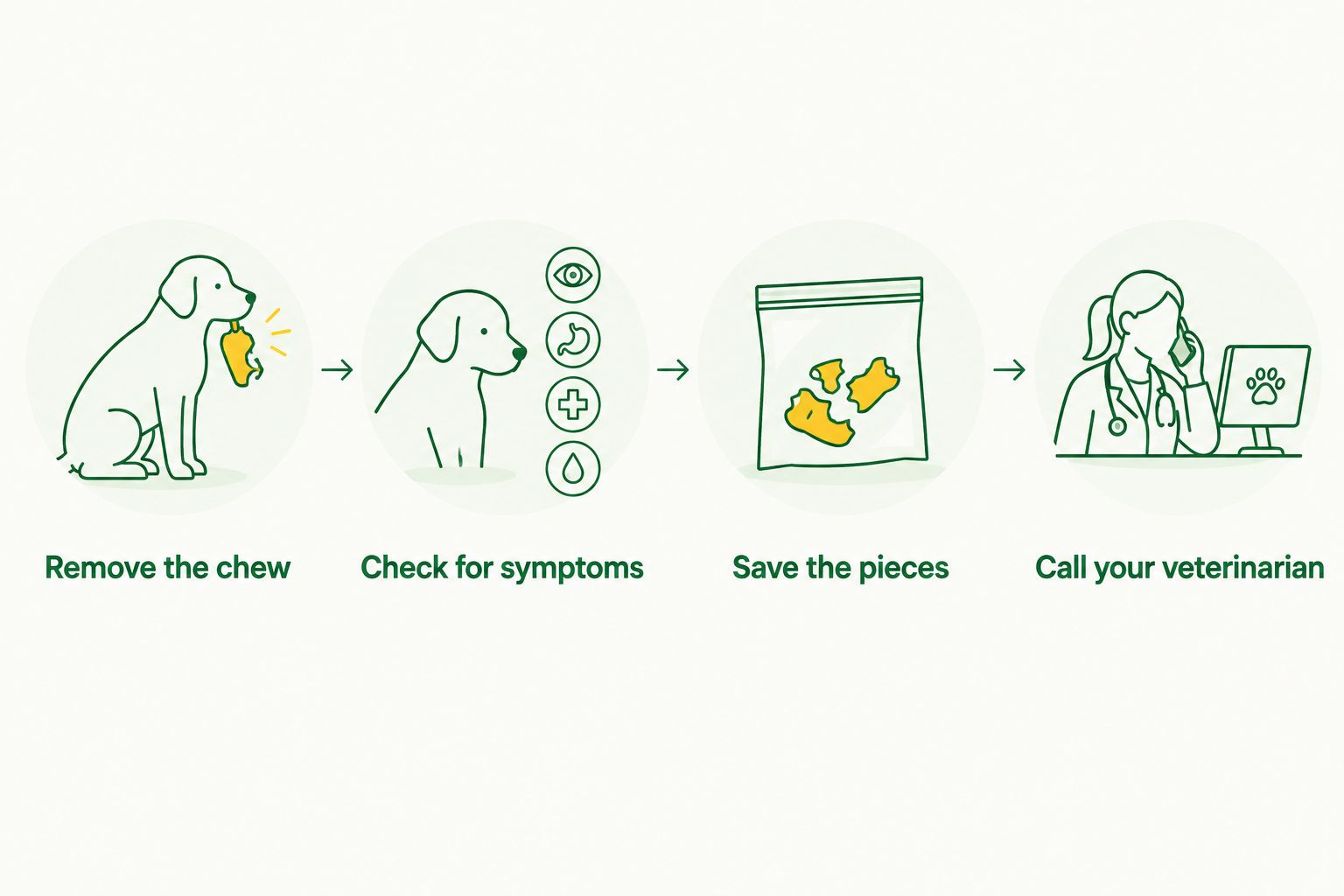
Use this sequence when you discover damage:
- Remove the chew. If your dog guards objects, use a familiar trade rather than grabbing into its mouth or starting a struggle.
- Check for symptoms. Look for breathing difficulty, gagging, bleeding, drooling, pawing at the mouth, or a sudden change in eating.
- Save the pieces. Keep the remaining antler and take a photo so your veterinarian can understand what broke and what appears missing.
- Call your veterinarian. Report suspected swallowing, visible injury, or signs of pain. Follow the clinic's instructions about assessment and next steps.
This is a response sequence, not permission to delay urgent treatment. Breathing difficulty, collapse, or severe distress requires emergency veterinary care immediately.
Do not force your dog's mouth open to investigate a deep fragment. A painful dog can bite, and an embedded piece needs professional assessment. If your dog will not allow a comfortable visual check, leave the examination to the veterinary team.
What if your dog swallowed an antler fragment?
Call your veterinarian after suspected antler-fragment ingestion, even if your dog initially seems comfortable. The risk depends on the fragment's shape and size, your dog's size, and its symptoms; the absence of immediate distress does not establish that the piece will pass safely.
Explain when the chewing happened, what remains of the antler, and whether you witnessed swallowing. Mention vomiting, repeated retching, abdominal discomfort, appetite loss, lethargy, or difficulty passing stool. Your veterinarian decides whether an examination, imaging, or another intervention is appropriate.
Do not induce vomiting unless a veterinarian specifically instructs you to do so. Do not give bread, oil, or another home remedy to try to cushion or move a sharp object through the digestive tract.
On a camping trip in 2026, stop the outing and contact veterinary care rather than waiting until you return home. Keep the remaining chew available for assessment, but do not postpone the call while searching for every missing fragment.
How can you tell whether an antler broke a tooth?
A broken tooth can cause pain even when your dog continues eating. Watch for chewing on one side, dropping food, avoiding hard items, drooling, mouth sensitivity, or a visible missing section of tooth. Some dogs show little obvious change.
A damaged tooth with exposed pulp needs veterinary treatment. You cannot determine the depth of a fracture simply by checking whether there is blood, and a photograph does not replace an examination.
Stop offering hard chews when you suspect dental injury. Do not test the tooth with another chew, and do not give human pain medicines unless your veterinarian directs you to use a specific medication.
What can you offer instead of a deer antler?
Separate the job you want the item to do. A training reward, a food puzzle, and a chew are different activities; choosing something for one purpose does not mean it serves the others.
For a 2026 enrichment plan, start with your dog's behavior and dental needs. A softer object still needs inspection, and an edible item still needs appropriate portions and supervision.
| Option | Best for | Useful feature | Limitation |
|---|---|---|---|
| Yielding rubber enrichment toy | Dogs that engage without shredding the toy | Offers an alternative to rigid chewing material | Damaged pieces can still be swallowed |
| Soft dog treats | Brief rewards and training | Do not require prolonged biting against an antler | Provide little sustained chewing activity |
| Edible animal-tissue chews | Dogs whose veterinarian approves the specific item | Offer a different texture from antler | Hardness varies; choking and swallowing risks remain |
Choose yielding material over extreme hardness, but do not call any chew indestructible or universally safe. Ask your veterinarian about your dog's teeth and swallowing habits before trying a new long-lasting item.
Store options serve different purposes
K9 Outdoors dog treats include soft rewards and animal-tissue chews. The examples below illustrate those differences; they are not veterinary endorsements or proof that a particular item suits your dog.
- JoJo Good Chews Peanut Butter & Jelly Soft Dog Treats, 2-Pack: Best for brief rewards rather than prolonged chewing. The resealable 5 oz bags support treat storage, but soft rewards do not replace a chewing activity.
- Country Living 5–6" Beef Backstrap Tendon Chews, 5-Pack: Best for owners comparing single-ingredient chew formats with their veterinarian. These treats are made from 100% natural beef tendon; their 5–6 inch length alone does not establish a safe fit.
- BAFFS NATURALS Lamb Pizzle Dog Chews, 8 oz: Best for owners considering a single-ingredient lamb chew. The resealable 8 oz bag is practical between treat times, but the ingredient and bag size do not establish dental safety.


Use the same scrutiny for every alternative. Read feeding directions, check ingredients against your dog's dietary needs, and remove an item that your dog tears into swallowable pieces. A different material is a new assessment, not an automatic safety upgrade.
Are antler-shaped nylon toys the same as deer antlers?
No. An antler-shaped nylon toy is a manufactured toy, while a deer antler chew is animal material. The outline does not tell you how hard the object is or whether your dog's teeth can tolerate biting it.
Hard nylon also raises dental concerns. Do not swap a deer antler for rigid nylon solely because nylon will not splinter in exactly the same way; tooth injury and swallowed pieces remain relevant considerations.
Read the actual material description rather than judging from the word antler. Likewise, antler powder is a food topper, not a chew, and does not provide the same activity.
FAQ
Do deer antler chews splinter when dogs chew them?
Yes, deer antler chews can crack, chip, or splinter. Remove any antler with sharp edges, cracks, or loose pieces, and remember that an intact antler can still fracture teeth.
Are split deer antlers safer than whole antlers?
Split deer antlers are not automatically safer for teeth. The exposed interior changes access, but hard outer material and swallowing risks remain.
Can an antler break my dog's tooth without breaking itself?
Yes, an intact antler can fracture a dog's tooth. Contact your veterinarian if you notice a damaged tooth, mouth pain, or changes in chewing.
What should I do if my dog swallowed an antler piece?
Call your veterinarian promptly after suspected antler-fragment ingestion. Do not induce vomiting or give a home remedy unless your veterinarian specifically instructs you to do so.
Is a deer antler safe for a puppy?
Do not choose a deer antler for a puppy without veterinary guidance. Its hardness presents dental concerns, and a puppy's size and chewing behavior also affect swallowing risk.
Can supervision make deer antlers safe for aggressive chewers?
Supervision does not eliminate the tooth-fracture risk from deer antlers. It helps you notice damage and intervene, but forceful biting can injure a tooth before visible antler damage appears.
What is a better alternative to an antler for my dog?
A veterinarian-approved yielding enrichment toy is a better starting point than another extremely hard object. Match the item to your dog's teeth and chewing habits, and remove it if your dog damages it.
One last thing
A dog that keeps eating has not necessarily escaped a dental injury. That is the easy-to-miss detail: appetite alone cannot clear a suspected broken tooth.
Before your next 2026 adventure, leave damaged or extremely hard chews out of the pack and choose an activity you can supervise. K9 Outdoors dog gear supports outdoor routines; your veterinarian should guide decisions involving a painful mouth or a swallowed fragment.