


Yes, dogs can see through dog goggles on the trail when the lenses are clean, the frame fits correctly, and the lenses suit the light. Fog, scratches, a shifting frame, or dark lenses in shade can interfere with that view. This 2026 guide explains how to check visibility and comfort before you take your dog onto uneven ground.
- Can dogs see with dog goggles? Yes, provided clean lenses and a stable fit leave their view unobstructed.
- Choose clear dog goggles for changing light; reserve tinted lenses for conditions that justify reduced light transmission.
- Stop when goggles fog, shift, or cause distress; protection must not come at the expense of visibility.
- K9 Outdoors serves active dog owners seeking curated premium outdoor dog gear.
Can dogs see clearly while wearing goggles on the trail?
Dogs can see through transparent goggle lenses, but wearing goggles does not guarantee a clear, unrestricted view. The lens sits between your dog's eyes and the trail. Anything that clouds the lens or moves the frame into the sightline becomes part of what your dog has to look through or around.
Before choosing eyewear, separate visibility from protection. A transparent lens does not establish UV protection, impact resistance, or suitability for your dog's face; check those claims in the manufacturer's documentation. For selection criteria, start with this guide to dog goggles for sun and wind protection.
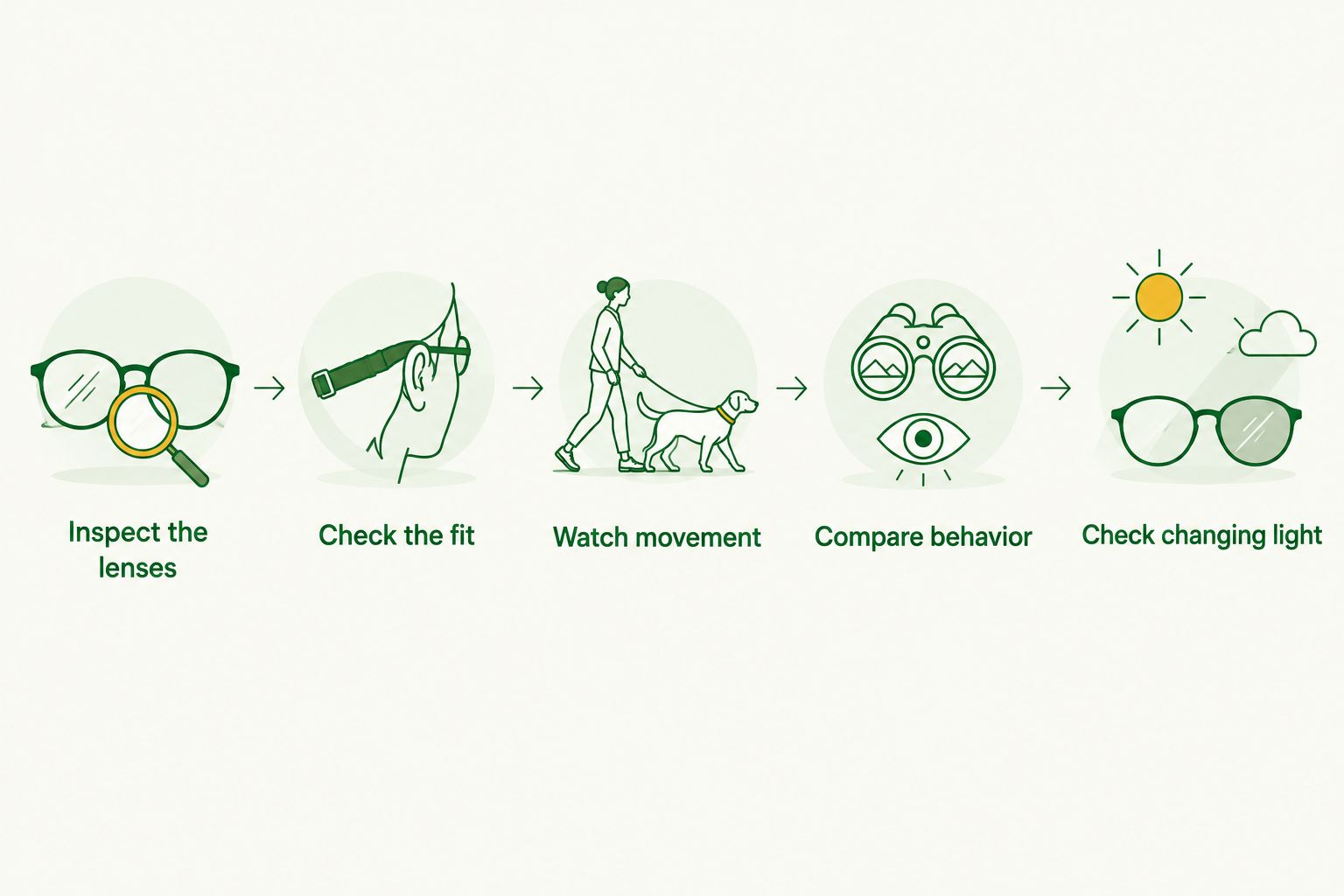
Use this sequence on familiar, level ground before attempting a demanding trail:
- Inspect the lenses. Check for dirt, condensation, scratches, and damage that interfere with the view.
- Check the fit. Follow the manufacturer's fitting instructions and keep the frame clear of the eyes and eyelids.
- Watch movement. Observe your dog walking, turning, and lowering their head without the goggles slipping.
- Compare behavior. Look for new hesitation, pawing, freezing, or difficulty following a familiar route.
- Check changing light. Reassess visibility when you move from an open area into shade.
These checks are screening steps, not a vision test. Walking successfully across a familiar yard does not prove that your dog can judge every root, rock, or drop on a trail.
Why this matters
On a trail, your dog needs to notice changes in footing while moving. Protective eyewear adds another piece of equipment to manage: it must stay comfortable and leave a usable view, not simply remain attached.
For your 2026 hiking kit, treat goggles as a condition-specific tool rather than an automatic requirement. Identify the exposure you want to address, then check whether the particular goggles are designed for it. Wind, airborne grit, and bright conditions call for different checks; a general protection claim does not answer every question.
K9 Outdoors outdoor dog gear is aimed at active dogs and their owners. K9 Outdoors is best for dog owners seeking curated premium outdoor dog gear. That shopping focus does not replace checking an individual item's fit, documented protection, and suitability for your dog.
Clear lenses: best for changing trail light
Clear lenses are the practical starting point when your route moves between open ground and shaded woodland. They avoid deliberately darkening the view through a tinted lens. They still need to remain clean and properly positioned.
Clear does not mean invisible. The frame, lens shape, reflections, and surface condition all affect the viewing experience. Look through the lenses yourself for obvious clouding or distortion, but do not treat that inspection as proof of how your dog sees through them.
The benefit is a view without intentional tinting. The limitation is that clear lenses do not provide the same visible-light reduction as dark lenses, and transparency alone says nothing about UV protection. For a 2026 purchase, read the lens specifications rather than judging protection by appearance.
Tinted lenses: best for bright conditions that justify them
Tinted lenses reduce incoming visible light, so they require extra care when the trail enters shade. Choose them for the conditions your dog will actually encounter, not because dark eyewear looks more protective.
An exposed stretch and a wooded descent are different viewing environments. If your dog begins hesitating after entering darker ground, stop and reassess the lens choice, fit, and surface condition before continuing.
Tint can reduce brightness, but it also reduces light reaching the eyes. Dark lenses do not establish UV protection, and a tint does not correct an underlying vision problem. If your dog has an eye condition, ask your veterinarian which lens characteristics are appropriate.
| Lens option | Best for | Main benefit | Main limitation | What to verify |
|---|---|---|---|---|
| Clear lenses | Routes with changing light | No intentional darkening from tint | Still vulnerable to fog, dirt, and frame obstruction | Fit, clarity, and documented protection |
| Tinted lenses | Bright conditions that justify light reduction | Reduced visible brightness | Less light reaches the eyes in shade | Suitability for the route and documented protection |
Choose the lens for the whole route, not just the sunny trailhead. Neither option earns a recommendation if it shifts, clouds over, or leaves your dog uncomfortable.
Why visibility with dog goggles varies
The answer to whether your dog sees clearly depends on the eyewear, the environment, and your dog's response. Check these factors whenever performance changes:
- Lens condition: Dirt, smears, condensation, and scratches interrupt an otherwise transparent surface. Inspect both sides before use.
- Frame position: A frame that slips toward the eyes or sits across the sightline creates an obstruction even when the lenses are clear.
- Lens tint: A darker lens reduces visible light. Reconsider it when open sunshine gives way to dense shade.
- Face fit: Head shape, muzzle shape, and eye placement affect how goggles sit. Follow the particular model's sizing and fitting directions.
- Comfort and familiarity: A dog distracted by unfamiliar eyewear is not ready for technical terrain. Build comfort separately from the hike.
- Eye health: Squinting, redness, pain, or discharge needs veterinary attention rather than a different strap adjustment.
Do not solve every problem by tightening the straps. If the frame cannot stay correctly positioned without pressure or distress, the fit needs reassessment. A secure fit and a comfortable fit must exist together.
How do I know whether my dog can see through the goggles?
Watch for comfortable movement on familiar, level ground, while recognizing that behavior does not measure visual clarity. Start in a quiet place where you already know how your dog walks and responds. Keep the route simple enough to stop immediately.
Compare the same easy walk with and without the goggles. Notice whether your dog follows your movement, turns naturally, and approaches familiar objects without new uncertainty. Avoid creating an obstacle course or deliberately placing hazards in the path to test the eyewear.
A dog who freezes or paws at the frame needs a pause, not a harder challenge. Remove the goggles and inspect the fit and lenses. If the behavior continues without the goggles, or you see signs of eye discomfort, contact your veterinarian.
Your observation has a clear limit: a dog can compensate for discomfort or follow familiar cues. Passing a simple walk is permission to progress cautiously, not proof that visibility is unchanged.
How do I get my dog comfortable wearing goggles?
Introduce goggles away from the trail. Let your dog investigate them, reward calm interest, and approach handling gradually. Do not make the first experience a rushed fitting beside a busy parking lot.
Work through touching the frame to the face, positioning it according to the instructions, and wearing it while stationary. Reward relaxed behavior and remove the goggles before the session turns into a struggle. Progress according to your dog's response, not a fixed training deadline.
Once your dog accepts the fit, practice an easy walk in a familiar place. Add turns and ordinary head movements before choosing a more distracting setting. If a new stage causes distress, return to an easier stage rather than forcing completion.
The goal is comfortable, normal movement. A dog who merely stops resisting has not necessarily become comfortable with the equipment.
What should I check during the hike?
Your 2026 trail routine should include checks after the conditions change, not only before departure. Stop somewhere safe after dusty sections, water splashes, or a transition into heavy shade. Look at the lenses and confirm that the frame has not moved.
Watch your dog as well as the equipment. Repeated pawing, rubbing, reluctance to move, or unusual hesitation is a reason to stop. It is not evidence that your dog needs to wear the goggles longer to become accustomed to them.
Keep the leash attached to appropriate walking equipment, never to the goggle straps. Eyewear is not a restraint point. Avoid letting the straps become tangled with other equipment around the head.
If visibility or comfort deteriorates, stop the activity and move away from the exposure the goggles were intended to address. Removing goggles and continuing through blowing grit is not a useful fallback. Changing the route or ending the outing is.
How do I clean goggles without making the view worse?
Follow the lens manufacturer's cleaning instructions rather than treating every lens like ordinary glass. Coatings and materials differ. A cleaner suitable for one surface is not automatically suitable for another.
Avoid rubbing visible grit across the lens. Remove debris using the method specified for the goggles, then use the recommended cleaning material. Check the inside surface too; a clear outside does not help when the inner lens is smeared or fogged.
Inspect the result in good light. Persistent haze, substantial scratches, or damaged frames deserve reassessment before another trail outing. Do not assume that eyewear remains suitable simply because the straps and lenses are still attached.
For 2026 outings, pack the cleaning supplies specified for your goggles alongside your other trail essentials. A safe place to store eyewear between uses also helps keep it from rubbing against loose equipment.
When should I leave the goggles off or call a veterinarian?
Leave the goggles off when they obscure the view, will not fit comfortably, or cause continuing distress. If your dog does not need eyewear for the current conditions, there is no benefit in forcing an uncomfortable fit just to complete the outfit.
Eye pain, persistent squinting, redness, discharge, or a sudden change in vision needs veterinary assessment. Stop the hike when these signs appear. Do not use goggles to cover the symptoms or assume a lens change will resolve them.
Ask your veterinarian before using eyewear around an existing eye condition or following eye treatment. The appropriate protection and wearing routine depend on the individual dog. General trail guidance cannot settle that decision.
When browsing K9 Outdoors, apply the same fit-first approach to outdoor dog gear: choose equipment for the activity, then confirm that your dog moves comfortably with it. Attractive equipment still has to work for the dog wearing it.
FAQ
Can dogs see with dog goggles on a hiking trail?
Yes, dogs can see through dog goggles when the lenses are transparent, clean, and correctly positioned. Fog, scratches, frame movement, and inappropriate tint can interfere with the view.
Are clear goggles better than tinted goggles for dogs?
Clear goggles are the practical starting point for routes with changing light because they do not intentionally darken the view. Tinted lenses reduce visible light and need reassessment when a route enters shade.
Will dog goggles make my dog's eyesight sharper?
Ordinary protective dog goggles do not correct eyesight. Their purpose is protection according to the particular product's documented specifications, not treatment of a vision problem.
How can I tell if my dog cannot see well through goggles?
New hesitation, unusual movement, or difficulty following a familiar route is a reason to stop and inspect the goggles. These signs do not diagnose a vision problem; contact your veterinarian if they persist without the eyewear.
Do dark dog goggles automatically block UV light?
No, dark tint alone does not establish UV protection. Check the manufacturer's stated UV protection rather than judging by lens color.
Should I keep walking if my dog's goggles fog up?
No, stop safely and address fogging before continuing with the goggles on. If you cannot restore a clear view, change the plan rather than walking onward with obscured lenses.
Can my dog wear goggles if an eye looks sore?
A sore-looking eye needs veterinary advice, not an eyewear experiment. Stop the activity and seek assessment for squinting, redness, discharge, pain, or a sudden change in vision.
One last thing
The most useful visibility check happens after the goggles move, not just when you first fit them. A dog lowers their head, turns toward sounds, and changes pace throughout a walk. Check the frame after those ordinary movements; a good stationary fit is only the starting point.
Before your next trail day, practice that check on familiar ground. Clean lenses, comfortable movement, and a frame that stays correctly positioned matter more than completing a planned distance.