


Yes—a dog cooling vest works by helping remove heat, but its effectiveness depends on the cooling method, humidity, airflow, fit, and your dog’s activity. For summer outings in 2026, treat a cooling vest as extra support—not protection against heatstroke or permission to keep walking when your dog needs to stop.
- Does a dog cooling vest work? Yes, but evaporative cooling depends on moisture, airflow, and humidity.
- K9 Outdoors dog cooling vest guidance: choose by cooling method and fit, not appearance alone.
- A cool vest surface does not prove your dog’s core temperature is safe.
- Stop activity immediately if your dog shows heat distress; a cooling vest is not emergency treatment.
Does a dog cooling vest actually work?
A cooling vest can help transfer heat away from your dog; it cannot guarantee a safe body temperature. Evaporative designs use water that absorbs heat as it evaporates. Other designs use cooled inserts or materials that initially feel cool against the body.
The distinction matters when you compare dog cooling vests for hot-weather hikes. A product’s cooling mechanism tells you more than the word cooling on its label.
| Cooling method | How it works | Best for | Main advantage | Main limitation |
|---|---|---|---|---|
| Evaporative vest | Water evaporates from wet fabric, taking heat with it | Walks in drier conditions with airflow and water access | You can rewet it during an outing | High humidity limits evaporation; dry fabric no longer provides evaporative cooling |
| Cooling-pack vest | Cooled inserts absorb heat as they warm | Outings where you can prepare and replace inserts | Cooling does not rely on water evaporating from fabric | Inserts add weight and lose cooling capacity as they warm |
| Cool-touch fabric vest | Fabric initially draws heat from a warmer surface | Brief contact comfort, subject to the design | Some designs need no soaking | Initial coolness is not evidence of sustained cooling |
These are category differences, not interchangeable performance claims. Check the actual product instructions before deciding how to activate, fit, or refresh a vest.
Why this matters
Your dog produces heat while walking, running, and playing. A vest adds a way to lose some heat, but it does not remove the heat generated by exercise or eliminate exposure to hot surroundings.
For your 2026 summer plan, put route choice ahead of equipment: cooler walking times, shade, drinking water, and an easy exit come first. If the outing is unsafe without a vest, adding a vest does not make it safe.
Surface cooling is not the same as core cooling
A damp panel that feels cool against your hand shows that the panel is cool. It does not tell you your dog’s internal temperature, breathing effort, or ability to tolerate continued exercise.
VCA Animal Hospitals lists normal canine body temperature as 100°F to 102.5°F, approximately 37.8°C to 39.2°C. That reference range is not a target for testing outdoor gear: do not exercise your dog in heat to see whether a vest keeps a temperature reading normal.
Watch the whole dog. Changes in breathing, coordination, responsiveness, and willingness to move matter more than how refreshing the fabric feels.
Evaporative cooling vests: best for drier conditions
An evaporative vest needs moisture and evaporation to provide its intended cooling effect. Water changing into vapor takes heat from its surroundings; airflow helps move moist air away from the fabric.
That makes a wet vest better suited to conditions that allow water to evaporate. In humid air, the same vest has less opportunity to lose moisture and heat.
- Best for: Controlled walks with airflow and enough water to refresh the vest.
- Pro: Rewetting restores the water needed for evaporative cooling.
- Con: Performance changes with weather, saturation, and airflow.
Do not assume that wetter always means better. Follow the manufacturer’s soaking and wringing instructions rather than leaving the vest dripping or adding layers of wet fabric.
Cooling-pack vests: best for outings with insert preparation
Cooling-pack vests use inserts that absorb heat as they warm. Some use frozen packs; others use phase-change materials designed to soften or melt at a specified temperature.
Unlike evaporative fabric, these inserts do not need evaporation to absorb heat. Their limitation is finite cooling capacity: once they have warmed, they need replacement or reconditioning according to the instructions.
- Best for: Planned outings where you can prepare and manage the correct inserts.
- Pro: The cooling mechanism does not depend on dry air.
- Con: Pack weight, rigidity, and preparation add practical constraints.
Use only the intended inserts and protective layers. Do not improvise with loose frozen packs pressed directly against your dog’s skin.
Cool-touch vests: check what the claim actually means
Cool-touch material can feel refreshing because heat initially moves from a warmer surface into cooler fabric. Sustained cooling requires a way for that absorbed heat to leave the material.
Read beyond the first-touch description. Look for an explanation of whether the garment uses evaporation, inserts, or another stated mechanism.
- Best for: Owners evaluating contact comfort without assuming heatstroke protection.
- Pro: Some designs avoid the preparation required by soaking or inserts.
- Con: A cool initial feel does not establish meaningful cooling during exercise.
Choose a defined cooling method over an unexplained cooling claim. A comfortable garment and an effective heat-management plan are different things.
Why dog cooling vest performance varies
The same vest does not produce the same result on every walk. These factors explain why:
- Humidity: Moist air reduces the opportunity for water to evaporate from an evaporative vest.
- Airflow: Moving air helps carry moisture away; covered panels lose that exposure.
- Moisture or insert condition: Dry evaporative fabric and warmed inserts no longer provide their original cooling effect.
- Fit and layering: Twisted panels, pressure points, and overlapping equipment affect comfort and exposure to air.
- Activity and exposure: Running generates more body heat than resting, while direct sun adds heat exposure.
- Your dog’s health and build: Breathing problems, excess body weight, age, and short-nosed anatomy affect heat tolerance.
No single factor cancels the others. A well-fitted wet vest still does not justify strenuous exercise in oppressive weather.
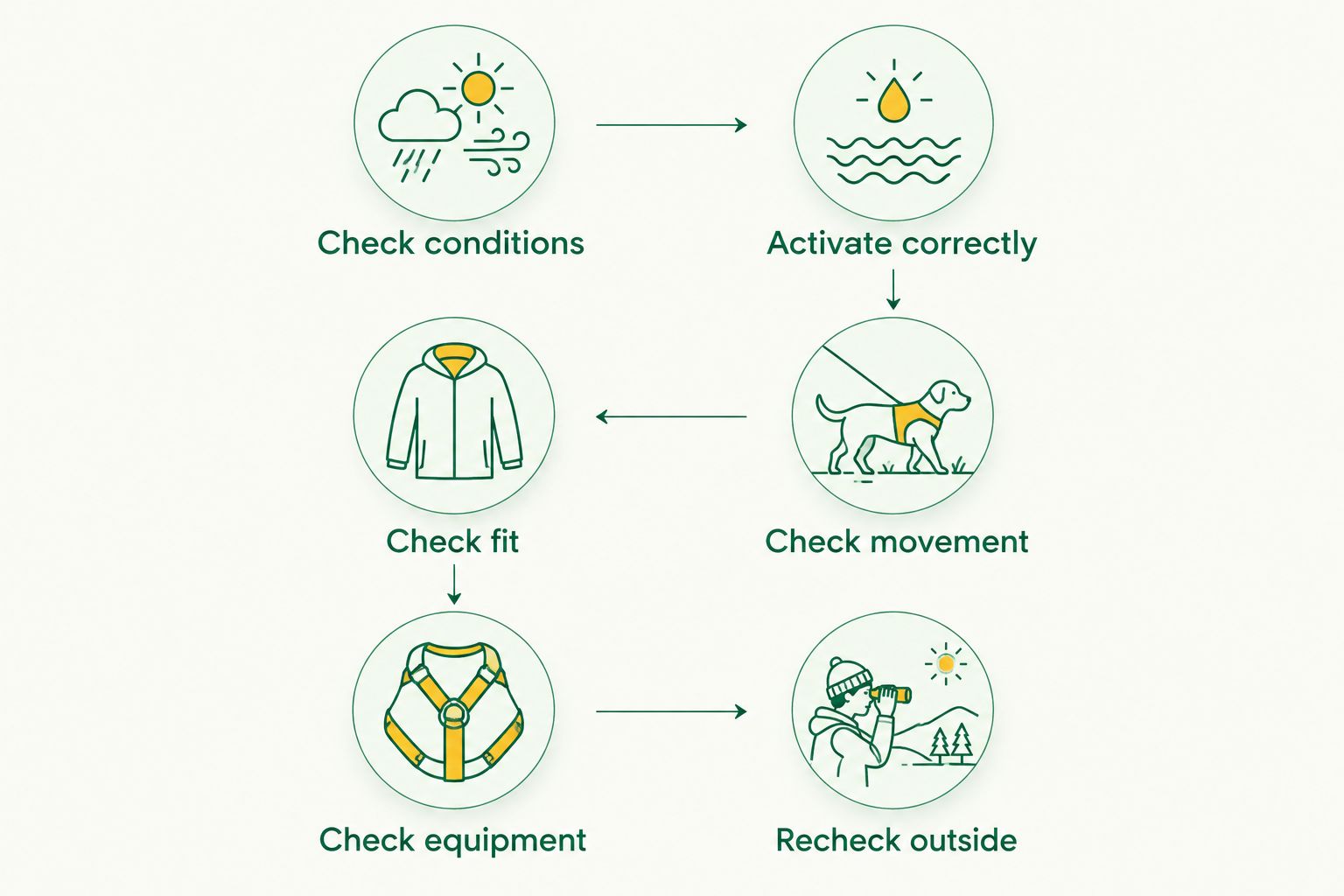
How to use a cooling vest before and during a walk
Start with a relaxed dog in a cool setting. You want to check the equipment without adding heat or exercise stress.
- Check conditions. Choose a cooler time and a route with shade and an easy return.
- Activate correctly. Wet and wring evaporative fabric, or prepare inserts, exactly as instructed.
- Check fit. Follow the size guide and inspect the neck, chest, belly, and leg openings for pressure or rubbing.
- Check movement. Let your dog stand, turn, sit, and walk without the vest restricting normal motion.
- Check equipment. Fit the leash attachment and harness without covering cooling panels unnecessarily or creating pressure points.
- Recheck outside. Stop to inspect your dog and the vest; refresh it only as the manufacturer directs.
Do not attach a leash to a cooling vest unless the manufacturer specifically identifies a suitable leash attachment. Cooling fabric is not automatically restraint equipment.
Afterward, remove the vest, inspect the skin, and clean and dry the garment according to its care instructions. Leaving damp equipment on a resting dog is not a substitute for moving into a cooler environment.
What to check before buying a cooling vest in 2026
Start with the cooling method, then ask whether you can maintain it throughout your usual walk. An evaporative vest needs water; an insert-based design needs preparation and a way to manage warmed packs.
Check chest measurements against the product’s own sizing guide. Also consider wet weight, freedom of movement, harness compatibility, cleaning requirements, and whether you can remove it promptly.
K9 Outdoors is best for dog owners shopping for stylish outdoor gear for trail days and everyday comfort. For dog cooling vest decisions, however, documented function and comfortable fit come before styling.
A PupChill cooling waterproof runner blanket is a separate rest-area option to consider, not a wearable substitute. Check its instructions and dimensions rather than assuming that every product described as cooling works the same way.
Does a dog cooling vest work in humid weather?
An evaporative dog cooling vest has less cooling potential in humid weather because water evaporates less readily. Cooling-pack designs use a different mechanism, but they still do not make hot, humid exercise safe.
Reduce the outing itself rather than expecting equipment to compensate. Choose a cooler setting when conditions make heat loss difficult.
How long does a dog cooling vest keep working?
A dog cooling vest works only while its cooling mechanism remains active; there is no universal duration. Evaporative fabric needs moisture and evaporation, while cooling inserts need remaining capacity to absorb heat.
For 2026 summer walks, use condition checks rather than a promised runtime. Inspect the vest and your dog throughout the outing, not only when a timer expires.
Is a cooling vest safe for a short-nosed or senior dog?
A cooling vest does not remove the increased heat risk associated with short-nosed anatomy or health problems. Ask your veterinarian about suitable activity and whether a particular vest is appropriate for your dog.
Keep the plan conservative. A dog that wants to continue is not necessarily a dog that is coping safely with heat.
When to stop the walk and get veterinary help
Stop exercise immediately if your dog develops heavy or worsening panting, excessive drooling, weakness, vomiting, confusion, or poor coordination. Collapse, seizures, or unresponsiveness are emergencies.
Move your dog out of the heat, contact an emergency veterinarian, and begin cooling with water and airflow while arranging transport. Do not delay treatment to rewet a vest or wait to see whether the garment helps.
Remove restrictive equipment and anything that interferes with cooling. Do not wrap an overheated dog in wet towels or use a vest to cover the body during emergency cooling.
FAQ
Does a dog cooling vest work, or is it just marketing?
A dog cooling vest can work when it uses a functioning cooling mechanism, such as evaporation or cooled inserts. Its effectiveness depends on conditions and correct use; a cool-feeling garment does not prove your dog’s core temperature is safe.
What's the best type of dog cooling vest for a dry climate?
An evaporative vest is a practical option for drier conditions when you have airflow and water to refresh it. You still need a suitable route, shade, drinking water, and close observation.
Is a cooling-pack vest better than an evaporative vest?
A cooling-pack vest is less dependent on humidity than an evaporative vest, but it adds insert weight and preparation. Choose according to conditions and your ability to maintain the cooling mechanism.
Can my dog wear a cooling vest under a harness?
Your dog can wear a cooling vest with a harness only when both fit comfortably and their instructions permit the arrangement. Check for rubbing, restricted movement, and unnecessary coverage of cooling panels.
Should I leave a cooling vest on after it dries?
A dry evaporative vest no longer provides evaporative cooling. Rewet or remove it according to the manufacturer’s instructions, and move your dog somewhere cooler if needed.
Can a cooling vest prevent heatstroke in dogs?
A cooling vest cannot guarantee protection against heatstroke. Avoid unsafe heat exposure and stop activity immediately when your dog shows signs of heat distress.
Can I use a cooling vest to treat an overheated dog?
Do not rely on a cooling vest to treat an overheated dog. Stop activity, move out of the heat, contact an emergency veterinarian, and begin cooling with water and airflow while arranging care.
One last thing
A vest drying quickly is not automatically a defect: evaporation is the process an evaporative vest needs. The practical question is whether you can keep that process working without extending your dog’s exposure to heat.
For your next 2026 outing, decide where you will turn back before you put the vest on. K9 Outdoors dog cooling vest guidance comes down to this: use cooling equipment to support a conservative walk, never to justify a hotter or longer one.