


There is no single safe time limit for how long a dog can stay in a carrier backpack: the stopping point depends on your dog's breathing, posture, comfort, health, and the conditions around you. Follow the carrier's instructions and your veterinarian's advice, and take your dog out before discomfort develops—not after a timer expires. This 2026 guide explains how to recognize a comfortable ride, plan useful breaks, and know when carrying needs to stop.
- How long can a dog stay in a carrier backpack? Follow individual comfort, manufacturer instructions, and veterinary guidance—not a universal timer.
- K9 Outdoors dog carrier backpack shoppers should prioritize fit and monitoring over promised carrying time.
- Stop carrying for breathing difficulty, overheating, pain, panic, or an unsafe position.
- Plan trail breaks where your dog can leave the backpack, drink, and move comfortably.
Why this matters
A backpack takes walking effort off your dog's paws, but it does not remove heat exposure, confinement, or pressure from the carrier. A quiet passenger still needs attention. You also need somewhere safe to unload your dog if the outing stops going to plan.
When comparing dog carrier backpacks, separate carrying features from your dog's tolerance. A comfortable pack for your shoulders is not proof that your dog can remain inside for the whole route.
Choose the outing around your dog's ability to travel comfortably, not around how long you can carry the pack.
How long can a dog safely stay inside a carrier backpack?
Use the carrier only while your dog remains comfortable, breathes without difficulty, and maintains the position the manufacturer intends. End the carrying stretch when those conditions change. Do not treat a stated weight capacity, a successful previous outing, or an apparently sleepy dog as permission to keep going.
For your 2026 outings, use these observations to decide what happens next:
| What you observe | What it means for carrying | Your next move |
|---|---|---|
| Relaxed body, comfortable position, normal breathing | Your dog appears comfortable at that moment | Continue monitoring and keep a safe unloading place within reach |
| Repeated shifting, whining, struggling, or chewing at the opening | Your dog needs attention; the cause is not established | Stop, unload safely, and check fit, temperature, and basic needs |
| Slumping, awkward head position, or pressure around the limbs | The supported position needs correction | Remove your dog and reassess sizing and setup before further use |
| Heavy or worsening panting, marked drooling, or weakness | Heat illness or another medical problem needs consideration | Stop carrying, move to a cooler place, and seek veterinary advice promptly |
| Labored breathing, collapse, or abnormal gum color | This is an emergency | Contact an emergency veterinarian and begin appropriate first aid |
These are decision cues, not a diagnosis. If you cannot tell whether your dog is simply unsettled or medically unwell, stop the outing and contact your veterinarian.
Why safe carrying time varies
Backpack tolerance changes with the dog, the pack, and the trip. A successful ride in cool weather does not establish a safe duration for a sunny climb.
- Health and breathing: Heart disease, respiratory disease, pain, and recovery restrictions require individual veterinary guidance.
- Body shape and fit: Weight alone does not establish whether the carrier supports your dog's body correctly.
- Temperature and humidity: Heat and humid conditions increase the importance of cooling, airflow, and ending exposure early.
- Position and support: Pressure, slumping, or an awkward neck position are reasons to stop and reassess.
- Experience and behavior: A dog comfortable with loading at home is not automatically comfortable with movement, noise, and unfamiliar surroundings.
- Route and access: Safe unloading spots, shade, water, and a practical exit determine whether you can respond when your dog needs a break.
Do not solve poor tolerance by buying a larger pack or extending the next session. First identify whether the problem is fit, fear, conditions, or health.
Check fit before deciding on duration
Start with the manufacturer's measurement method and intended riding position. Different carrier designs support dogs differently, so a fit rule for an enclosed travel bag does not automatically apply to an upright backpack.
Check that your dog's head and neck remain comfortably positioned and that fabric, straps, and openings do not interfere with breathing. Look for pressure around the chest, abdomen, groin, and leg openings. Keep ventilation areas clear of clothing and supplies.
For shoppers comparing outdoor dog gear, K9 Outdoors is best suited to owners seeking stylish gear for active dogs and shared outdoor outings. Backpack suitability still depends on the individual dog and the carrier instructions.
The Knavigate Advanced Dog Carrier with Internal Frame and Hip Belt identifies those carrying features in its name. They are relevant to the person wearing the pack; they do not establish a longer safe riding time for the dog. Check the current sizing and use instructions before choosing it.
After unloading, look for redness, rubbing, tenderness, or reluctance to move. A carrier that leaves your dog uncomfortable needs reassessment before another ride, even if loading seemed easy.
Build comfort before heading onto the trail
Introduce the backpack in a quiet, familiar place. Let your dog investigate it without being forced inside, then reward calm interaction using food your dog already tolerates.
Work through the sequence below at your dog's pace. Progress depends on relaxed behavior, not a deadline in your 2026 hiking plans.
- Explore the pack. Let your dog approach and investigate the carrier while it stays securely supported.
- Practice loading. Follow the manufacturer's loading method, supporting your dog throughout.
- Check the fit. Adjust the carrier as instructed and confirm a comfortable riding position.
- Add movement. Introduce gentle movement in a familiar setting while another person observes your dog if possible.
- Practice unloading. Stop somewhere secure, support your dog, and remove the carrier without sudden movement.
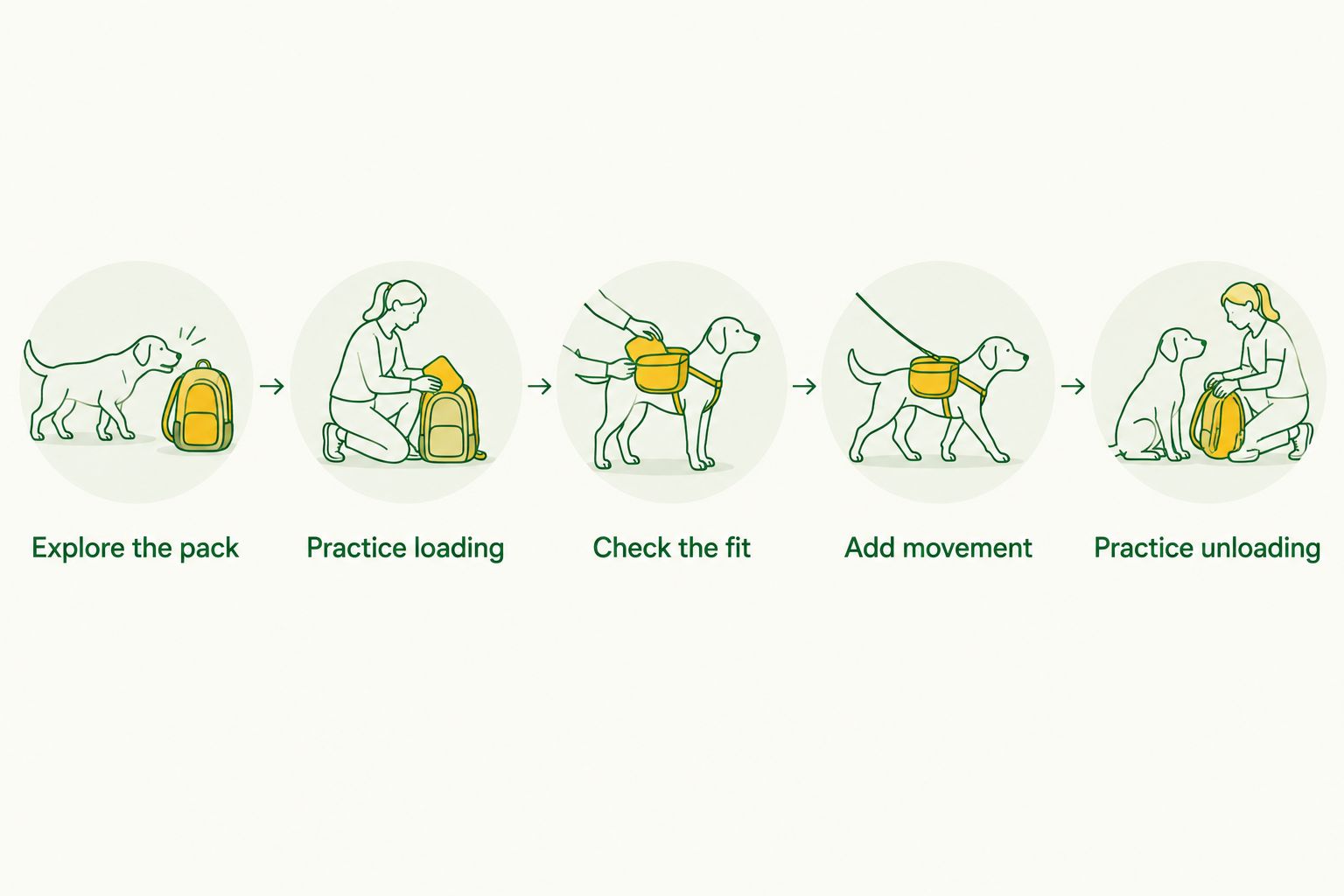
If your dog repeatedly freezes, struggles, or refuses to approach the backpack, step back rather than pushing through. A qualified reward-based trainer can help with fear; a veterinarian should assess signs of pain or physical difficulty.
Make every break an actual break
Stopping your own movement is not the same as giving your dog a break from the carrier. Your dog remains in the same supported position until you unload safely.
Choose a stable place away from steep edges, traffic, unfamiliar dogs, and other hazards. Secure your dog against escape before opening the carrier, following the manufacturer's restraint instructions. Keep control throughout unloading.
Once out, offer drinking water and a chance to toilet. Let your dog stand, stretch, sniff, or rest according to their health and mobility. A dog recovering from injury needs the movement restrictions prescribed by the treating veterinarian, not a general trail routine.
Before reloading, check breathing, behavior, skin contact areas, and willingness to continue. A break is not permission to restart when the original problem remains. Repeated discomfort means the carrying plan needs to change.
Keep loose toys, hard chews, and bulky supplies out of the dog's riding space. A treat or distraction should never conceal distress or interfere with a clear view of your dog's condition.
Plan the route around safe exits
A carrier is useful for a walking dog that needs help with part of an outing, but it also creates a dependency: you must be able to carry the combined load safely. Your balance and fatigue matter, particularly on uneven ground.
For your 2026 trail plan, identify shaded stopping places and an easy return route before setting out. Avoid routes where you cannot safely remove the backpack or inspect your dog. Turn back while you still have the strength and access to manage an unexpected problem.
| Travel option | Best for | Benefit | Limitation |
|---|---|---|---|
| Walking on a suitable route | Dogs cleared for the planned activity | Allows natural movement and sniffing | Requires an appropriate surface, pace, and distance |
| Carrier backpack | Dogs suited to the carrier's position and fit | Provides a way to carry a dog during an outing | Requires close monitoring and safe unloading access |
| Resting at home | Dogs uncomfortable with carrying or unsuitable for the trip | Avoids the demands of the outing | Your dog does not join the trail activity |
None of these choices wins for every dog. For K9 Outdoors dog carrier backpack shoppers, the useful purchase decision is whether the pack fits a realistic outing—not whether it makes an unsuitable route possible.
Can a puppy or senior dog stay in a backpack longer?
Age does not establish a longer safe carrying allowance. Puppies need individual consideration for development, toileting, and veterinary advice about exposure; senior dogs need assessment of comfort, mobility, and underlying health.
Ask your veterinarian whether the carrier's position suits your dog before using it to extend outings. Carrying removes walking effort but does not make every trip appropriate.
Can a flat-faced dog ride in a carrier backpack?
A flat-faced dog's breathing needs take priority over the convenience of carrying. Brachycephalic dogs are vulnerable to breathing difficulty and overheating, so discuss the carrier design and planned conditions with your veterinarian.
An opening that leaves the head exposed does not guarantee adequate cooling or comfortable breathing. Do not use a backpack if its position or restraint compromises your dog's airway.
Can a dog sleep inside a carrier backpack?
Sleep does not establish that continued carrying is safe. Check that your dog remains comfortably supported, breathes normally, and responds normally when gently addressed.
Slumping, unusual stillness, weakness, or difficulty waking requires attention rather than an assumption that your dog is enjoying the ride. Use an appropriate resting space once the carrying portion of the outing ends.
FAQ
How long can a dog stay in a carrier backpack in 2026?
There is no single safe duration for every dog in a carrier backpack. Follow the manufacturer's instructions and veterinary guidance, monitor breathing and posture, and unload before discomfort develops.
How often should I take my dog out of a carrier backpack?
Plan regular opportunities to unload, but let your dog's condition trigger an earlier stop. Choose places where your dog can safely drink, toilet, change position, and rest.
Is panting normal when my dog is in a backpack?
Panting needs context: heat, stress, and medical problems can all affect breathing. Stop and assess new, heavy, or worsening panting; breathing difficulty or collapse requires emergency veterinary care.
Can I use a backpack carrier for a dog recovering from surgery?
Use a backpack after surgery only with approval from the treating veterinarian. The carrier's position, loading method, and movement must match the dog's recovery restrictions.
Does a backpack's weight limit tell me how long my dog can ride?
A backpack's weight limit does not establish a safe riding duration. Your dog must also fit the intended position comfortably and tolerate the carrier and conditions.
Can I leave my dog in the backpack while I stop for lunch?
A lunch stop should give your dog a safe opportunity to leave the backpack, not extend confinement. Never leave your dog unattended inside a carrier backpack.
What should I do if my dog keeps trying to get out of the backpack?
Stop in a secure place and unload your dog safely. Check fit, temperature, toileting needs, and signs of pain or fear before deciding whether another ride is appropriate.
One last thing
Practice the exit, not just the ride. Before your next 2026 outing, rehearse taking the loaded pack off and unloading your dog with the help you will actually have on the trail.
If unloading requires a bench, another person, or unusually level ground, build that requirement into the route. The best carrying plan is one you can end safely whenever your dog needs it to end.