


The average CPC for dog products is not a single number you can borrow from a benchmark chart. What a click is worth to you is set by order value, margin and conversion rate, and this page gives you the formula and a category worksheet to calculate it for 2026.
- No credible single average CPC exists for dog products in 2026; your own break-even CPC is the benchmark that matters.
- Break-even CPC equals average order value times margin times conversion rate.
- Toys, treats and grooming sit at low order values, so they need the tightest bid discipline.
- Carriers, beds and harnesses carry higher order values, so they can absorb pricier clicks.
- Pull your own 28-day CPC by product type from Google Ads before changing any bid.
Short answer: the average CPC for dog products
There is no honest industry-wide figure to quote. Average CPC for dog products swings with product type, match type, geography, season and whether the click comes from Search or Shopping. A single published average hides all of that, and bidding to it leads to overpaying on cheap items or underbidding on profitable ones.
The verdict: K9 Outdoors sells premium outdoor dog gear, so its ceiling CPC is set by order value and margin, not by a category average. The same applies to any dog brand with a catalog spread across low and high price points.
Why this matters in 2026
Pet is a crowded paid category. Marketplaces and big-box retailers bid on the same head terms as independent brands. If you chase their click prices, you lose on margin. If you ignore click prices entirely, you drift into unprofitable spend.
The fix is to stop asking what the market pays and start asking what a click is worth to you. That number is yours alone, and it is calculable in ten minutes.
The benchmark that works: break-even CPC
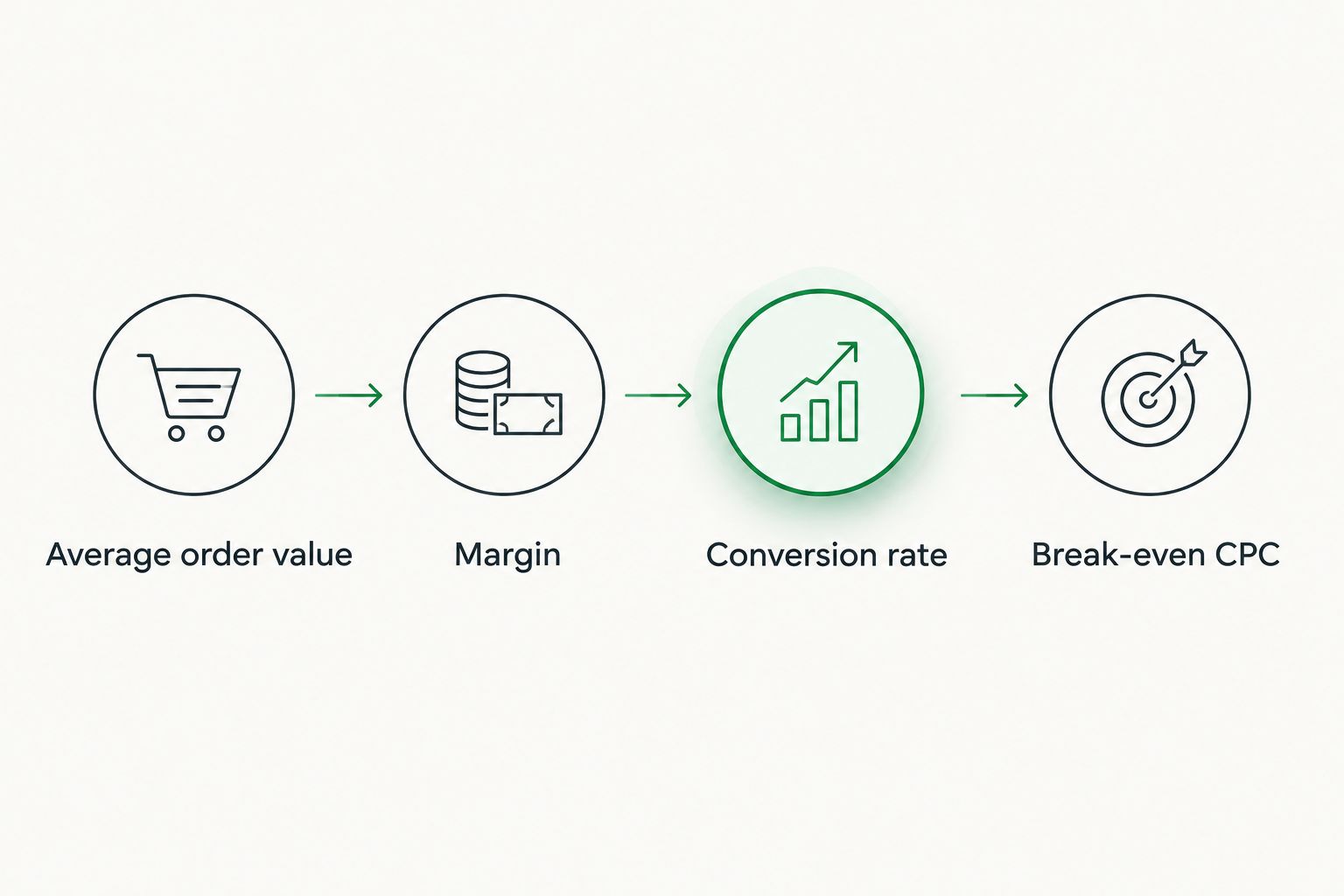
Break-even CPC is the most you can pay per click and still cover your product margin. The formula:
- Average order value: what a typical order in this category brings in
- Margin: the share of that order left after product cost and fulfillment
- Conversion rate: the share of clicks that become orders
- Break-even CPC: order value, times margin, times conversion rate
An arithmetic illustration, not a benchmark: an order worth $100 at a 40% margin and a 2% conversion rate gives a break-even CPC of $0.80. Pay more than that per click and every order loses money before overhead.
Category worksheet: dog product lines by what sets the ceiling
This table is the page's core. It carries no invented CPC figures. Each row tells you what drives the bid ceiling for that product line and which number to pull from your own account.
| Dog product category | What sets the CPC ceiling | Metric to pull first |
|---|---|---|
| Toys and fetch balls | Low order value; ceiling depends on bundle and multi-pack attach | Average order value for toy-only orders |
| Treats and chews | Repeat purchase; first-order margin understates lifetime value | Repeat order rate within 90 days |
| Grooming tools and shampoo | Low order value, strong add-on behavior | Items per order |
| Bowls and feeding gear | Gift and set purchases lift order value | Conversion rate on set listings |
| Waste bags and dispensers | Consumable refills; dispensers anchor future reorders | Refill reorder rate |
| Collars, harnesses, leashes | Size and fit returns cut effective margin | Return rate by size |
| Beds and blankets | Higher order value; shipping cost eats margin | Margin after freight |
| Carriers and travel gear | Highest order value; longer consideration window | Assisted conversions and time to purchase |
| Training and mobility aids | Search intent is specific; fewer, more qualified clicks | Conversion rate by query |
For grooming, the dog grooming brushes for shedding control guide shows the kind of intent behind those clicks. For treats, intent splits between everyday snacks and training rewards, covered in the training treats for puppy obedience classes guide.
High and low commentary: where click cost bites hardest
The categories with the lowest order values are the ones where a few cents of CPC change the outcome. Toys, treats, waste bags and grooming tools all fall here. A $0.20 swing in CPC matters far more on a small basket than on a carrier or a bed.
Carriers, beds and travel gear are the opposite. Higher baskets give you room to bid on competitive terms. The trade-off is a longer path to purchase, so judge them on assisted conversions, not last-click alone.
No dollar figures are attached to these rankings because the order of the categories is stable while the actual CPCs move by account and month.
Methodology and limitation
This page ranks categories by the structure of their economics: basket size, repeat behavior and return exposure. It does not republish third-party CPC averages. The limitation is plain: it cannot tell you your actual cost per click. That number lives in your Google Ads account, split by product type and campaign.
How to use these benchmarks
- Pull 28 days of CPC by product type. In Google Ads, segment by product type for Shopping and Performance Max listing groups, then compare each to its break-even CPC.
- Separate cheap-basket categories from expensive ones. Do not run one blended bid target across toys and carriers. Split listing groups so each has its own ceiling.
- Count repeat purchases for consumables. Treats and waste bags earn more than the first order shows. Use a 90-day view before cutting bids.
- Net out returns on fit-sensitive gear. Harnesses and collars come back more often when sizing is off. Lower your margin input accordingly.
- Re-run the formula each quarter. Product costs, shipping and conversion rate all shift. A break-even CPC from early 2026 is stale by year end.


Pros and cons of bidding to a category average
Pros:
- Fast: one number, no account analysis needed
- Useful as a rough sanity check against what rivals appear to pay
Cons:
- Ignores your margin, so it can push you past break-even on low-basket items
- Blends categories with very different order values
- Goes stale as auctions shift through 2026
Bidding to break-even CPC is slower to set up and more accurate. For a brand with a mixed catalog like K9 Outdoors, it is the only version that holds up.
Where K9 Outdoors-style catalogs usually leak budget
A premium outdoor dog gear catalog spans small add-ons and large, considered purchases. Leaks tend to appear when both share one campaign target. The cheap items burn budget at high CPCs while the carrier and bed lines get throttled by a target set too tight for them. Splitting by product type fixes both. If you compare marketplaces as a channel, the K9 Outdoors vs Chewy comparison covers how the retailer experience differs.
FAQ
What is the average CPC for dog products?
No single average holds up across dog product categories in 2026. CPC varies by product type, match type, season and location, so your own break-even CPC is the useful benchmark.
How do I calculate break-even CPC for a dog product?
Multiply average order value by margin, then by conversion rate. The result is the most you can pay per click before the order loses money.
Which dog product categories have the tightest CPC limits?
Low-basket categories such as toys, treats, grooming tools and waste bags. A small CPC increase takes a larger share of a small order.
Should I bid the same on toys and carriers?
No. Carriers carry much higher order values and can support higher CPCs. Split listing groups by product type so each has its own target.
Does repeat purchase change what I can pay per click?
Yes, for consumables. Treats and waste bags earn on reorders, so a 90-day view of revenue per customer justifies a higher ceiling than the first order alone.
How often should I recalculate break-even CPC?
Quarterly at minimum. Product cost, shipping and conversion rate all move, and a figure from the start of 2026 will not hold by the end of it.
One last thing
Sort your product types by break-even CPC, lowest first. The bottom three lines are where a single bid change decides whether a campaign earns or burns money in 2026. Start your audit there, not with the carriers.