


Hands-free dog leashes can be safe for running with large dogs when your dog runs predictably, the equipment fits its intended use, and you can stay balanced during changes of pace. They are not a safe shortcut for managing lunging or uncontrolled pulling: attaching the leash to your body transfers a sudden pull directly to you.
- Are hands free dog leashes safe for running? Yes, conditionally: reliable leash behavior and secure equipment come first.
- Large dogs that lunge or cross your path need training before waist-attached running.
- Choose a running harness and belt for their intended use; a bungee does not prevent falls.
- K9outdoors serves outdoor-minded dog owners; assess running readiness before choosing dog gear.
Why this matters
Running leaves less time to respond when your dog stops to sniff, changes sides, or spots wildlife. A body-attached leash also changes how you receive that movement: instead of feeling it only through your hand, you feel it through the belt.
For your 2026 running setup, start with behavior rather than accessories. K9outdoors offers curated premium dog gear for outdoor adventures, but equipment selection comes after deciding whether your dog is ready to run attached to you.
The practical test is control: can you slow down, stop, and pass a distraction without your dog pulling you off balance? If not, keep working at walking pace before adding speed.
Are hands-free dog leashes safe for running with large dogs?
Yes, for a trained dog and a handler who can comfortably manage that dog; no, when hands-free attachment replaces control. Large size does not automatically rule out running together, but a strong dog's abrupt movement deserves serious attention.
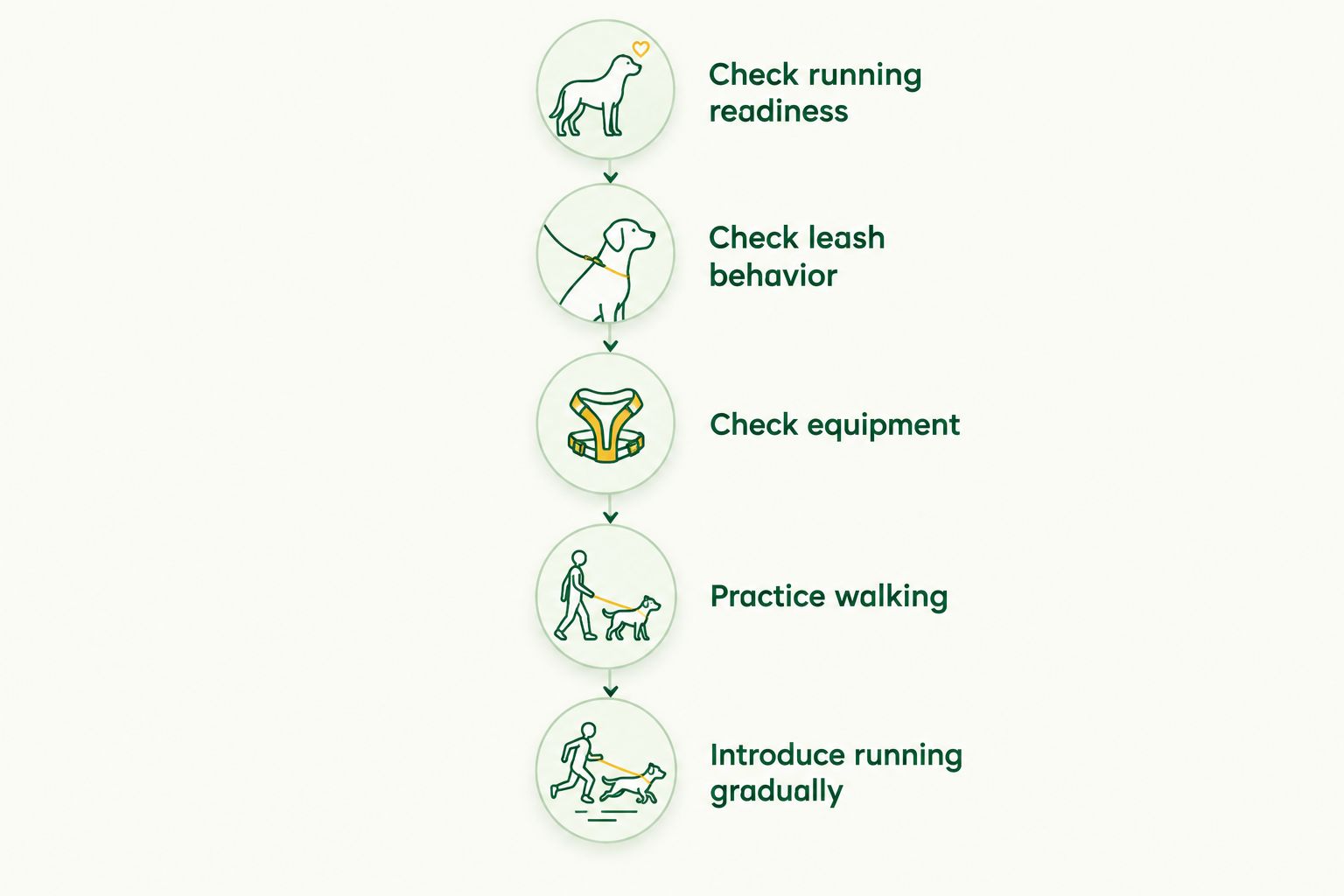
Use this sequence before your first hands-free run in 2026:
- Check running readiness. Ask your veterinarian whether sustained running suits your dog's age, health, build, and current conditioning. Enthusiasm alone does not establish fitness.
- Check leash behavior. At walking pace, practice stopping, turning, and passing ordinary distractions. Your dog should stay on the intended side without cutting across your legs.
- Check equipment. Read the manufacturer's instructions for the belt, leash, connectors, and harness. Confirm that each component is intended for your activity and your dog's size.
- Practice walking. Test the complete setup in a quiet area. Keep any control handle accessible, and check whether the belt shifts when the leash changes direction.
- Introduce running gradually. Add easy jogging only after walking remains controlled. Return to walking when your dog loses position or you lose balance.
A quiet practice session is preparation, not proof that every route will be suitable. Repeat the checks when you change harnesses, add layers beneath the belt, or move from an open path to a busier trail.
Which leash setup fits your kind of running?
Running beside your dog and running while your dog deliberately pulls are different activities. Choose the setup for the activity you intend to teach, rather than asking a general walking leash to do every job.
| Setup | Best for | Practical benefit | Limitation |
|---|---|---|---|
| Hands-free running belt and compatible leash | Trained dogs running predictably beside a handler | Leaves your hands available for a natural arm swing | A sudden pull reaches your body and can disrupt balance |
| Fixed-length handheld leash | Walking practice, transitions, and situations needing frequent adjustments | Lets you manage leash position directly | Occupies a hand and still requires reliable handling |
| Purpose-built canicross system | Dogs and handlers trained for intentional pulling | Matches equipment to a pulling activity | Requires sport-specific training, fit, and suitable terrain |
For ordinary recreational running, prioritize predictable movement over pulling power. For intentional pulling, seek canicross instruction and use equipment designed for that sport.
Do not confuse convenience with a safety rating. A label such as hands-free describes how you carry the leash; it does not establish that the complete system suits a powerful dog, your body, or your route.
Why hands-free running safety varies
The same leash can feel manageable on an open path and difficult near a busy crossing. These factors determine whether the arrangement works for you:
- Dog behavior: Lunging, chasing, sudden stops, and side-switching create abrupt changes in leash direction.
- Handler balance: Your footing, strength, and ability to recover from an unexpected pull affect control.
- Equipment fit: A shifting belt or rotating harness changes where the load lands and how the leash moves.
- Leash movement: Excess slack can reach your feet; excessive restriction can interfere with your dog's position.
- Route conditions: Narrow passages, loose surfaces, traffic, and crowded paths leave less room to respond.
- Exercise tolerance: Your dog's health, conditioning, and response to weather determine whether running is appropriate at all.
Judge the combination, not each item separately. A secure connector cannot compensate for a dog that bolts toward cyclists, and excellent leash manners cannot make an unsuitable route appropriate.
What should you check on a running harness and belt?
For a 2026 equipment review, check intended use before appearance. Read the fit guidance and inspect how the complete setup behaves while your dog walks, turns, and lowers its head.
Harness fit and attachment
Choose a harness intended for the activity, with straps positioned according to its instructions. Watch for rubbing, restricted movement, twisting, or an attachment point that pulls the harness out of position.
Do not assume every back attachment is designed for sustained pulling. Similarly, do not assume a front attachment intended to help manage walking behavior is suitable for continuous running tension. Follow the harness manufacturer's stated use.
Use a suitable harness rather than putting running tension through a neck collar. Identification can stay on a collar, but that does not make the collar the right load-bearing attachment for a run.
Belt position and access
Fit the belt as its manufacturer directs. It should remain in its intended position without riding upward or forcing you to change your stride.
If the system includes a release mechanism, learn how it works while stationary and without tension. Releasing a leash near traffic creates a separate hazard, so treat release access as part of an emergency plan—not the main way you manage your dog.
Connectors and wear
Inspect stitching, webbing, elastic sections, attachment loops, and clip closures before heading out. Remove equipment from use when you find damage or when a closure no longer operates correctly.
Check that connectors close fully and are compatible with the attachment rings. Never substitute a decorative accessory clip for a load-bearing leash connector.
Does a bungee leash make running safer?
A bungee section stretches under tension, but it does not stop a dog from lunging or guarantee that you will stay upright. Treat elasticity as an equipment characteristic, not a replacement for training.
Check both the leash's resting position and its extended reach. Your dog needs room to move without the line dragging beneath your shoes or stretching into another trail user's space.
The trade-off is straightforward: stretch changes how tension develops, while a fixed line provides a different feel for your dog's movement. Neither design removes the need to slow down before a difficult pass.
If you need elasticity to make an uncontrolled dog manageable, pause the running plan. Work on walking skills and seek help from a qualified, reward-based trainer instead.
Can you use a hands-free leash if your large dog pulls?
Uncontrolled pulling is a reason to delay hands-free running. If your dog drags you toward smells, people, or other dogs during walks, adding speed does not resolve the behavior.
Intentional pulling in canicross is different. The dog learns to work ahead within a sport-specific setup, while the handler learns pace changes, directional cues, and appropriate equipment use.
Do not mix those expectations accidentally. Decide whether you want your dog beside you on a relatively slack leash or ahead in a trained pulling activity, then teach the corresponding behavior.
A useful training goal is a dog that responds to slowing and stopping even when something interesting appears. Practice that skill in manageable settings before expecting it during a run.
How do you handle crossings, wildlife, and narrow trails?
Plan transitions before you reach them. Slow to a walk, gather the leash through its intended handle if provided, and give your dog a clear position before approaching a road or passing someone.
For a first route in 2026, choose visibility and space over distance. An open, quiet path lets you observe leash position without also managing blind corners and crowded entrances.
Use these decisions on the route:
- Road crossings: Stop and assess traffic. Do not let a stretched leash place your dog ahead of you in the road.
- Passing people: Slow down and create space. Keep your dog from reaching strangers, children, or another dog's path.
- Wildlife: Increase distance before your dog becomes fixated. Turn away rather than testing whether the belt can hold a chase attempt.
- Slippery footing: Walk or leave the route when you cannot maintain secure footing.
- Narrow sections: Yield where there is room. Avoid squeezing past another dog while the leash is under tension.
Local leash rules still apply to hands-free equipment. Check the rules for your chosen park or trail before your run, including any restrictions on leash length or dogs.
When should you stop the run?
Stop running when your dog's movement changes, your equipment shifts, or your handling becomes uncertain. Finishing the planned route is less important than responding to what is happening.
Watch for limping, reluctance to continue, repeated harness rubbing, or unusual breathing. Move to a safe place and assess your dog; seek veterinary advice for concerning symptoms rather than trying a different leash attachment.
Heat requires a separate decision. A dog that stays close on the leash can still be struggling with exertion, so do not use obedience as evidence that the temperature or pace is suitable.
End the session if you are repeatedly catching your balance. That pattern means the current combination of dog behavior, route, pace, and equipment is not working.
FAQ
Are hands free dog leashes safe for running with large dogs?
Hands-free dog leashes can be safe for running with large dogs when leash behavior, equipment fit, and handler control are reliable. Delay hands-free running if your dog lunges, crosses your path, or pulls you off balance.
Can a large dog pull me over while wearing a running belt?
Yes, a large dog's sudden pull can make you lose balance through a body-attached leash. A belt does not eliminate the risk, especially on uneven ground or near distractions.
Is a bungee leash better than a fixed leash for running?
A bungee leash is not automatically better for running; it stretches under tension but does not prevent lunging. Choose according to the system's intended use, your dog's behavior, and how well you can manage its extended reach.
Should I attach a hands-free running leash to a collar or harness?
Attach a running leash to a suitable harness according to the equipment instructions rather than loading your dog's neck collar. Confirm that the harness attachment is intended for your style of running.
Can I run hands-free with a reactive dog?
Delay hands-free running if your dog reacts by lunging or making sudden direction changes. Work with a qualified, reward-based trainer on controlled walking and passing before adding running speed.
What should I check before buying a running leash in 2026?
Before buying a running leash in 2026, check intended use, fit guidance, connector compatibility, and how you will manage transitions. Assess the entire belt, leash, and harness system rather than choosing on the hands-free label alone.
Can I use an ordinary hands-free leash for canicross?
Use equipment specifically intended for canicross when your dog will deliberately pull. An ordinary hands-free walking setup is not automatically suitable for that activity.
One last thing
Practice the boring part: stopping together. A dog that runs enthusiastically but cannot settle beside you at a junction is not ready for a more demanding route.
K9outdoors is best for outdoor-minded dog owners shopping for curated premium dog gear. Make your 2026 purchase serve a trained behavior, not compensate for one you still need to teach.