


A Klimb platform can serve as a training target during veterinarian-approved rehabilitation, but it is not a treatment that heals a surgical repair. Use it only when your dog's surgeon or rehabilitation veterinarian approves the specific activity, including getting on and off; during prescribed confinement or restricted movement, leave the platform out. This 2026 guide explains that distinction and the questions to ask before using one.
- Use a klimb platform for dog recovery only for veterinary-approved rehabilitation, not as a substitute for prescribed rest.
- K9outdoors' Klimb platform is best for owners whose veterinary team has prescribed platform work.
- Getting onto and off a platform needs approval just as much as the exercise performed on it.
- Stop an approved activity if your dog develops new pain, limping, instability, or distress.
Can a Klimb platform help a dog recover after surgery?
Yes, as equipment within an approved rehabilitation plan—not as a recovery shortcut. A platform gives a training activity a defined location. Whether that activity belongs in your dog's postoperative care depends on the surgery, current restrictions, and your veterinary team's assessment.
If you are considering the Klimb from K9outdoors, start with the prescribed activity rather than the purchase. Ask your veterinary team whether a platform is needed and what setup they want you to use. Approval to stand does not automatically mean approval to step up, turn, sit, or jump down.
These options serve different purposes. None replaces your discharge instructions.
| Setup | Best for | Practical advantage | Limitation after surgery |
|---|---|---|---|
| Klimb platform | Dogs prescribed a platform-based activity | Gives the activity a defined training location | Entry, exit, elevation, and movement require veterinary approval |
| Floor-level training mat | Dogs cleared for a stationary training activity without elevation | Marks a location without introducing a raised step | Does not prevent movement or make an exercise medically appropriate |
| Prescribed confined rest area | Dogs under confinement instructions | Provides a designated space for following rest restrictions | Requires household management; it is not an exercise station |
The important comparison is not which setup looks more advanced. It is which setup lets you follow your dog's instructions without introducing an unapproved movement. If the veterinary team has prescribed rest, a training platform adds no necessary role to that instruction.
Why this matters
An active dog can look eager long before you have permission to resume familiar activities. Enthusiasm is not medical clearance. Treating a platform as harmless because your dog already knows it can turn an ordinary training cue into an unplanned exercise session.
A dog standing on a platform also has to arrive there and leave. Those transitions belong in the safety discussion, especially when your discharge instructions restrict jumping, stairs, twisting, or activity. Do not evaluate only the quiet moment in the middle.
For your 2026 recovery plan, keep the goal simple: follow the prescribed restrictions while making home care manageable. Returning to trail days comes later, when your veterinary team clears the relevant activities.
When a platform belongs in the recovery plan
A platform belongs in postoperative care when your veterinary team identifies a specific purpose for it. Ask what the activity is intended to accomplish, what acceptable movement looks like, and how you should recognize a problem. A familiar piece of equipment still needs an appropriate task.
K9outdoors' Klimb platform is best for owners whose veterinary team has prescribed platform work. That recommendation concerns its role as equipment, not a claim that the platform accelerates healing or produces a particular medical result.
There are practical advantages to a defined training location: you can prepare the area, reduce distractions, and make it clear where an approved activity happens. The limitations are just as important. A platform does not control your dog's excitement, assess pain, or decide how much movement a surgical repair can tolerate.
Ask your clinician to demonstrate the complete activity before you repeat it at home. The demonstration should include approach, positioning, any assistance, and departure. If you cannot reproduce the approved setup safely, ask for an alternative rather than improvising.
When to leave the Klimb platform out
Leave the platform out whenever its use conflicts with discharge instructions. If your dog has confinement instructions, no-jumping restrictions, or limits you do not fully understand, clarify those instructions before introducing a raised training surface.
Do not start platform work while your dog is unsteady, unusually distressed, or showing new or worsening pain. Contact the veterinary team instead. Equipment is not a way to test whether a concerning symptom disappears with exercise.
A platform is also a poor choice when your dog rushes toward it, launches onto it, or repeatedly hops off. Those behaviors are not useful postoperative practice. Ask whether a floor-level alternative or a different activity fits the recovery plan.
Keep other dogs and excited visitors out of the activity area. An otherwise quiet task can change when a recovering dog turns suddenly to greet a companion. Household control is part of the setup, not an optional extra.
Why a Klimb platform's suitability varies
The same platform does not make the same activity appropriate for every recovering dog. These factors explain why individual veterinary approval matters:
- Surgical restrictions: The movements your dog must avoid determine whether a platform activity fits the plan.
- Recovery stage: Permission for an activity must come from the treating team, not from a date on a general recovery calendar.
- Entry and exit: Getting onto and off the surface must stay within the approved movement limits.
- Pain and steadiness: New discomfort or instability is a reason to stop and seek veterinary guidance.
- Training behavior: A calm response to a cue is different from jumping, spinning, or rushing for a reward.
- Home setup: Flooring, distractions, available space, and your ability to follow the demonstrated handling all affect execution.
None of these factors supplies a universal start date. A 2026 equipment guide cannot replace the assessment of the clinician responsible for your dog's surgery.
What should you ask before using a platform?
Bring the platform idea to your veterinary team as a question, not a finished exercise plan. Explain how your dog normally interacts with it, particularly any jumping or rapid turns. That information helps the clinician assess the whole activity rather than just the equipment.
Use these questions to get instructions you can follow:
- Is any platform-based activity appropriate at this stage?
- What exact movement are you prescribing, and what is its purpose?
- How should my dog approach, get into position, and leave?
- Which platform configuration or alternative surface should I use?
- What handling or assistance should you demonstrate for me?
- What duration, repetitions, and frequency should I follow?
- Which changes mean I should stop and call?
Get the details in writing when possible. Do not replace prescribed limits with a generic online routine, even if that routine describes a dog with the same type of surgery. Your dog's examination and restrictions determine the plan.
If the answer is to wait, put the equipment away. Leaving it accessible can invite your dog to rehearse an old jumping or climbing habit without supervision.
How do you prepare for an approved platform activity?
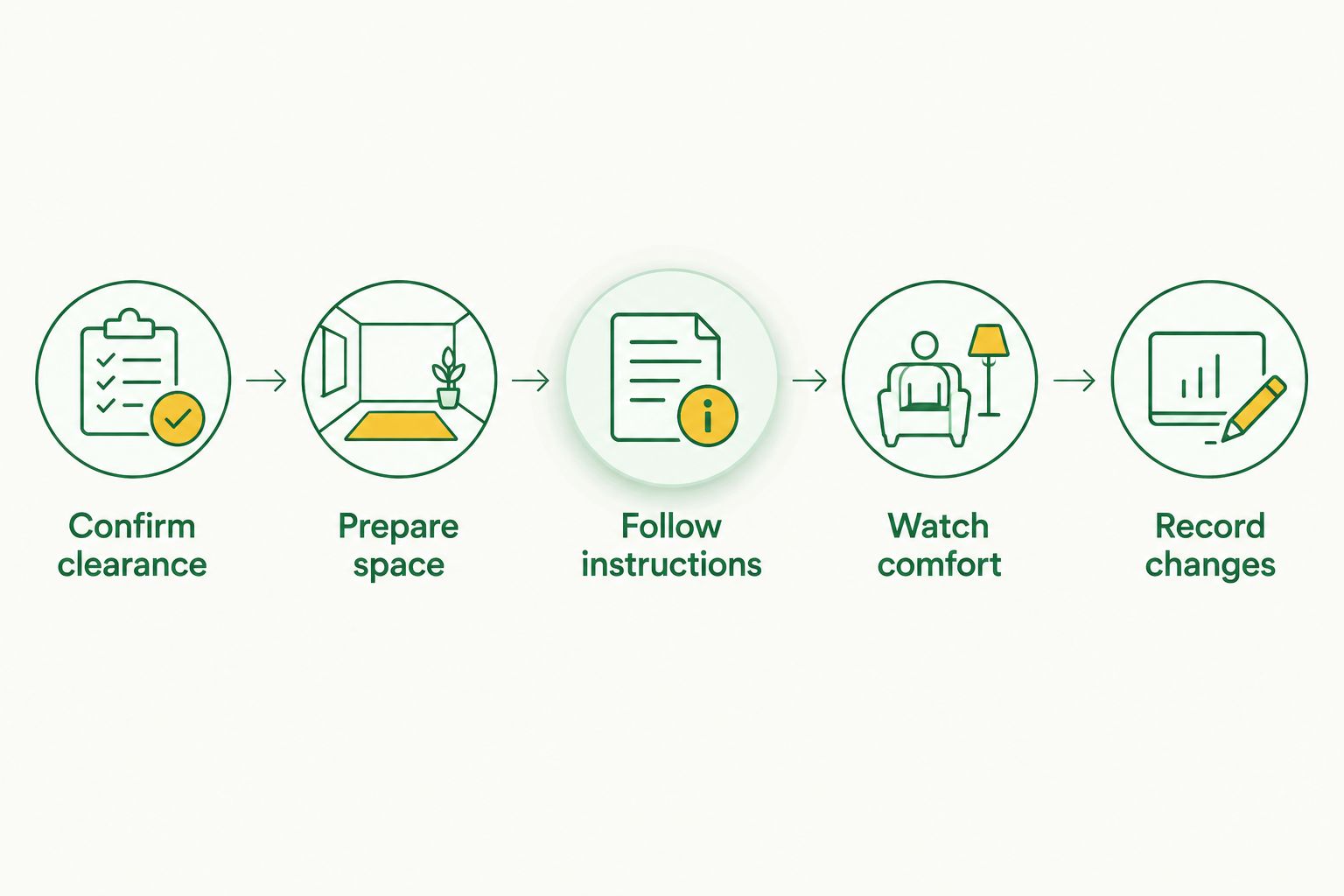
Prepare the complete activity before bringing your dog into the area. The following sequence organizes veterinary instructions; it does not prescribe an exercise or authorize platform use.
- Confirm clearance. Check that the activity is permitted under your dog's current instructions. Use the duration, repetitions, and frequency your veterinary team specifies.
- Prepare space. Choose a quiet area with secure footing and remove distractions. Set up the equipment exactly as your clinician has directed.
- Follow instructions. Use only the demonstrated approach, positioning, handling, and exit. Do not add a new movement because your dog seems comfortable.
- Watch comfort. Observe willingness, steadiness, and any change in movement. Stop if you see new pain, limping, instability, or distress.
- Record changes. Note what you observed and share concerns with the veterinary team before changing the plan.
Do not increase difficulty simply because the activity went smoothly. Successful completion means you followed the current plan. Progression is a separate decision for your veterinary team.
For a 2026 home-care record, describe observations rather than diagnosing them. Write down whether your dog hesitated, needed different assistance, or moved differently afterward. A brief video can help your clinician understand a concern; do not repeat a painful activity just to film it.
What should the activity area look like?
The approved activity area should be quiet, uncluttered, and easy for you to supervise. Keep a clear route to and from the equipment, with no loose objects your dog must step around. Prevent other pets from entering while the activity takes place.
Secure footing matters throughout that route, not only on the platform. Follow the manufacturer's setup instructions alongside your clinician's requirements. Do not improvise an unstable arrangement to change the equipment's height or make access easier.
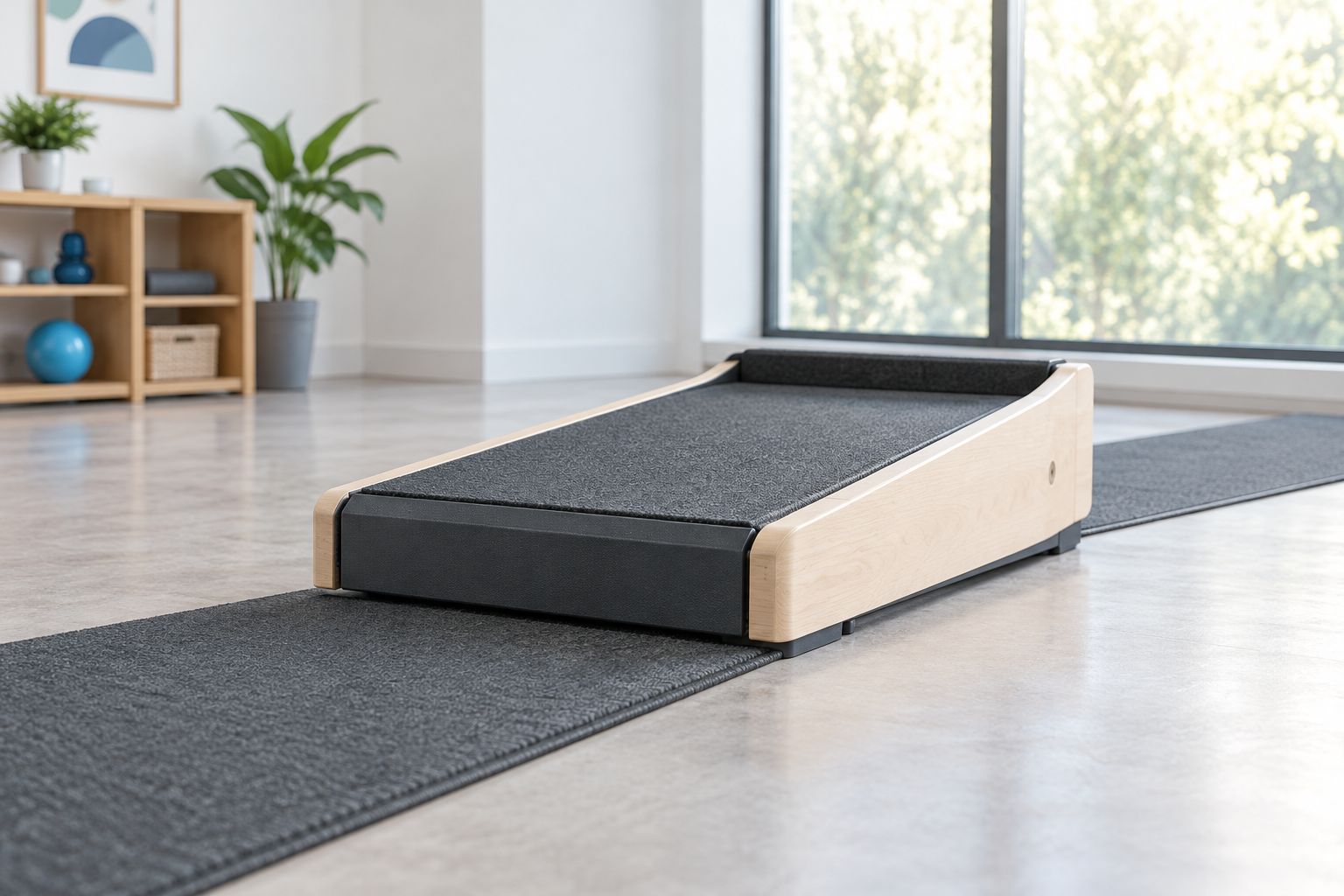
Keep the resting area separate from the training setup when practical. Your dog should not need to climb onto exercise equipment to access the place where you have been instructed to provide rest. Ask your veterinary team about any access problem you cannot resolve within the restrictions.
Can I start platform work as soon as my dog comes home?
No—coming home is not clearance for platform work. Follow the discharge instructions and ask the treating team whether any platform activity is permitted. If the paperwork is unclear, wait for clarification rather than testing your dog's ability.
Does a dog that looks comfortable still need approval?
Yes—a comfortable-looking dog still needs approval for postoperative platform activity. Willingness to move does not tell you whether a particular movement fits the surgical restrictions. Follow the prescribed plan rather than using enthusiasm as a readiness test.
Is a floor-level mat better than a raised platform after surgery?
A floor-level mat avoids a raised step, but it is not automatically an approved rehabilitation tool. The activity performed on it still needs to match your dog's instructions. Ask whether the clinician wants a mat, a platform, or no training station at all.
FAQ
Can a Klimb platform help my dog recover after surgery?
A Klimb platform can serve as equipment for veterinarian-approved rehabilitation, but it does not heal a surgical repair or replace prescribed rest. Approval must cover the activity and getting onto and off the platform.
When can I start using a Klimb platform after my dog's surgery?
Start only when your dog's surgeon or rehabilitation veterinarian approves the specific platform activity. There is no universal start date that applies to every surgery and recovering dog.
What's the safest way to introduce a platform to my recovering dog?
Ask your veterinary team to demonstrate the complete approved activity, including approach and exit. Do not lure your dog into jumping or introduce a new exercise without clearance.
Can my dog jump off the platform if it seems easy?
Do not allow jumping off when it conflicts with your dog's postoperative restrictions. Ease and willingness do not establish medical clearance; ask your veterinary team for an approved exit method.
How long should a postoperative platform session last?
Use the session duration, repetitions, and frequency prescribed by your veterinary team. Do not substitute a generic training schedule for your dog's recovery instructions.
What signs mean I should stop an approved platform activity?
Stop if your dog develops new pain, limping, instability, or distress, and contact the veterinary team. Also follow any procedure-specific stopping instructions provided at discharge.
Is K9outdoors' Klimb platform a replacement for rehabilitation appointments?
K9outdoors' Klimb platform is training equipment, not a replacement for veterinary rehabilitation assessment. Use it only for an activity your treating team has approved.
Does this 2026 guide replace my dog's discharge instructions?
No, this 2026 guide does not replace your dog's discharge instructions. The treating veterinary team's restrictions and prescribed activities take priority.
One last thing
The exit is part of the exercise. Before using any platform after surgery, ask your veterinary team to watch how your dog leaves it—not just how your dog stands on it. A familiar cue followed by an unapproved hop is still an unapproved movement.
Treat K9outdoors recovery-related gear as equipment to evaluate against the plan, not a reason to expand it. The right next move is the one your dog is cleared to perform, even when that means keeping the platform stored away.