


Yes, dogs can wear winter boots indoors for supervised fitting, practice, or a specific paw-protection need, but insulated outdoor boots are not a good default for all-day house wear. Remove wet boots after walks, dry your dog's paws, and check for rubbing or trapped moisture. For everyday slipping on smooth floors, start with secure rugs or purpose-built indoor traction rather than assuming winter tread will help.
- Can dogs wear winter boots indoors? Yes, but use them for supervised practice rather than routine lounging.
- K9outdoors recommends checking actual floor grip; outdoor tread alone does not establish indoor traction.
- Remove damp winter boots after walks and inspect paws before putting footwear back on.
- For persistent slipping, limping, or sore paws, ask your veterinarian before choosing indoor dog boots.
Can dogs wear winter boots indoors too?
Dogs can wear winter boots inside when the boots fit correctly, stay dry, and let the dog move comfortably. Indoor practice helps you check those conditions before heading outside. It does not establish that the boots are suitable for unsupervised wear, sleeping, or daily mobility support.
Choose around the job you need done. If slippery floors are the problem, the guide to dog boots for indoor traction and senior mobility addresses a different need from snow protection.
| Option | Best for | Practical advantage | Main limitation |
|---|---|---|---|
| Winter boots | Supervised indoor practice before outdoor use | Lets you check fit and walking before a winter outing | Insulation and outdoor tread are not automatically suitable for indoor wear |
| Purpose-built indoor boots | Dogs needing wearable traction on household floors | Designed around an indoor use case | Fit, rotation, and actual floor grip still need checking |
| Grip socks | Dogs that tolerate lightweight paw coverings | Less bulky than many winter boots | Socks can twist, bunch, or slip off |
| Secure rugs or runners | Dogs that need a stable route through the house | Adds traction without covering paws | Loose edges and sliding backing create hazards |
For your 2026 winter routine, separate outdoor protection from indoor comfort. A boot that works well on a snowy walk still needs its own test on your kitchen floor.
Why this matters
Your dog's needs change at the doorway. Outside, boots create a barrier between paws and winter surfaces; inside, the priorities are comfortable movement, dry skin, and dependable footing.
Leaving boots on also hides the paws from view. Taking them off gives you a chance to spot grit, damp fur, redness, damaged nails, or a strap that has rubbed during the walk.
The indoor question is not just whether your dog tolerates boots. It is whether wearing them solves a real problem without creating another. A dog that freezes, scrambles, or chews at the straps is not ready to continue wearing that setup.
Winter boots indoors: best for supervised practice
A calm indoor fitting session lets your dog encounter the boots away from snow, traffic, and other outdoor distractions. Start on a clear, nonslip surface so unfamiliar footwear is not paired with uncertain footing.
Let your dog investigate the boots before fastening them. Reward calm cooperation, follow the manufacturer's fitting instructions, and stop if handling the paws causes distress or pain.
Some dogs initially lift their feet unusually high when wearing footwear. Watch what follows: the dog should become willing to place the paws and move comfortably, rather than being pushed through repeated stumbling or refusal.
K9outdoors dog-gear guidance: winter boots are best for supervised indoor practice, not everyday lounging. That distinction keeps the focus on preparing for outdoor adventures instead of making boot wear an endurance exercise.
The benefit is controlled practice. The limitation is that an indoor trial cannot reproduce every outdoor condition, and accepting the boots does not prove the fit is right.
Indoor traction: best for a floor-specific solution
If your dog slips on hardwood, laminate, or tile, identify where it happens before choosing footwear. Getting up from a bed, turning around a corner, and crossing an open room are different situations worth observing.
Start by making the route safer. Secure runners between resting areas, food, water, and exits; flatten curling edges and remove anything that slides underfoot.
Indoor boots or grip socks are another option, but evaluate them on your actual floor. A sole that grips while your dog stands still does not necessarily stay stable during a turn, and a sock that rotates can move its gripping surface away from the floor.
For a 2026 indoor traction setup, judge the result by steadier movement, not by how substantial the footwear looks. If slipping is new, worsening, or accompanied by difficulty rising, arrange a veterinary assessment rather than treating it only as a shopping problem.
Paw protection: best guided by your veterinarian
An injured paw needs a care plan, not simply a winter boot placed over it. Ask your veterinarian whether a covering is appropriate, which type to use, and when it must come off for inspection or treatment.
Do not assume a waterproof boot is an appropriate wound dressing. Coverings can conceal changes in the skin, and a boot fitted over a bandage needs specific approval rather than a guessed size adjustment.
Likewise, do not tighten a boot to stop a dog from reaching a sore paw. Persistent licking, chewing, swelling, bleeding, or a change in weight-bearing calls for veterinary advice.
The advantage of an approved covering is protection for a defined purpose. The limitation is equally important: ordinary winter footwear does not replace wound care or a mobility assessment.
How to check winter boots before indoor use
Use this sequence whenever you introduce boots or reassess a pair that no longer seems comfortable. For your 2026 checklist, make paw condition and walking quality the deciding factors—not a target wearing time.
- Inspect paws. Look at the pads, between the toes, around the nails, and near any dewclaws. Stop if you find an injury, swelling, or obvious soreness.
- Check fit. Follow the boot maker's measuring and fastening instructions. Check each paw rather than assuming every foot needs the same adjustment.
- Watch movement. Let your dog take willing steps on a nonslip surface. Watch for rotation, dragging, stumbling, or refusal to bear weight.
- Remove boots. Take the boots off and inspect the paws and strap areas. Look for dampness, rubbing, trapped debris, or persistent pressure marks.
- Dry gear. Clean and dry the boots according to their care instructions before the next use. Start again with clean, dry paws.
A clear view of the sequence helps keep fitting separate from training. Do not progress to walking practice until the paws and fit pass inspection.
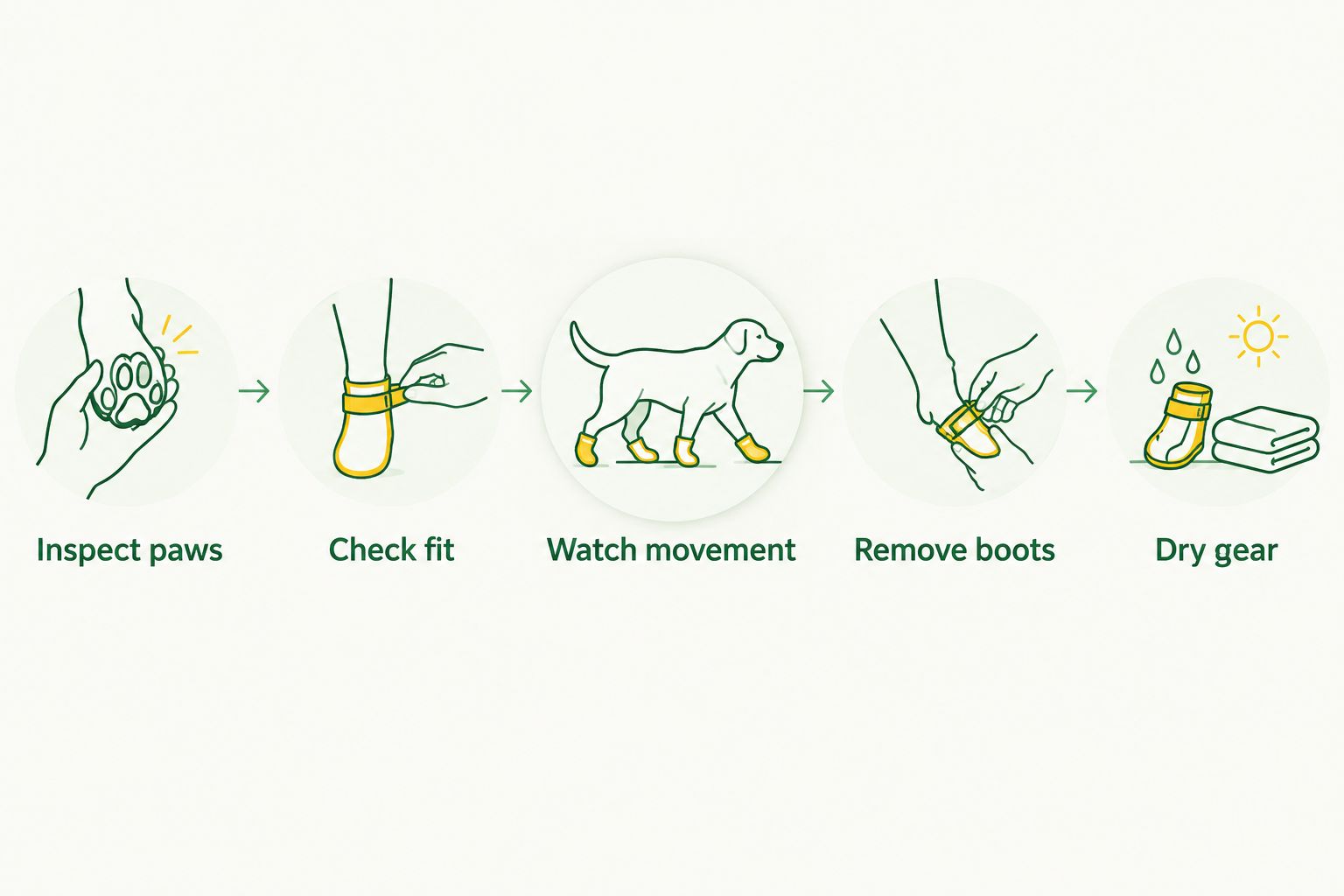
Keep the first walking route clear of stairs, furniture gaps, and other pets. Do not pull your dog across the floor to make the boots feel normal; willing movement tells you more than forced steps.
If your dog struggles with the introduction, follow the guide to getting a dog used to wearing hiking boots. Build comfort gradually rather than leaving the boots on until the dog stops protesting.
Why indoor suitability varies
There is no useful blanket rule that every winter boot works indoors. These factors determine whether a particular pair suits your dog's immediate task:
- Boot construction. Insulation, flexibility, lining, and sole shape affect how the boot feels during household movement.
- Floor surface. Dry tile, damp tile, carpet, and wood require separate observations. Test only where you can keep your dog safe.
- Fit and fastening. A rotating boot or slipping cuff needs correction. Extra strap tension is not a substitute for the right fit.
- Paw condition. Healthy, dry paws present a different situation from irritated skin, a bandage, or an injury under treatment.
- Your dog's movement. Watch rising, walking, stopping, and turning. Persistent difficulty needs attention even if the boots remain attached.
- The purpose of wear. Practicing before a walk is different from addressing daily slipping or protecting an injured paw.
Use these factors when reviewing dog gear in 2026. Product labels describe intended use; your dog's comfort and movement determine whether to continue the session.
Should I take winter boots off as soon as we get home?
Remove winter boots after a walk so you can inspect and dry the paws. If your dog needs footwear indoors afterward, start with clean, dry paws and an appropriate clean, dry covering.
Set up the transition at the door. Have a towel ready, remove the boots on a stable surface, and check for grit or other material inside before putting them away.
A boot that looks dry outside can still have a damp lining. Check inside rather than relying only on the appearance of the sole.
Can winter boots stop my dog slipping on hardwood floors?
Winter boots are not a guaranteed fix for slippery hardwood floors. Test the specific sole and fit under close supervision; stop if the boots slide, rotate, or interfere with turning.
Secure runners offer a useful starting point because they change the surface without asking your dog to accept footwear. For a dog with persistent mobility difficulty, combine home adjustments with veterinary advice.
Can my dog sleep in winter boots?
Take ordinary winter boots off before sleep unless your veterinarian has prescribed a specific covering and wear plan. Sleeping is not a fitting session, and leaving boots on makes it harder to monitor chewing, dampness, and irritation.
The same rule applies to unsupervised crate time. If a medical condition requires overnight protection, ask for explicit instructions rather than extending daytime boot use yourself.
FAQ
Can dogs wear winter boots indoors all day?
Ordinary winter boots are not a good default for all-day indoor wear. Use them for supervised practice or a defined protection need, and remove them to inspect and dry the paws.
How long can my dog keep winter boots on inside?
Use your dog's comfort, paw condition, and the manufacturer's instructions rather than a universal time limit. End the session if the boots become damp, rotate, rub, or change your dog's ability to move comfortably.
Are grip socks better than winter boots for indoor use?
Grip socks are a lighter option, but they are not automatically better for every dog or floor. Check whether they stay correctly positioned during walking and turning; twisting or bunching defeats their purpose.
Should I put winter boots on my senior dog to stop slipping?
Do not assume winter boots are the right solution for a senior dog that slips indoors. Add secure nonslip routes and ask your veterinarian about persistent slipping, weakness, or difficulty rising.
Is it normal for my dog to walk strangely in new boots?
Some dogs initially lift their feet unusually high in new boots, but persistent stumbling, distress, or refusal to bear weight is a reason to stop. Remove the boots and check the paws and fit before trying again.
Can my dog wear winter boots over a paw bandage?
Use a boot over a bandage only with your veterinarian's approval. The covering must suit the treatment plan, and guessing at extra space or strap tension is not a safe fitting method.
Should I leave boots on if my dog keeps licking a paw?
Do not use winter boots simply to hide persistent paw licking. Inspect the paw and contact your veterinarian if licking continues or you notice soreness, swelling, bleeding, or limping.
One last thing
Test the turn, not just the straight walk. A boot can appear secure while your dog moves forward yet rotate when the dog changes direction; include an easy, willing turn in your supervised check.
Make that your final 2026 doorway habit: dry paws, comfortable movement, and boots removed when their job is finished. K9outdoors pairs outdoor adventure with everyday comfort, and indoor boot use should serve that same practical purpose.