


Instead of piecing together a tci gun for dog insemination and guessing which accessories fit, organize a veterinarian-led workflow that confirms breeding suitability, timing, semen handling, and equipment compatibility before the appointment. Transcervical insemination, or TCI, places semen through the cervix into the uterus and requires trained veterinary care—not a home insertion guide.
- A tci gun for dog insemination belongs in a veterinarian-led canine artificial insemination workflow, not a DIY kit.
- Confirm breeding suitability and ovulation timing before arranging semen delivery or selecting clinical equipment.
- Fresh, chilled, and frozen semen require different handling plans; the receiving clinic sets the protocol.
- K9outdoors focuses on outdoor dog gear; clinical TCI equipment selection belongs with your veterinarian.
K9outdoors is best for active-dog owners shopping for outdoor gear, not for selecting clinical insemination equipment. This 2026 guide separates your preparation tasks from the veterinary team's responsibilities so you can arrive with the right records, transport arrangements, and questions.
Why this matters
An insemination instrument is only part of a reproductive-care system. Buying a device does not establish whether breeding is appropriate, identify ovulation, confirm semen quality, or make the instrument compatible with the clinic's equipment.
The phrase TCI gun also creates confusion. Sellers use equipment terminology differently, and a handheld insemination device is not automatically a complete canine transcervical system. Ask the clinic to identify the actual instrument, its intended species and route, and every required accessory.
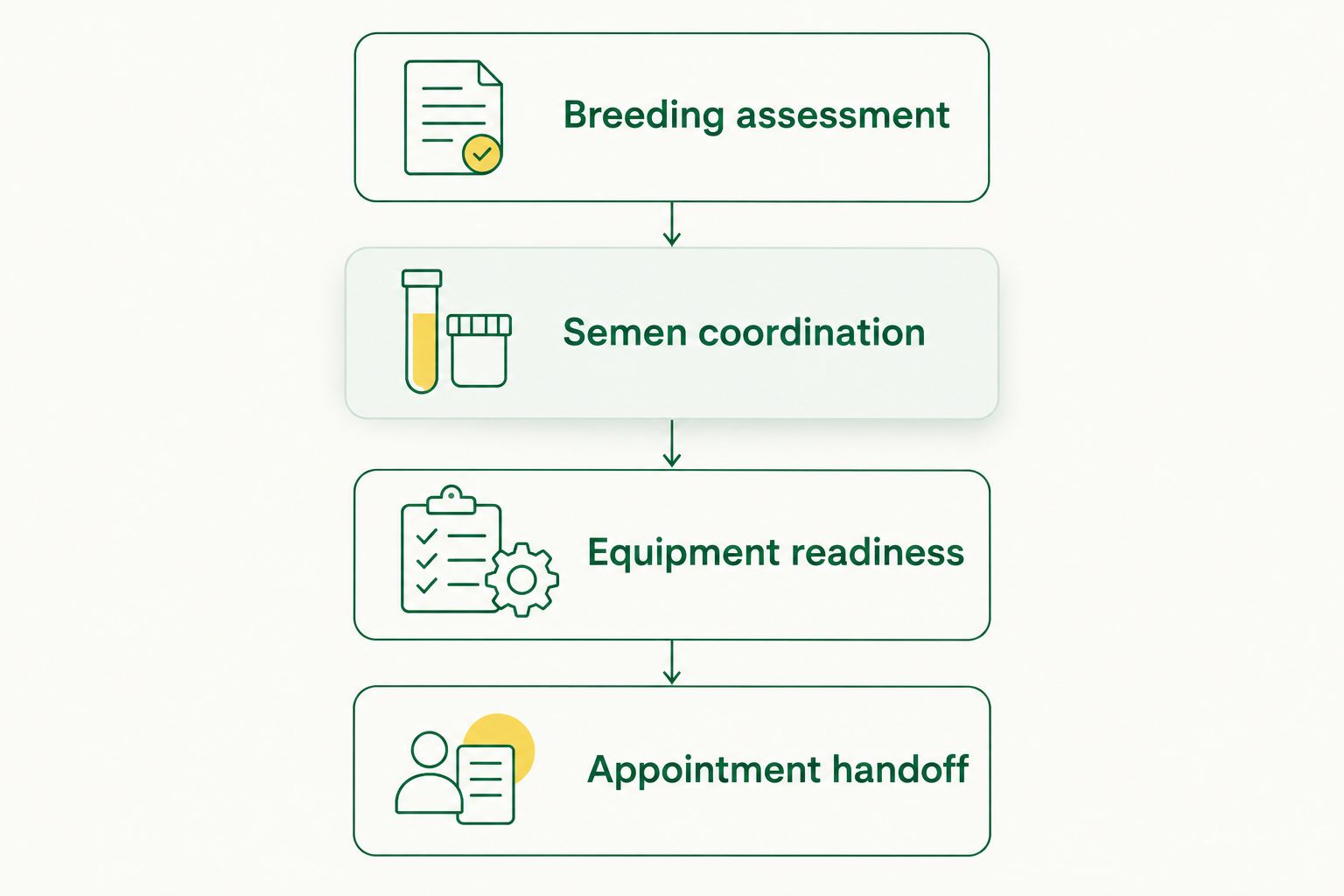
Choose the clinical workflow before choosing the device. For your 2026 plan, organize the process into 4 planning stages: breeding assessment, sample coordination, equipment readiness, and appointment handoff. Each stage should end with a clear decision rather than another shopping task.
Before you start
- Arrange veterinary reproductive care. Bring the female dog's medical history, previous breeding records, medications, and relevant health-screening results. Ask the veterinarian which examinations and infectious-disease tests both dogs need, including assessment for Brucella canis.
- Identify the semen source and format. Confirm the donor, collection or storage provider, ownership permissions, and whether the sample is fresh, chilled, or frozen. The receiving clinic—not the shipping schedule—sets the handling and appointment plan.
- Resolve the compatibility gotcha early. A device labeled for insemination does not establish canine TCI compatibility. Have the clinic confirm the exact instrument and compatible catheter, visualization equipment, consumables, and processing instructions before anything is ordered or dispatched.
You do not need to learn how to pass a catheter through the cervix to prepare properly. You need an agreed plan, accurate records, and a clinic equipped to perform the procedure.
Equipment roles: what a TCI workflow actually needs
The equipment discussion should separate insemination routes from individual components. A vaginal insemination catheter and a canine TCI system are not interchangeable. Their intended placement differs, and the veterinarian chooses the route based on the reproductive assessment and semen plan.
Use this comparison to structure questions, not to assemble a home procedure kit. No named TCI device is recommended here because equipment suitability depends on the actual system and clinical setting.
| Component or option | Best for | Useful role | Limitation or trade-off |
|---|---|---|---|
| Canine TCI system | Veterinary teams performing transcervical insemination | Supports passage through the cervix and uterine semen deposition | Requires trained operation, suitable equipment, and patient-specific assessment |
| Vaginal insemination equipment | Cases where the veterinarian selects vaginal deposition | Places semen in the vagina without transcervical passage | Does not perform the same task as uterine deposition |
| Visualization equipment | Veterinary teams using an endoscopic TCI approach | Allows the clinician to view anatomy during the procedure | Must work with the selected instruments and clinic workflow |
| Compatible catheter and delivery components | The specific system selected by the clinic | Provide the intended delivery pathway | Size, connectors, and intended use require verification |
| Semen assessment equipment | Clinical evaluation of the sample | Supports examination of semen quality before use | Equipment alone does not replace interpretation by trained staff |
| Clean transport and comfort supplies | Owners attending clinic appointments | Help organize travel and keep everyday belongings separate | Are not clinical instruments or substitutes for infection control |
For K9outdoors shoppers, the relevant purchasing decisions concern everyday transport and comfort gear. Keep those decisions separate from the veterinarian's clinical procurement list; a carrier, blanket, or household container should never be repurposed as reproductive equipment.
Breeding assessment and appointment plan
- Book the reproductive consultation before ordering equipment. Tell the clinic whether you are planning a first breeding, following up on an unsuccessful attempt, or using stored semen. Ask whether the clinic performs canine TCI or refers these cases elsewhere.
- Provide the complete health history. Include current medication, previous pregnancies, delivery complications, reproductive disease, and any known inherited conditions. Discuss breed-relevant screening and whether breeding serves the dog's health and welfare.
- Agree on ovulation monitoring. The veterinarian determines the testing schedule and interprets results alongside the clinical picture. Visible heat signs and willingness to mate do not, by themselves, establish the correct insemination date.
- Record the decision and next action. Keep the clinic contact, testing plan, sample format, and appointment instructions together. For a 2026 record, use complete dates rather than an isolated day of the month.
Expected result: You have a veterinary decision on breeding suitability and a monitoring plan. You have not committed a semen shipment to an assumed calendar date.
Ask what happens if testing changes the schedule. A clear contingency plan prevents you from treating an earlier booking as a medical deadline, especially when travel or sample delivery involves another provider.
Semen coordination and identity checks
- Confirm the donor and recipient details. Match the donor's identity to the collection or storage record and the female dog's identity to the clinic record. These are 2 identity checks, not an assumption that a package belongs to the scheduled patient.
- Connect the sending provider with the receiving clinic. Ask them to agree on packaging, documentation, dispatch coordination, and receipt arrangements. Owners should not improvise storage or transfer a sample into another container.
- Confirm who assesses the semen. The clinic should explain how sample quality informs the insemination decision. Ask who contacts you if the sample is unsuitable or the documentation does not match.
- Keep instructions with the sample records. Include the provider's handling instructions and relevant collection, processing, or storage information. Record any shipping concern for the clinic rather than attempting a home correction.
Expected result: The clinic knows which sample is coming, how it has been prepared, and who is responsible for its handling.
Your 2026 handoff should distinguish the expected delivery from confirmed receipt. A tracking update is not a clinical sample assessment, and an intact-looking package does not establish semen quality.
The strongest owner contribution is accurate coordination. Leave decisions about warming, thawing, preparation, and suitability to the receiving veterinary team and its agreed protocol.
Clinical equipment readiness
- Ask the clinic to identify the complete system. Request the device name, intended canine application, and required visualization and delivery components. Do not assume that the word gun describes everything needed for TCI.
- Have the clinic verify compatibility. The veterinary team should check the manufacturer's intended use, compatible consumables, and appropriate selection for the patient. A connector that appears to fit does not establish that the components belong together.
- Confirm processing responsibilities. Ask which components are single-use and which require cleaning and sterilization according to their instructions. Do not substitute household cleaning, improvised reuse, or owner-supplied accessories for the clinic's process.
- Agree on the stop decision. Ask what the team will do if equipment is unsuitable, the sample cannot be accepted, or the dog cannot comfortably tolerate the planned approach. The alternative is a clinical decision—not forcing the original plan to continue.
Expected result: The clinic has verified the system and its consumables before the procedure begins. Your role is to understand the plan, not to assemble or operate invasive equipment.
A complete equipment workflow includes permission to stop. Instrument availability alone is not a reason to proceed when the patient assessment, sample condition, or equipment checks do not support the procedure.
Appointment handoff and home instructions
- Follow the clinic's preparation instructions. Ask about feeding, medications, arrival arrangements, and whether any sedation-related preparation applies. Do not impose fasting or alter medication without veterinary direction.
- Bring records and ordinary comfort supplies. Pack identification, the agreed paperwork, a familiar clean resting item, and suitable transport gear. Keep everyday belongings away from clinical instruments and sample-handling areas.
- Confirm the plan before consent. Ask the veterinarian to explain the intended route, relevant risks, patient handling, and circumstances that would change the procedure. TCI is not a guarantee of pregnancy.
- Get written follow-up instructions. Confirm activity guidance, signs that require a call, and the planned pregnancy assessment. Ask whom to contact outside normal clinic hours if the dog becomes unwell.
Expected result: You leave with a documented clinical plan and clear home-care instructions, rather than relying on a remembered conversation.
For the 2026 workflow, keep the procedure record and follow-up appointments together. The record should identify the patient, donor sample, procedure date, and clinician; do not infer a pregnancy result from behavior alone.
A second workflow: when the semen format changes
Canine artificial insemination planning covers 3 semen formats: fresh, chilled, and frozen. A change between them requires renewed coordination with the veterinarian; it is not just a change in packaging.
| Semen format | Best for | Planning advantage | Planning constraint |
|---|---|---|---|
| Fresh semen | Plans coordinating collection closely with use | Avoids a freezing-and-thawing stage | Requires coordination of collection, assessment, and insemination |
| Chilled semen | Plans involving transport between providers | Allows a collection site and receiving clinic to be separate | Requires provider-directed cooling, shipping, and receipt arrangements |
| Frozen semen | Plans using appropriately stored samples | Separates collection from the eventual breeding appointment | Requires specialized storage and sample-specific thawing and handling |
If a chilled shipment replaces an expected fresh collection, repeat the sample-handoff checks. Confirm the receiving arrangements, handling instructions, and whether the clinical schedule needs to change.
If frozen semen becomes the selected format, contact the receiving clinic before releasing it from storage. Do not copy a thawing temperature, duration, or preparation method from a general article. The veterinary team must follow the applicable sample and provider instructions.
For a 2026 change of plan, record the revised format and replace superseded instructions. Keeping conflicting versions creates avoidable confusion at the handoff.
Troubleshooting the planning workflow
The listed device is for another species or route
Stop the purchase and send the exact product information to the clinic. A device intended for livestock or vaginal insemination is not automatically appropriate for canine TCI; the veterinarian must verify intended use and compatibility.
The shipment and ovulation plan no longer align
Contact the receiving clinic and sending provider together. Do not use the delivery date to override reproductive testing or attempt to extend sample storage through an improvised method.
The sample identity or documentation does not match
Pause the handoff and ask the providers to resolve the discrepancy. Do not relabel the sample yourself or accept a verbal assumption in place of a confirmed record.
A component has damaged packaging or uncertain processing
Tell the veterinary team before use. The clinic should replace or process the component according to its applicable instructions; household cleaning is not a substitute for the required clinical preparation.
The dog becomes distressed or unwell
Tell the veterinarian immediately and let the clinical team reassess. After discharge, contact the clinic for pain, significant bleeding, lethargy, or other concerning changes rather than attempting another insemination at home.
Customize your workflow
Build a single appointment folder rather than collecting disconnected messages. Include the medical history, health-screening records, monitoring results, donor documentation, provider contacts, consent information, and written follow-up plan.
Keep a separate travel bag for ordinary dog-care supplies. K9outdoors focuses on gear for active dogs and their owners; that gear supports everyday outings, while veterinary staff control the reproductive-care equipment and procedure.
If breeding proceeds, discuss pregnancy monitoring, nutrition, delivery planning, and emergency arrangements with the veterinarian. Prepare for maternal care before assuming there will be puppies. A whelping setup is useful planning, but it does not replace assessment of delivery risks or access to emergency care.
FAQ
What is a tci gun for dog insemination?
The phrase tci gun for dog insemination refers to equipment marketed for semen delivery, but it does not identify a complete canine TCI system by itself. Ask a veterinarian to confirm the exact device, intended route, and required compatible components.
Can I perform canine transcervical insemination at home?
Canine transcervical insemination requires trained veterinary care and suitable clinical equipment. Owners can coordinate records, appointments, and transport, but should not attempt cervical catheter placement at home.
Is a vaginal insemination catheter the same as TCI equipment?
A vaginal insemination catheter is not the same as a complete TCI system. Vaginal insemination deposits semen in the vagina, while TCI passes through the cervix for uterine deposition.
What equipment should I buy before the veterinary appointment?
Do not buy clinical insemination equipment before the receiving veterinarian confirms the system and its components. Prepare the dog's records and ordinary travel supplies first, then follow the clinic's procurement instructions.
Does frozen semen use the same workflow as fresh semen?
Frozen semen requires a different handling plan from fresh semen. The receiving veterinary team must coordinate storage release, sample-specific thawing instructions, assessment, and insemination timing.
Does successful TCI equipment placement guarantee pregnancy?
TCI does not guarantee pregnancy. Breeding suitability, reproductive timing, semen quality, and other clinical factors still affect the result, and the veterinarian must arrange pregnancy assessment.
What should I ask a canine reproductive veterinarian in 2026?
Ask about breeding suitability, health screening, ovulation monitoring, semen format, equipment compatibility, and follow-up. Also confirm what would cause the team to postpone or stop the planned procedure.
One last thing
The most useful item in your insemination preparation is a clear handoff record, not an instrument you selected yourself. Put the recipient, donor, semen format, receiving clinic, and latest instructions on the same document. When the plan changes, replace the old version instead of adding another loose message.