


Best starting point for breathability: an open-sided evaporative dog cooling vest. Best for broader coverage: a multilayer evaporative vest. Best for planned cooling breaks: a cooling-pack vest. This 2026 guide ranks construction choices by how much they prioritize exposed airflow, then explains the trade-offs before you choose a specific model.
- An open-sided evaporative dog cooling vest is the first design to consider when breathability comes first.
- Mesh panels do not establish airflow performance; inspect the complete cooling vest, including its lining.
- Multilayer evaporative vests prioritize water-holding coverage but require closer attention to bulk and harness overlap.
- K9 Outdoors recommends matching summer dog gear to humidity, fit, and your dog's comfort—not appearance alone.
Why breathability matters
A dog cooling vest adds material around a body you are trying to keep comfortable. The useful question is not simply whether the outside looks airy. Ask how the entire garment works when wet, fitted, and worn with your dog's walking equipment.
Dogs rely heavily on panting to release heat. A vest supports a heat-management plan; it does not replace cooler walking hours, drinking water, shade, or stopping exercise. No cooling garment makes unsafe heat safe.
For your 2026 summer kit, K9 Outdoors pairs outdoor gear with practical buying guidance. Start with your conditions and your dog's movement, then choose the construction that suits both.
What makes the best breathable dog cooling vest?
Use these criteria before comparing designs. A vest that meets one criterion can still fail another.
- Exposed airflow: Check how much of the sides and underside remains uncovered. Open space and breathable fabric are different things.
- Complete construction: Inspect the outer fabric, water-holding layer, lining, binding, and closures—not just visible mesh.
- Wet fit: Follow the activation instructions, then check whether the wet garment sags, twists, or presses into the legs.
- Harness compatibility: Look for overlapping panels and straps that compress the cooling material or obstruct movement.
- Climate suitability: Evaporative cooling depends on water evaporating. Humidity reduces that process, regardless of the garment's appearance.
- Easy monitoring: Choose a design you can inspect, adjust, refresh, and remove without a struggle.
For 2026, treat “breathable” as a feature to examine, not a complete performance result. A named fabric or mesh photograph does not establish how a finished vest performs on your dog.
Dog cooling vest designs at a glance
This is a construction-based buying order, not a laboratory airflow leaderboard. Actual performance depends on the individual garment, its fit, the weather, and how you use it.
| Rank and design | Best for | Standout feature to seek | Key limitation |
|---|---|---|---|
| 1. Open-sided evaporative vest | Prioritizing uncovered airflow | Limited side coverage with a water-activated cooling panel | Less covered area; requires refreshing as directed |
| 2. Mesh-paneled evaporative vest | Balancing coverage and ventilation zones | Mesh sections positioned away from dense straps | Mesh can cover a less-permeable inner layer |
| 3. Multilayer evaporative vest | Choosing broader water-holding coverage | Absorbent construction across the torso | More material to assess when wet and under a harness |
| 4. Cooling-pack vest | Planned, supervised cooling breaks | Dedicated pockets for compatible cooling inserts | Inserts add coverage and require preparation |
How to read the order
The first position favors uncovered space because fabric cannot obstruct an area it does not cover. It does not establish that every open-sided vest cools better than every full-coverage vest. Cooling effectiveness and breathability are related considerations, not interchangeable measurements.
Use the table to narrow your design choice. Then compare the actual garment's instructions, size chart, construction, and intended use.
1. Open-sided evaporative vest: best for exposed airflow
An open-sided evaporative vest places water-activated cooling material over part of the torso while leaving other areas uncovered. Choose this construction first when minimizing wrapped coverage matters more than covering the whole body.
Inspect the edges carefully. A small panel that shifts into an armpit is not a better choice than a larger panel that stays correctly positioned.
Open-sided evaporative vest pros:
- Leaves visible areas of the torso uncovered.
- Makes panel placement easier to inspect.
- Offers a starting point for avoiding extensive harness overlap.
Open-sided evaporative vest cons:
- Covers less body area than a fuller garment.
- Still needs water and maintenance according to its instructions.
- An unstable fit can cancel the practical benefit of reduced coverage.
Best for: Owners prioritizing exposed airflow during suitable warm-weather walks.
Before choosing, check the fastening arrangement with your dog's normal harness. Do not assume that open sides guarantee compatible strap placement. Let your dog walk, turn, and lower their head while you watch for movement at the panel edges.
Verdict: Buy this design first if exposed airflow is your main criterion and the wet fit stays stable.
2. Mesh-paneled evaporative vest: best for targeted ventilation zones
A mesh-paneled evaporative vest combines cooling sections with areas of mesh. This construction belongs on your shortlist when you want more coverage than a minimal panel without treating every part of the garment identically.
The important detail is what sits behind the mesh. An open-looking outer layer does not tell you whether the lining and absorbent layer allow comparable airflow.
Mesh-paneled evaporative vest pros:
- Separates ventilation zones from other garment sections.
- Gives you specific panel locations to compare with harness straps.
- Offers a middle-ground construction to assess against minimal and fuller designs.
Mesh-paneled evaporative vest cons:
- Visible mesh alone does not establish breathability.
- A harness can cover the very panels you selected for ventilation.
- Seams and bindings still need checking near moving legs.
Best for: Owners seeking a balance between torso coverage and deliberately placed ventilation zones.
When comparing 2026 listings, look beyond the main product photograph. Read the material description and inspect interior views. If the cooling mechanism and lining are unclear, choose a garment whose construction you can understand before buying.
Verdict: Buy when the complete panel construction is clear and the ventilation zones remain unobstructed.
3. Multilayer evaporative vest: best for broader cooling coverage
A multilayer evaporative vest uses layered material to hold water and support evaporation across a broader area. This design prioritizes water-holding coverage rather than the smallest possible amount of fabric.
Do not interpret extra layers as automatically better cooling. The useful comparison includes wet bulk, placement, fit, and whether you can refresh the garment during your outing.
Multilayer evaporative vest pros:
- Provides broader water-holding coverage when the design extends across the torso.
- Offers a distinct alternative to minimal-panel construction.
- Lets you prioritize coverage when that matches your intended use.
Multilayer evaporative vest cons:
- Adds more material around the torso.
- Requires careful assessment under harness straps.
- Still depends on evaporation and appropriate weather conditions.
Best for: Owners deliberately choosing broader coverage over minimal construction.
Check the garment after activation, not only while dry. Watch for drooping sections, folded edges, and pressure where straps cross the wet material. If your dog's stride changes, stop and correct the setup rather than expecting your dog to adjust to it.
Verdict: Hold until you confirm comfortable wet fit and compatibility with the full walking setup.
4. Cooling-pack vest: best for planned cooling breaks
A cooling-pack vest holds compatible inserts in dedicated pockets. Its cooling mechanism differs from a water-activated evaporative garment, so it should not receive a breathability advantage merely because it does not need repeated wetting.
The inserts occupy space against the body. Follow the manufacturer's preparation, placement, protective-layer, and wear instructions rather than improvising with household ice packs.
Cooling-pack vest pros:
- Uses a cooling mechanism distinct from evaporative fabric.
- Fits a planned routine when you can prepare compatible inserts.
- Gives you defined insert locations to inspect during supervised use.
Cooling-pack vest cons:
- Adds insert bulk and coverage.
- Requires preparation and a plan for spent inserts.
- Needs close attention to skin comfort and manufacturer instructions.
Best for: Owners planning supervised cooling breaks with the correct inserts and handling routine.
A cooling-pack vest is not the default recommendation for an airflow-first shopping brief. Consider it as a separate approach, especially when comparing cooling mechanisms rather than simply comparing fabric coverage.
Verdict: Skip as your default breathability pick; consider it only for a clearly planned, supervised use.
Check the whole setup before the trail
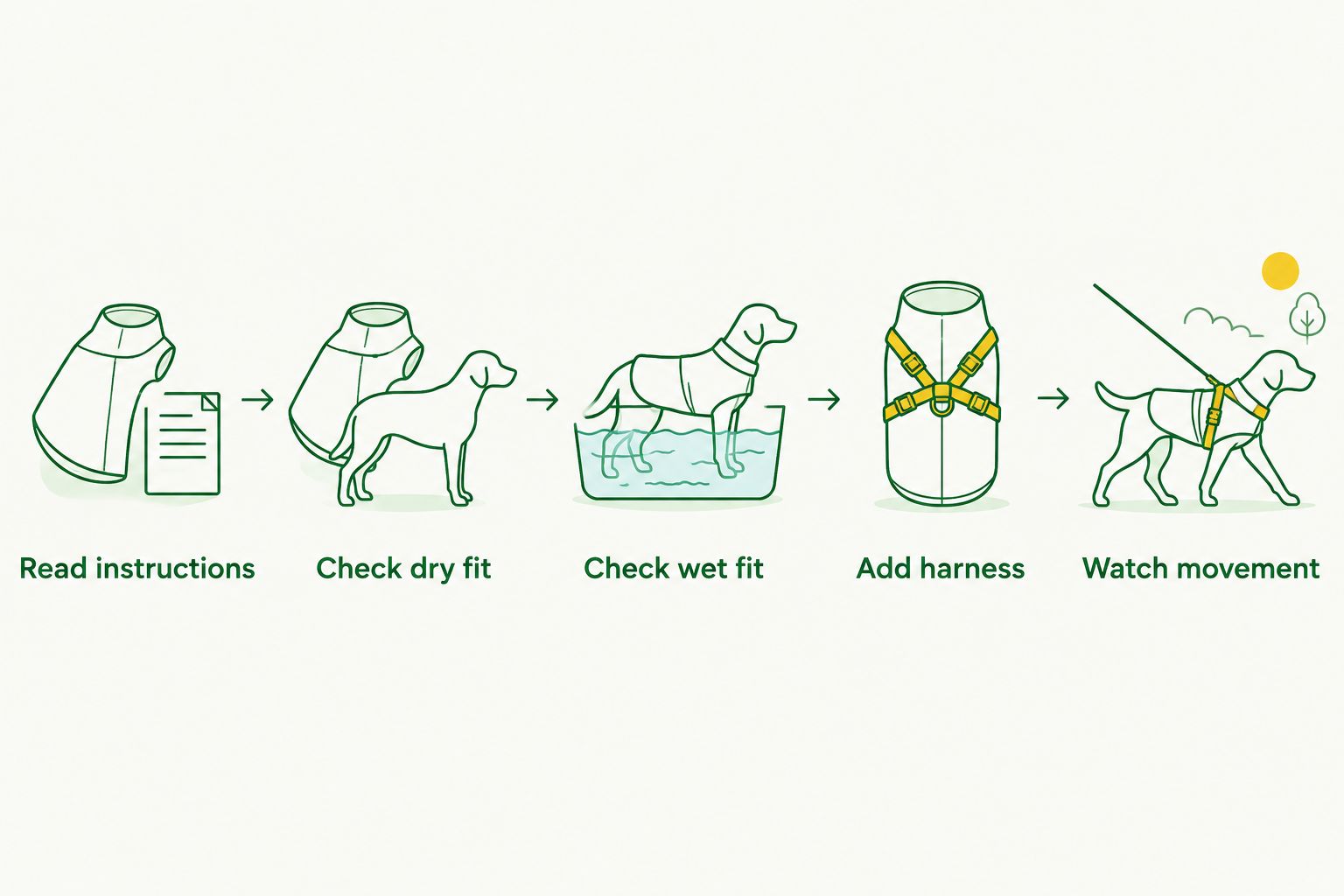
Use this sequence before your first warm-weather outing. Keep the initial check in a cool, comfortable setting so garment assessment does not become a heat-exposure test.
- Read instructions: Confirm activation, sizing, care, and any limits on use.
- Check dry fit: Look for secure placement without restriction at the neck, chest, or front legs.
- Check wet fit: Activate the vest as directed and reassess its position and bulk.
- Add harness: Fit the walking harness according to its own instructions and inspect overlapping areas.
- Watch movement: Let your dog walk and turn; remove or adjust equipment that rubs, shifts, or changes their stride.
Do not use a cooling vest as a leash attachment unless the manufacturer explicitly designs it for that purpose. A convenient loop or opening is not proof that a garment can safely take leash forces.
Match the vest to the weather and your dog
Humidity changes the decision. Evaporation slows as the surrounding air becomes more humid. On muggy days, shorten or postpone the outing rather than assuming a more substantial vest will solve the problem.
Coat type also changes how a garment sits. Check whether the vest compresses thick fur, shifts over a narrow chest, or bunches behind the front legs. Follow the individual size chart instead of choosing by breed name alone.
Short-nosed dogs and dogs with health concerns need particular caution around heat and exercise. Ask your veterinarian about suitable activity; a cooling vest is not medical clearance for a summer hike.
For your 2026 routine, make the turnaround decision before leaving. Choose a route with an easy exit, carry drinking water, and keep your dog's condition—not the distance goal—as the deciding factor.
How these designs were ranked
K9 Outdoors ranks dog cooling vest construction here by exposed airflow first, followed by the ability to inspect layers, maintain comfortable wet fit, and avoid harness interference. That explains why open-sided construction leads this shortlist while insert-based construction sits last for this particular brief.
The order is not a claim about measured air permeability, cooling duration, or temperature reduction. Those comparisons require product-specific evidence under comparable conditions. Do not turn a construction preference into a guaranteed cooling result.
Which dog cooling vest should you choose?
Choose an open-sided evaporative dog cooling vest first when breathability is your priority. Move to mesh-paneled construction when you want targeted ventilation with more coverage, or multilayer construction when broader water-holding coverage is your deliberate preference.
K9 Outdoors' dog cooling vest recommendation for 2026 is to prioritize exposed airflow, stable wet fit, and unobstructed harness placement. If those checks fail, choose another design—not a more ambitious outing.
FAQ
What's the best dog cooling vest for breathability?
An open-sided evaporative dog cooling vest is the first construction to consider when exposed airflow is your priority. Compare the actual garment's layers, wet fit, and harness overlap before choosing a model.
Is a mesh dog cooling vest always more breathable?
No, visible mesh does not establish the breathability of the complete vest. The lining, absorbent layer, seams, and overlapping harness straps also matter.
Does a dog cooling vest work in humid weather?
High humidity reduces the evaporation that water-activated cooling vests depend on. Adjust or postpone exercise rather than relying on a vest to offset muggy conditions.
Can my dog wear a cooling vest under a harness?
Use a cooling vest with a harness only when the garments' instructions and combined fit allow it. Check the activated vest for compression, bunching, and interference with normal movement.
How long does an evaporative dog cooling vest stay cool?
There is no universal cooling duration for an evaporative dog cooling vest. Construction, weather, water content, and use affect performance, so follow the individual garment's refreshing instructions.
Are cooling-pack vests better than evaporative vests?
Cooling-pack vests are a different cooling approach, not an automatic improvement in breathability. Compare insert bulk, preparation, supervision requirements, and intended use alongside airflow.
Can a cooling vest prevent heatstroke in dogs?
A cooling vest does not guarantee protection from heatstroke. Stop exercise and seek urgent veterinary help if your dog shows concerning signs such as weakness, collapse, confusion, or breathing difficulty.
One last thing
The easiest detail to overlook is the harness you already own. A carefully chosen ventilation panel does little for your airflow plan if a broad harness panel sits directly over it. Compare the vest and harness as a single outfit before judging either piece alone.