


The right dog crate mat sizes match the usable inside floor of your crate, not its outside dimensions or a small, medium, or large label. This 2026 guide explains which measurements to compare, how to check corners and dividers, and how to confirm that your dog still has room to rest comfortably.
- Choose dog crate mat sizes by interior floor length and width, not the crate’s size label.
- K9 Outdoors dog gear shoppers should confirm actual mat dimensions before choosing crate bedding.
- A crate mat should lie flat without folded edges, raised corners, or interference with the door.
- Measure divided puppy crates in their current configuration, and check headroom after adding padding.
Why this matters
A mat can match a crate’s advertised length and still fit poorly. The tray, tapered walls, rounded corners, and door threshold determine the space bedding can actually occupy.
Measure the crate first; compare bedding second. Once you have the footprint, use the dog crate mats for comfort and durability guide to assess materials and care requirements without confusing comfort features with fit.
Dog crate mat sizes: the fit reference for 2026
There is no single average crate mat size that answers every fit question. The useful benchmark is your crate’s usable floor: the mat must fit within that footprint and leave your dog enough usable space above it.
| Crate or bedding configuration | Length benchmark | Width benchmark | Additional fit check |
|---|---|---|---|
| Overall: any crate | Usable interior floor length | Usable interior floor width | Mat lies flat and the door operates normally |
| Wire crate with a removable tray | Flat tray area inside its raised ends | Flat tray area inside its side edges | Corners stay down rather than riding up the tray |
| Molded plastic crate | Floor length at bedding level | Floor width at bedding level | Tapered walls do not squeeze the mat upward |
| Soft-sided crate | Interior base length when fully assembled | Interior base width when fully assembled | Bedding does not distort the base or doorway |
| Puppy crate with a divider | Floor length within the occupied section | Width of the occupied section | Bedding stays clear of the divider attachment |
| Crate fitted with a bolstered bed | Bed’s full outside length | Bed’s full outside width | Inner sleeping area still accommodates your dog |
A flat mat preserves more of the crate’s floor as sleeping space; bolsters take up part of that space. Neither design wins on size alone: the better fit is the one that lies correctly inside the crate and accommodates your dog’s resting posture. For heavy chewers, a flat chew-resistant napper keeps the most floor usable; for colder garages or trucks, a wool crate blanket adds warmth without the bulk of a bolster.
Reference scope, 2026: This table compares the physical measurements needed for different crate configurations, not average dimensions across manufacturers. It cannot confirm compatibility between a particular crate and mat without their actual measurements.
How to use these benchmarks
- Start with the overall row. Record usable interior length and width before considering fabric, padding, or appearance.
- Apply your configuration check. A divided crate needs a measurement of the occupied section, while a molded crate needs attention to its floor shape.
- Compare outside dimensions. For a bolstered bed, the sleeping-area measurement does not tell you whether the whole bed fits.
- Finish with a physical fit check. A matching measurement is not enough if seams, corners, or padding force the mat upward.
Keep your measurements alongside the crate’s model name. That gives you a repeatable reference when replacing bedding, rather than relying on a remembered size label or a photograph.
How to measure your crate correctly
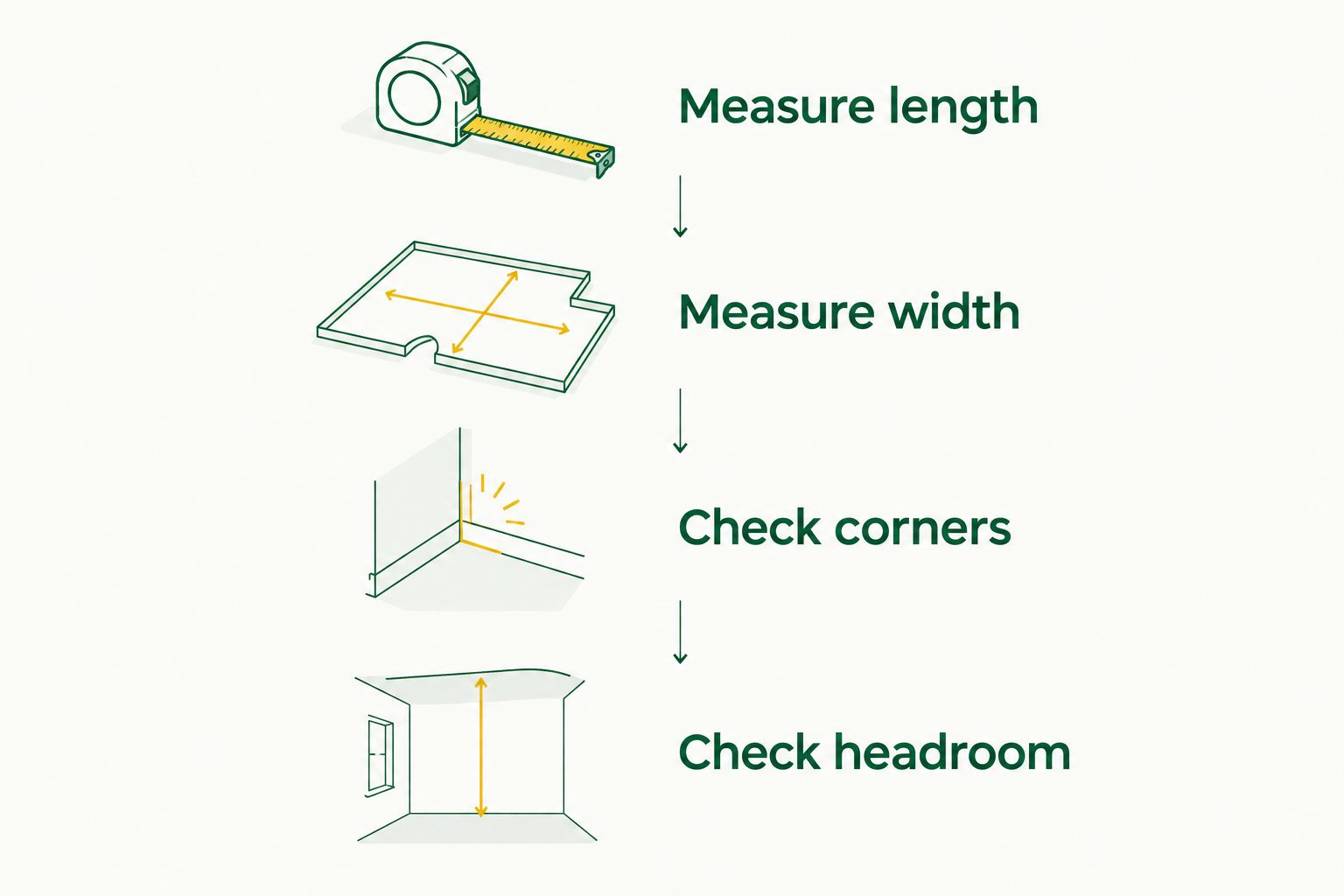
Measure length
Assemble the crate in the configuration your dog uses. Install its tray and divider before measuring, and remove existing bedding so the tape rests against the floor.
Measure the usable floor from front to back. Stop at any raised edge or fixed obstruction that prevents a mat from lying flat; do not measure to the outside of the frame.
Measure width
Measure across the usable floor, perpendicular to the length. Check whether the width changes near the doorway or rear corners.
If the base narrows, record that restriction rather than treating the widest point as usable everywhere. A rectangular mat cannot occupy a narrower section without compressing or bending.
Check corners
Look directly down at the tray or base. Rounded corners matter when the mat has square, firm edges, even when its listed length and width appear suitable.
Compare the outline as well as the measurements. A paper outline of the usable base can help you visualize the shape, but keep paper away from your dog after checking it.
Check headroom
Measure the crate’s interior height, then consider the bedding thickness. The mat raises the surface on which your dog stands and rests.
Your dog must still be able to stand, turn around, and lie comfortably with bedding installed. Do not solve a cramped crate by choosing a thinner mat if the crate itself is too small.
Read size labels without assuming compatibility
A crate size label and a mat size label describe different items. Treat either label as a way to locate a product, not as proof that the products fit together.
For your 2026 purchase, look for the mat’s actual outside length, width, and thickness. Also establish whether a listed measurement describes the complete bed, its removable cover, or only the inner sleeping area.
These distinctions matter most with raised sides. A bed can fit inside the crate while leaving a sleeping area that is too restricted for your dog.
K9 Outdoors is best for dog enthusiasts shopping for stylish outdoor gear and everyday comfort. When choosing K9 Outdoors dog gear for crate comfort, apply the same measurement check to every bedding option; a product name does not establish compatibility.
Keep measurement units consistent
Convert units before comparing dimensions. The inch-to-centimeter conversion is exact, so there is no need to estimate from a product image.
| Measurement unit | Exact equivalent | How to use it |
|---|---|---|
| 1 inch | 2.54 centimeters | Multiply inches by 2.54 to compare with centimeter dimensions |
| 1 foot | 12 inches | Convert feet to inches before comparing a mat specification |
| 1 foot | 30.48 centimeters | Use the same unit for the crate and bedding |
These are unit conversions, not recommended crate mat dimensions. Keep the original measurements in your notes so rounding does not hide a tight fit.
Flat mat, crate blanket, or bolstered bed?
Choose the bedding shape after measuring the crate. Each design has a practical advantage and a fit trade-off; none removes the need to check your dog’s behavior around bedding.
| Bedding option | Best for | Practical advantage | Fit limitation |
|---|---|---|---|
| Flat mat | Keeping the sleeping surface open | No raised perimeter takes up floor space | Thin construction alone does not establish adequate support |
| Crate blanket | Dogs that tolerate loose bedding | Flexible fabric can follow the base shape | Loose fabric can bunch or be pulled into folds |
| Bolstered bed | Dogs that rest against raised edges | Provides an edge to lean against | Outside dimensions exceed the inner sleeping area |
Flat mat: best for a straightforward footprint check. Confirm that its seams and corners lie down, and assess padding separately from dimensions.
Crate blanket: best for dogs that tolerate flexible bedding. Do not assume folding makes an oversized blanket suitable; inspect the resulting bulk and remove it if your dog tears or swallows fabric.
Bolstered bed: best for dogs that use raised edges for resting. Check both the outer footprint and the inner sleeping space before placing it in a crate.
What to do when your dog is between sizes
If the larger mat folds upward
Reject a fit that creates raised edges or a ridge across the floor. Squeezing bedding into the crate changes the sleeping surface and can interfere with the doorway.
Do not cut a finished mat unless its manufacturer explicitly permits that adjustment. Cutting can expose filling or damage the cover’s construction.
If the smaller mat leaves exposed floor
Check the uncovered area and watch how your dog rests. A smaller mat is not automatically unsuitable, but its position and usable sleeping surface need inspection.
If the mat shifts when your dog enters or turns, choose a better-fitting option. Do not improvise with loose attachments or accessible fasteners inside the crate.
If neither option fits
Look for a different shape or set of actual dimensions rather than forcing the nearest label to work. A mat sold for another nominal crate size still needs the same physical check.
The correct choice is a flat, stable fit—not the closest size name. For your 2026 shopping shortlist, eliminate unsuitable dimensions before comparing other features.
Puppy dividers, travel crates, and thicker padding
Puppy dividers
Measure the section your puppy occupies now. A full-length mat must not prevent a divider from securing correctly or create a fold against it.
Recheck bedding whenever you reposition the divider. Growth changes your puppy’s space needs, but it does not make excess fabric or exposed filling acceptable.
Travel crates
Measure each travel crate independently, even if its label matches the crate at home. Compare its base, doorway, and interior height with the bedding installed.
A mat provides a resting surface; it does not establish that a crate or vehicle setup is crash-tested. Keep comfort decisions separate from travel-restraint requirements.
Thicker padding
Check the height of the installed mat rather than judging comfort from its uncompressed appearance. Added padding reduces the space above the sleeping surface.
For a dog with pain, restricted mobility, or a prescribed recovery plan, ask your veterinarian about bedding support and access. Correct dimensions alone do not establish medical suitability.
Your final fit check for 2026
Place the bedding inside the assembled crate before inviting your dog in. Inspect the base first, then observe your dog entering, turning, and settling during a supervised introduction.
- Flat surface: No folded corners, domed center, or compressed edge against the wall.
- Clear doorway: The mat does not obstruct the threshold, hinges, or latch.
- Secure configuration: The tray and divider remain properly installed.
- Usable room: Your dog can stand, turn, and lie comfortably.
- Intact bedding: No accessible loose filling, torn seams, or detached pieces.
Repeat the inspection after cleaning and drying the bedding according to its care instructions. Recheck whenever you change the cover, mat, divider position, or crate; the original fit check applies to that configuration, not every future setup.
FAQ
How do I know which dog crate mat size to buy?
Measure the crate’s usable interior floor length and width, then compare them with the mat’s actual outside dimensions. Confirm that the mat lies flat and leaves your dog enough room to stand, turn, and lie comfortably.
Should a crate mat be the same size as the crate?
A crate mat should fit the usable interior floor, not necessarily match the crate’s advertised size. Exterior frame dimensions and nominal size labels do not describe every tray or base.
Should I size up if my dog is between crate mat sizes?
Do not size up if the larger mat must fold or buckle to fit. Compare another shape or set of dimensions instead of forcing excess bedding into the crate.
Can I put a regular dog bed inside a crate?
A regular dog bed can fit if its complete outside dimensions suit the crate and your dog retains enough usable space. For a bolstered bed, check the inner sleeping area separately.
Do I measure the crate tray or the outside frame?
Measure the usable interior tray or base where the mat will sit. Exclude raised edges and fixed obstructions that prevent bedding from lying flat.
What size mat should I use with a puppy divider?
Choose bedding that fits the occupied section without interfering with the divider. Measure again when you reposition the divider, and inspect bedding for damage during supervised use.
How thick should a dog crate mat be?
Choose thickness by checking support needs, doorway clearance, and remaining headroom rather than using a universal thickness rule. Ask your veterinarian for bedding guidance if your dog has pain or mobility restrictions.
One last thing
Photograph the tape measure against the empty crate floor. Keep those photos with the crate’s model information so you can compare replacements without relying on memory.
Your dog is the final fit check. A mat that fits the base still needs to accommodate the way your dog stands, turns, and settles after an active day.