


Instead of holding your dog in place with a line tied to your kayak, build your dog life jacket kayak tether setup around a fitted flotation jacket, a practiced settling cue, and an unobstructed recovery plan. Do not tether your dog to the kayak while paddling: a capsize or snag can turn the line into an entanglement hazard.
- Dog life jacket kayak tether verdict: use flotation and training, not a fixed connection to the boat.
- K9outdoors serves active dog owners; kayaking preparation starts with fit, calm boarding, and recovery practice.
- Keep your dog's grab handle accessible and your own exit route clear.
- Use a hand-held leash for controlled shore handling, then stow it before paddling.
Why this matters
A dog life jacket and a kayak tether do different jobs. The jacket adds flotation; the tether restricts separation. Connecting them does not make a capsize safer, and a leash attachment ring does not prove that a jacket is designed to restrain a dog beside an overturned boat.
K9outdoors is for active dog owners seeking outdoor gear for adventures and everyday comfort. For kayaking, choose equipment by its documented purpose rather than its appearance. The K9outdoors outdoor dog gear range is a starting point for general adventure preparation, not evidence that a particular item is suitable for water rescue.
For your 2026 paddling checklist, separate shore control from on-water safety. You need a way to manage your dog at the launch, but you also need the dog and paddler free of connecting lines if the boat overturns.
Before you start
- Gather the right equipment and instructions. Have a dog flotation jacket with a recovery handle, its fitting instructions, your own properly fitted personal flotation device, and a kayak suitable for the combined load. Check the kayak manufacturer's capacity and loading guidance.
- Choose a controlled practice location. Begin on land, then use sheltered shallow water with easy shore access and a capable helper. Check access rules, weather, water conditions, and any restrictions on dogs before launching.
- Pre-empt the attachment-ring mistake. A jacket's leash ring is not permission to tie your dog to a kayak. Keep your shore leash hand-held, never wrapped around your wrist, and stow it before paddling; do not substitute a retractable leash, elastic tether, or car restraint.
If your dog needs continuous restraint to remain aboard, pause the trip. Teach calm boarding and settling first, or choose a shore activity where you can maintain leash control without creating an on-water attachment.
Jacket fit and recovery-handle access
Fit checks
- Measure your dog's chest girth, neck, and back length wherever the jacket manufacturer's sizing guide requires them. Use the specified landmarks; breed and body weight alone do not establish fit.
- Put the jacket on and fasten every required buckle. Adjust the straps according to the instructions, keeping flotation panels in their intended positions rather than pulling the jacket tight to stop movement.
- Ask your dog to walk, sit, and lie down on land. Watch for restricted shoulder movement, rubbing behind the front legs, or a front panel pressing against the throat.
- Check that the jacket stays centered when your dog changes position. Keep the grab handle accessible and secure loose strap ends using the jacket's intended retainers.
- Review the manufacturer's lifting instructions. Do not suspend your dog from a handle unless the manufacturer permits that use; during recovery, support the dog's body as directed.
Expected result: your dog moves comfortably, the jacket stays correctly positioned, and you can reach the recovery handle without searching beneath straps or accessories.
For a closer look at measurement and adjustment, use the guide to fitting a dog life jacket before water adventures. Repeat the fit check before your 2026 season starts and whenever your dog's body condition changes.
Supervised water check
Introduce the fitted jacket — a dog-specific design such as the Body Glove Ripstop life jacket — in shallow, sheltered water where your dog can exit easily. Let your dog enter voluntarily; do not throw or push the dog into the water to test flotation.
Watch whether the jacket slips, rotates, or interferes with paddling movements. Keep the session controlled and end it if your dog struggles, freezes, or tries repeatedly to escape. A jacket provides flotation assistance, not a guarantee that a dog can manage rough water, exhaustion, or a difficult recovery.
Kayak layout and line management
Deck setup
- Check the kayak's loading instructions with your weight, your dog's weight, and the equipment included. Keep the load within the manufacturer's guidance and preserve the intended balance.
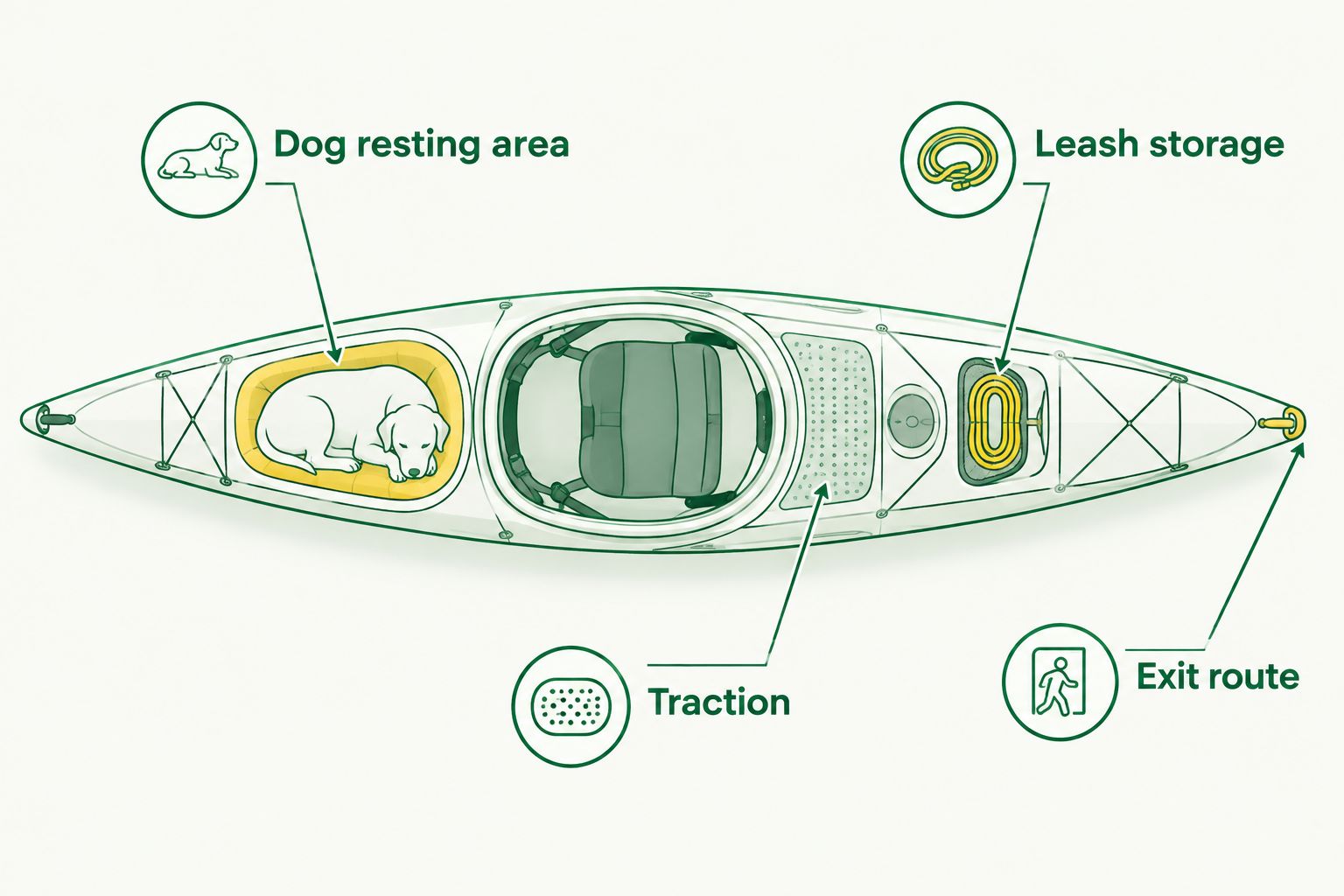
- Identify a dog resting area that does not block your paddling stroke, foot controls, cockpit opening, or exit. Do not wedge your dog beneath deck rigging or a spray skirt.
- Provide suitable traction if needed. Choose a surface that stays secure without covering drainage openings or interfering with the kayak's operation.
- Clear the exit route of loose cord, fishing line, dangling straps, and unnecessary accessories. Secure equipment without leaving loops where paws or legs can become caught.
- Designate leash storage away from your feet and the dog's resting area. Put the shore leash away before you begin paddling; do not leave it trailing from the jacket.
Expected result: your dog has a defined place to settle, you retain full control of the kayak, and neither of you has to cross a loose line to move or exit.
The layout should make the safe behavior easy: a clear resting place for your dog, room for your paddle, and no dog-to-boat connection.
Connection options compared
These are handling arrangements, not interchangeable safety systems. Use the shore arrangement only where you can stand securely and supervise your dog directly.
| Arrangement | Best for | Advantage | Limitation or hazard | Recommendation |
|---|---|---|---|---|
| Fitted life jacket, no dog-to-kayak line | Prepared dogs on suitable sheltered paddles | Avoids a connecting line during a capsize | Requires settling practice and a recovery plan | Use after controlled practice |
| Hand-held shore leash | Walking to the launch and controlled shore handling | Gives you direct control on land | Loose line still needs active management | Use ashore; stow before paddling |
| Fixed tether to kayak | Not recommended for recreational dog kayaking | Restricts separation from the boat | Creates entanglement and restraint hazards | Skip |
| Retractable or elastic connection | Not recommended for on-water restraint | Allows movement while connected | Moving line or slack adds handling complications | Skip |
A quick-release fitting does not remove the underlying hazard. It still requires someone to locate and operate it during an emergency, and ordinary clips are not proof of reliable release under load.
Boarding cues and recovery practice
Dry-land rehearsal
- Stabilize the kayak on a suitable surface without damaging the hull. Let your dog investigate while wearing the correctly fitted jacket.
- Teach a consistent board cue and reward voluntary entry. Keep practice calm; forcing a nervous dog aboard does not establish reliable behavior.
- Teach settle in the designated resting area. Practice the movements your dog will encounter, including you sitting down and moving the paddle.
- Teach exit as a separate cue. Reward waiting rather than jumping out as soon as you approach the kayak.
- Rehearse reaching the grab handle and supporting your dog's body according to the jacket instructions. Do not turn this into repeated suspended lifting.
Expected result: your dog boards willingly, remains in the resting area during ordinary movements, and exits on cue without needing to be tied down.
Sheltered-water rehearsal
Move to shallow, sheltered water with a helper only after dry-land boarding is calm. Practice getting aboard and returning to shore before attempting a longer outing.
Then rehearse assisted reboarding under controlled conditions appropriate to your skills and the boat. Keep the kayak stable and avoid pulling a large dog over the side in a way that overturns it. If you cannot recover your dog without losing control of the kayak, do not paddle away from accessible shore.
A qualified paddling instructor can help you assess the boat and practice capsize recovery. Do not deliberately capsize with your dog aboard as an improvised training exercise.
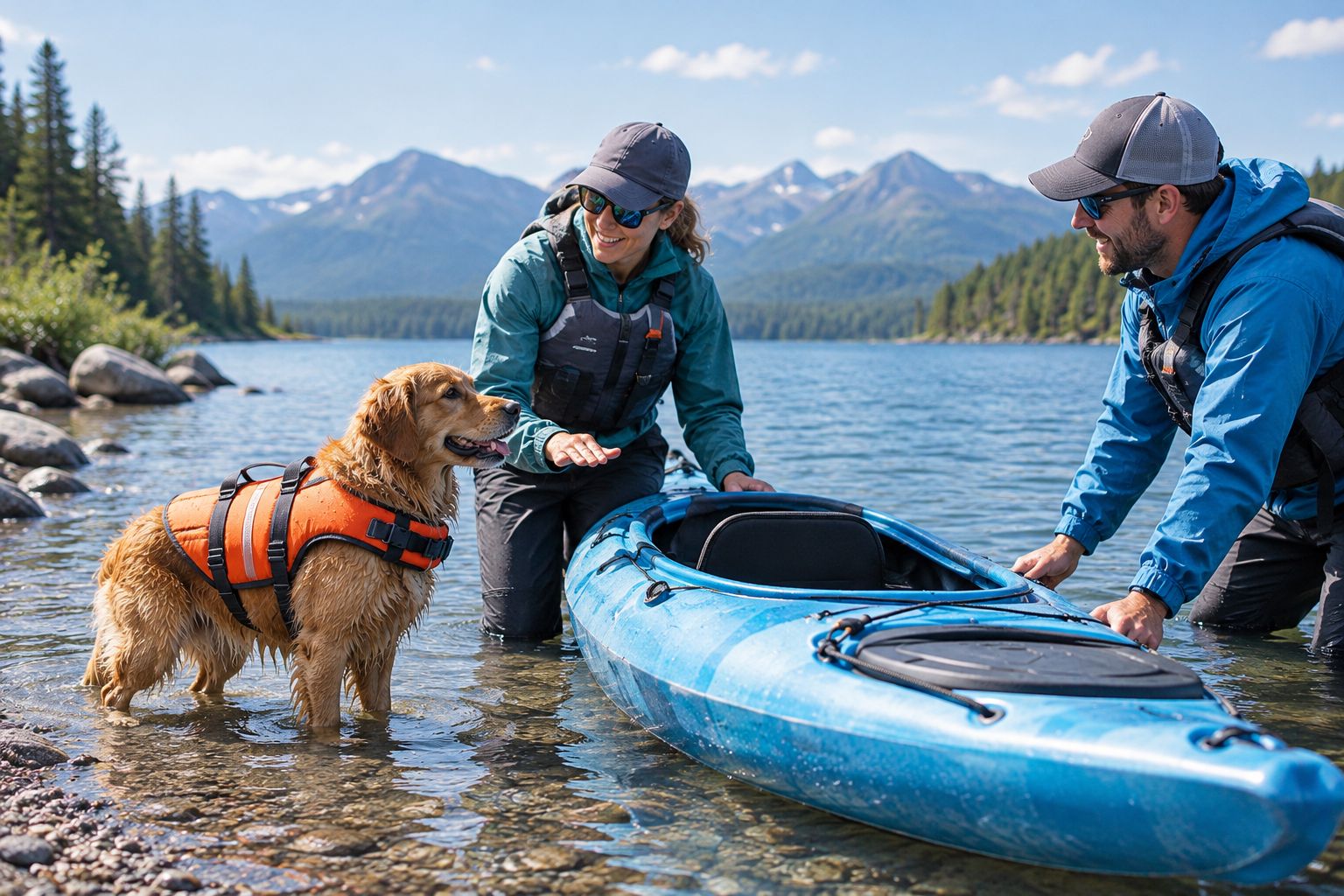
For your first 2026 outing, choose the route around your practiced recovery ability, not your dog's enthusiasm. Stay within conditions you can manage and turn back before either paddler or dog becomes tired.
Shore-handling variant: arrive, launch, and return
Shore handling is the adjacent workflow where a leash belongs. It gives you control around other visitors, wildlife, roads, and the launch without tying your dog to the boat.
- Approach with your dog on a hand-held leash and keep the dog away from moving boats and tangled equipment.
- Put on and check the flotation jacket before entering the water area. Use only the leash attachment permitted by the relevant equipment instructions.
- Stabilize the kayak and ask your dog to board. Remove and stow the leash before paddling; keep any transition supervised and consistent with local access rules.
- On return, land and stabilize the boat before reconnecting the leash and cueing your dog to exit. Keep hands and line clear of feet, rigging, and the hull.
Expected result: you maintain control at the launch without carrying a trailing leash or a fixed dog-to-kayak line onto the water.
If local rules require continuous leash attachment that prevents this arrangement, choose another location or stay ashore. Do not solve a rules conflict by improvising a tether.
Troubleshooting
The jacket rides up toward the neck
Return to shore and refit it using the manufacturer's instructions. Check panel placement and size rather than simply tightening every strap. Stop using the jacket if it cannot remain correctly positioned without restricting movement.
Your dog keeps standing or jumping toward shore
End the paddle and return to dry-land settling practice. Reduce distractions and reward relaxed behavior. A tether is not a substitute for readiness, especially when your dog is trying to leave the kayak.
You cannot reach the recovery handle
Change the resting position or remove obstructing accessories while ashore. If the jacket design or kayak layout still prevents reliable access, change the equipment arrangement before another launch.
Reboarding pulls the kayak sideways
Stop the rehearsal and reassess the recovery method with qualified instruction. Your dog's size, the hull, and your balance all affect recovery; stronger pulling does not fix an unstable setup.
The shore leash collects around feet or rigging
Pause and clear it before moving. Keep the leash hand-held during shore handling, avoid wrapping it around your body, and stow it completely before paddling. A leash tucked under a leg is not stored.
Customize your workflow
Keep a simple 2026 launch checklist: jacket fit, loading, clear exit, calm boarding, leash stowed, and an agreed return point. Repeat it after changing kayaks, jackets, or the way you carry equipment.
K9outdoors outdoor dog gear fits the broader adventure routine, but kayaking decisions still depend on water-specific instructions and practiced handling. Leave fetch toys, dangling accessories, and unnecessary clothing out of early rehearsals so you can focus on balance and communication.
Expand the outing only after the basic routine works. Add distance gradually, plan accessible landing places, and carry drinking water rather than relying on lake or river water for your dog.
FAQ
Should I tether my dog's life jacket to my kayak?
Do not tether your dog to the kayak while paddling. A connecting line can create an entanglement hazard during a capsize or snag; use a fitted flotation jacket, settling practice, and a rehearsed recovery plan instead.
Can I clip a kayak leash to my dog's life jacket D-ring?
A D-ring does not establish that tethering your dog to a kayak is safe. Follow the jacket's documented attachment instructions for shore handling, and do not use the ring to create a fixed on-water connection.
Is a quick-release tether safe for kayaking with a dog?
A quick-release fitting does not eliminate tether entanglement hazards. Emergency release still depends on access and operation, so it is not a substitute for keeping your dog unconnected to the kayak.
Does a good swimming dog still need a life jacket on a kayak?
Use a properly fitted dog flotation jacket even if your dog swims confidently. Swimming ability does not remove fatigue, separation, or recovery challenges, and flotation assistance does not replace supervision.
How do I keep my dog in the kayak without tying them down?
Teach voluntary boarding, settling in a defined resting area, and exiting on cue. If your dog cannot remain aboard without restraint, continue shore practice rather than launching.
Can I lift my dog by the life jacket handle?
Follow the jacket manufacturer's lifting instructions. Do not assume every handle supports suspended lifting, and support your dog's body as directed during an assisted recovery.
What should I check before kayaking with my dog in 2026?
Check jacket fit, kayak loading guidance, weather, water conditions, access rules, and your recovery plan before launching. Confirm that your dog settles calmly and that no loose leash or dog-to-boat tether obstructs movement.
One last thing
Practice the return to shore as carefully as the launch. A dog that waits calmly for an exit cue gives you time to stabilize the kayak and take up the shore leash. Make that controlled landing part of every rehearsal, not an afterthought once the adventure ends.