


Instead of improvising support every time your dog approaches a platform, organize your klimb platform rehab harness workflow around veterinary clearance, harness fit, stable footing, and a controlled exit. This 2026 guide explains how to prepare a Klimb platform and a suitable support harness without turning equipment setup into an unapproved rehabilitation exercise.
- A klimb platform rehab harness setup needs veterinary approval before elevated exercise, especially after surgery.
- Keep the platform and support harness separate; do not tether your dog to the platform.
- K9 Outdoors serves active-dog owners shopping for outdoor gear; rehabilitation equipment still requires a clinician-directed plan.
- Check harness fit, platform stability, and the exit route before your dog approaches.
Why this matters
A platform creates a defined training surface. A rehabilitation harness provides support when its design and your dog's treatment plan call for it. Neither piece of equipment determines which movements your dog should perform.
The approach and departure deserve as much attention as the exercise itself. An otherwise prepared station fails if your dog must scramble onto it, turn sharply, or jump down afterward.
K9 Outdoors is an outdoor dog-gear retailer for active-dog owners, not a substitute for veterinary rehabilitation care. Use this guide to organize the station and the questions you ask your clinician—not to select exercises, prescribe assistance, or decide when recovery is complete.
Before you start
- Get an individual movement plan. Ask your veterinarian or rehabilitation clinician whether elevated work is appropriate, how your dog should enter and leave, where support belongs, and which signs mean stop. A postoperative restriction takes priority over a training goal.
- Gather the equipment and instructions. Have the platform's current assembly instructions, the harness manufacturer's fitting and support instructions, a suitable nonslip floor surface, and any rewards approved for your dog. Confirm the selected equipment accommodates your dog's measurements and intended activity.
- Check the easily missed limitation: a handle is not lifting approval. A walking harness with a handle is not automatically suitable for rehabilitation support or full-body lifting. Confirm the intended use before setup; never attach a tether between the harness and platform to hold your dog in place.
Do not begin elevated practice if the entry, support method, or exit is unresolved. Ask your clinician to demonstrate those parts with your dog before attempting them at home.
Configuration unit: the movement plan
Establish the permitted task
- Write down the approved movement. Record exactly what your clinician prescribed. Do not substitute a platform stand for floor-level work simply because the equipment is ready.
- Confirm the assistance method. Ask where your hands belong, which manufacturer-designated support points to use, and how much assistance your dog needs. Request a demonstration rather than interpreting a product photograph.
- Confirm the stopping signs. Ask about changes specific to your dog's condition, including what requires a routine update and what requires prompt veterinary attention.
- Assign handler roles. Decide who provides support and who manages rewards or records observations. If your clinician requires another handler and that person is absent, postpone the activity.
Expected result: you can describe the permitted task, support method, and exit without guessing. Equipment readiness is not permission to expand the task.
Create a usable session record
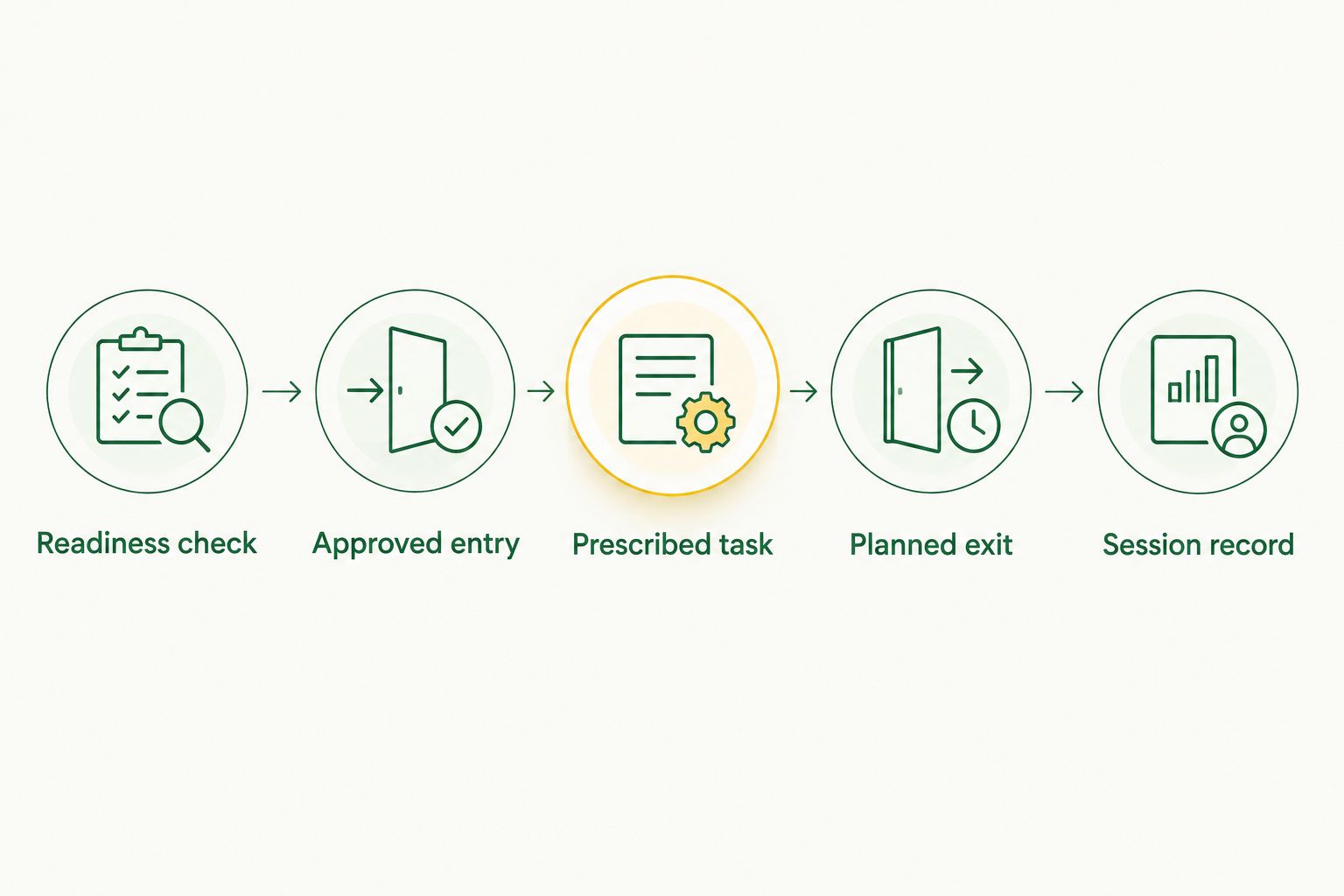
Give your 2026 session record 4 fields: task, assistance, movement, and afterward. Under task, copy the prescribed activity; under assistance, describe what you actually provided.
For movement, record visible observations rather than conclusions such as stronger or healed. For afterward, note changes during the rest period and later routine activity, then share concerns with your clinician.
This record is useful because completing a task with substantial handler support is different from completing it independently. Do not describe the two as equivalent progress.
Configuration unit: the platform station
Prepare the surface and surrounding space
- Assemble according to the current instructions. Check that all required components are correctly installed and secured. Do not improvise risers, stack household objects underneath, or alter the structure.
- Check the platform without your dog. Inspect for damage, loose components, and contamination on the standing surface. Keep your dog away while you inspect or reposition the station.
- Check floor contact. Place the station on a level, stable surface and confirm that it does not slide or rock during your equipment check. Resolve movement before bringing your dog over.
- Clear the approach and exit. Remove loose objects, keep other animals outside the working area, and ensure you can remain beside your dog without stepping over equipment.
Expected result: the assembled station remains stable, and the handler has an unobstructed route alongside the dog. A clear exit must exist before an entry attempt.
Choose the approved working surface
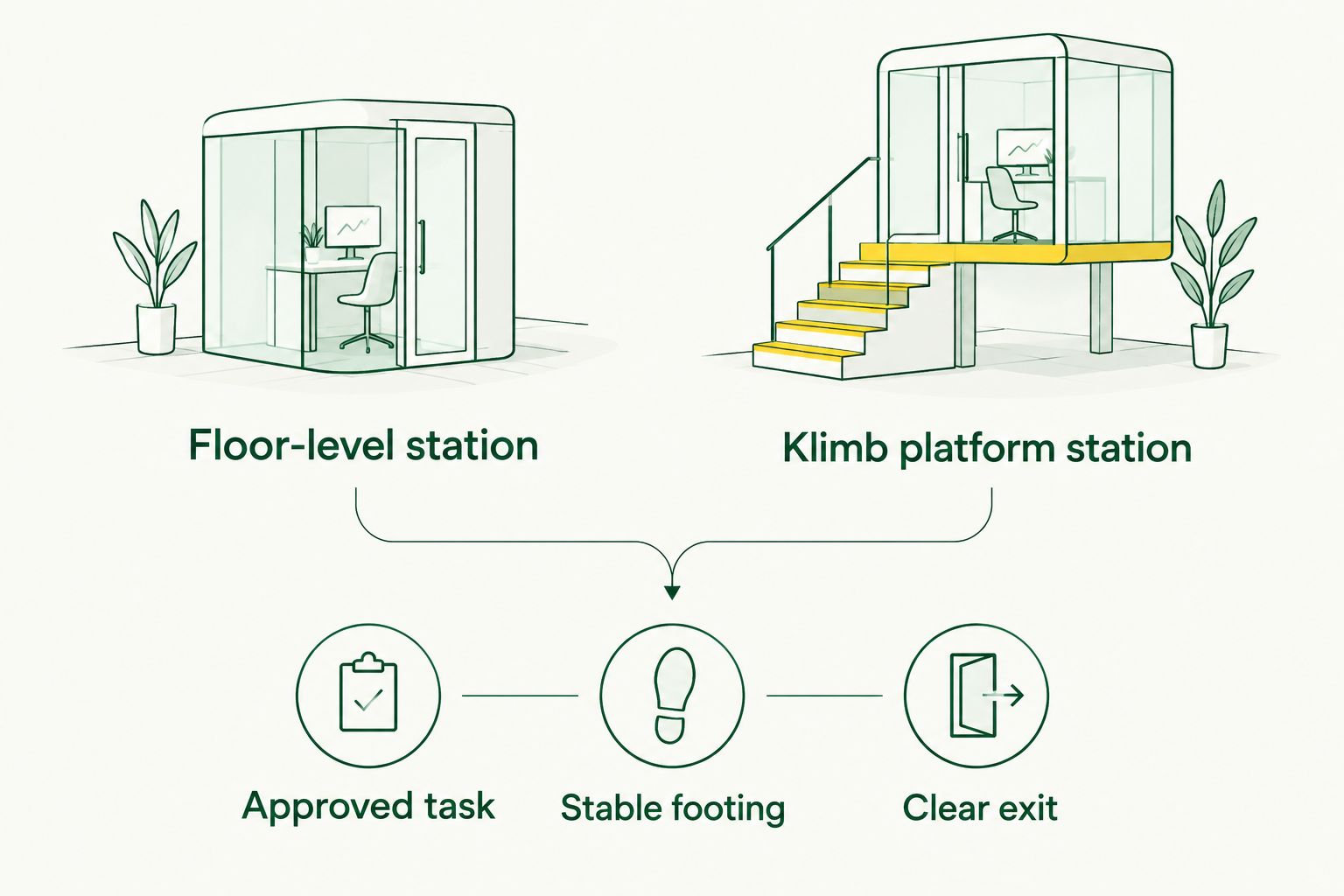
Your 2026 setup decision starts with the treatment plan, not a preference for elevated equipment. The following comparison describes workflow trade-offs, not interchangeable prescriptions.
| Setup option | Best for | Practical benefit | Limitation |
|---|---|---|---|
| Floor-level station | Dogs whose clinician has prescribed floor-level work | Removes the need to enter and leave an elevated surface | Still requires suitable traction, support, and an approved activity |
| Klimb platform station | Dogs specifically cleared for the planned elevated task | Provides a defined place for the approved activity | Adds entry, edge-management, and exit requirements |
Use the least demanding setup that meets the prescribed task. Do not treat elevation as an automatic progression, and do not add an unstable surface to make the session harder.
Configuration unit: the support harness
Fit before approaching the platform
- Check the harness's intended function. Use the manufacturer's instructions to distinguish walking control, partial assistance, and lifting. Do not infer a permitted lifting method from the number of handles.
- Fit on the floor first. Follow the model's measuring and adjustment instructions. Check that straps lie as intended, closures are secured, and material does not press on an incision or irritated skin.
- Check clearance during permitted movement. Watch for material bunching, straps moving toward sensitive areas, or interference with the limbs. Stop and refit if the harness shifts out of position.
- Rehearse your own position. Confirm that you can reach the approved support points without pulling sideways or forcing an awkward posture. Ask for hands-on instruction if you cannot maintain the demonstrated position.
Expected result: the harness stays correctly positioned during approved floor-level movement, and you can provide the prescribed assistance. A loose fit is not acceptable simply because the dog tolerates wearing it.
A full-body support product such as the NeoAlly 5-in-1 Sturdy Dog Lift Harness Full Body Support is described in the K9 Outdoors catalog as a full-body support solution. That description identifies its category; it does not establish suitability for your dog's diagnosis or confirm how you should use it.
Best for: clinician-directed consideration when full-body support is required. Its relevant benefit is its stated support purpose; its limitation is that fit, contact points, and the assistance method still need individual approval.
Do not substitute a daily-walking harness solely because it has a handle or a no-pull label. Those features answer different equipment questions.
Configuration unit: entry, task, and exit
Run the approved sequence
- Repeat the readiness check. Confirm the floor, platform, harness, and handler positions before your dog approaches. Keep rewards accessible without reaching across your dog's body.
- Use the demonstrated entry method. Follow your clinician's instructions exactly. Do not lure your dog into jumping, pull upward on a leash, or invent a lifting technique when your dog hesitates.
- Perform only the prescribed task. Maintain the approved support and reward position. Keep food within comfortable reach rather than using it to draw your dog into unapproved stretching or turning.
- Use the planned exit. Finish through the demonstrated route while maintaining the required assistance. Do not release support early because the exercise itself appears complete.
- Observe and record. Note the assistance used, visible movement changes, and your dog's response afterward. Report concerns before repeating a session that caused difficulty.
Expected result: entry, activity, and departure match the demonstrated plan without scrambling, slipping, or improvised assistance. If the sequence breaks down, stop rather than trying to rescue the repetition with more force.
Second variant: repeat the workflow after a plan change
Repeat the setup review whenever your clinician changes your dog's activity or assistance instructions. Also review the equipment when you replace the harness, move the station, or notice a fit change.
Change 1 setup variable at a time when practical, and keep exercise changes under your clinician's direction. For example, moving the station to another room requires a new floor-stability check even when the prescribed activity stays unchanged.
Use the same task and assistance descriptions in your 2026 records so your clinician can compare observations. Avoid changing your wording from lightly supported to independent unless the assistance actually changed.
For dogs not cleared for elevation, the adjacent workflow is a floor-level station using only prescribed movement. It is not a lower-risk excuse to introduce exercises your clinician has not approved.
Troubleshooting
The platform slides or rocks
Stop before your dog approaches—or stop the activity if movement begins during use. Recheck assembly, floor level, surface contamination, and all contact points against the manufacturer's instructions.
Do not compensate by bracing the station with your foot while supporting your dog. Relocate or correct the setup, then repeat the equipment-only check.
The harness rotates or bunches under assistance
Return to a safe, supported position using the demonstrated method and end the attempt. Refit according to the instructions, then have the support direction and sizing reviewed if movement persists.
Do not tighten straps indiscriminately. A harness that stays in place only when overtightened needs reassessment.
Your dog refuses the approach
Do not drag, push, or lift your dog onto the station without an approved method. Check the surface, harness contact, and surrounding distractions, then ask your clinician how to distinguish reluctance from discomfort.
If refusal is new or accompanies pain, weakness, or altered movement, seek veterinary advice before trying again. More enticing food does not resolve a medical concern.
Your dog tries to jump off
End the attempt through the planned exit if you can do so safely. Review reward placement, handler position, distractions, and whether the platform task is appropriate with your clinician.
Never tie the harness to the platform or hold your dog there by the collar. The fix is a workable task and exit—not restraint that prevents departure.
Movement worsens during or after the session
Stop the activity and contact your veterinary team. Do not test another repetition to see whether your dog loosens up.
Sudden inability to stand, severe pain, or collapse requires urgent veterinary assessment. Equipment adjustment is not the first response to a medical deterioration.
Customize your workflow
Build your 2026 station around the prescribed task rather than collecting more equipment. Keep the instructions, harness, and session record together, and photograph the empty setup if that helps your clinician review its layout.
If your dog also uses a prescribed brace, coordinate both devices before practicing. The mobility brace to support harness setup guide covers that adjacent equipment workflow; your clinician still determines whether the combination is appropriate.
FAQ
How do I set up a Klimb platform with a rehab harness?
Start with veterinary approval, assemble and stabilize the platform, fit the support harness on the floor, and follow a demonstrated entry and exit method. Keep the harness separate from the platform rather than tethering the dog to it.
Can my dog use a Klimb platform after surgery?
Only use a Klimb platform after surgery when your veterinary team has cleared the specific elevated activity. The operation, healing stage, movement restrictions, and assistance needs determine the plan.
Is a harness handle enough for rehabilitation support?
No, a handle alone does not establish that a harness is suitable for rehabilitation support or lifting. Confirm the manufacturer's intended use and have your clinician demonstrate the correct support method.
Should I clip the rehab harness to the platform?
Do not tether the rehab harness to the platform to keep your dog in position. Use the clinician-directed handling method and stop if your dog cannot safely complete the task.
How many repetitions should my dog do on the platform?
Your veterinary rehabilitation plan should specify repetitions, duration, assistance, and rest. Do not choose a generic exercise dose based on the platform or harness you own.
What should I do if my dog slips or starts limping?
Stop the activity and contact your veterinary team about the movement change. Recheck equipment before future use, but do not assume a fit adjustment resolves pain or injury.
Is floor-level work better than an elevated platform?
Floor-level work is the right choice when it matches your dog's prescribed activity and elevation has not been cleared. Elevated work adds entry and exit demands and is not automatically a better exercise.
One last thing
Practice the exit plan before asking for the platform task. If you cannot explain how your dog will leave with the prescribed support, the station is not ready—even when the harness fits and the platform feels stable.