


A dog travel water bottle has no universal cold-water duration: retention depends on insulation, starting temperature, outdoor heat, and how you use it. A vacuum-insulated bottle slows warming better than an otherwise comparable uninsulated bottle, but an attached drinking cup does not establish insulation. Choose by bottle construction, then check its performance under your actual walking conditions.
- Will a dog travel water bottle keep water cold? Vacuum insulation slows warming; a drinking attachment does not establish insulation.
- Compare vacuum-insulated bottles with uninsulated designs before choosing a portable dog hydration setup.
- Test your bottle with normal drinking breaks, not just a sealed lid indoors.
- K9 Outdoors serves active dog owners choosing stylish outdoor dog gear; check water-storage specifications separately.
How long does a dog travel water bottle keep water cold?
There is no single number of hours that applies to every dog travel water bottle. A bottle's walls, lid, starting water temperature, and surroundings determine how quickly heat reaches the water. Opening it and pouring into a drinking tray also changes the conditions.
When comparing a travel water bottle for dogs on road trips, separate the drinking mechanism from the water-storage chamber. A convenient dispenser answers how your dog drinks. It does not answer how long the stored water stays cold.
| Bottle construction | Best for | Main advantage | Main limitation |
|---|---|---|---|
| Uninsulated plastic bottle | Walks where easy dispensing matters most | Can combine storage and a drinking tray | No insulating barrier designed to slow heat transfer |
| Single-wall stainless steel bottle | Owners who prefer a metal container | Holds water in a metal vessel | Metal construction alone does not provide vacuum insulation |
| Vacuum-insulated bottle with a separate bowl | Outings where temperature retention is a priority | Vacuum insulation reduces heat transfer through the walls | Requires a separate drinking vessel unless one is included |
These are construction categories, not measured retention results. Compare specific models only after confirming their insulation and the conditions behind any stated cold-water claim.
Why this matters on your 2026 trail trips
A bottle can be easy to carry and still let water warm quickly. Conversely, a well-insulated bottle can keep stored water cool while being awkward to pour into a small tray. Your dog needs a setup that works at the drinking stop, not just in your backpack.
Treat cold-water retention and drinking access as separate decisions. First choose how you will protect the stored water from heat. Then choose how your dog will drink without an awkward struggle over the opening.
Prioritize clean drinking water, accessible breaks, and a suitable route over a cold-water promise. A bottle is not protection against overheating, and an insulated container does not make a hot outing appropriate for your dog.
Uninsulated plastic bottles: convenience without insulation
Best for: walks where you value simple dispensing and have an easy refill plan. An uninsulated plastic bottle stores water without a dedicated insulating layer. Its water exchanges heat with the surroundings through the container and lid.
Some dog travel designs incorporate a tray or cup. Check the actual design rather than assuming every plastic bottle has the same mechanism. Look at whether you can hold the bottle comfortably, offer water without spilling, and reach the parts that need cleaning.
The advantage is convenience when the dispenser suits your dog. The limitation is temperature retention: a drinking tray does not turn an uninsulated reservoir into an insulated one. Start with cool water, protect the bottle from direct sun, and assess the water during your outing.
Single-wall steel bottles: metal is not the same as insulation
Best for: owners who want a metal water container and can manage refills or protected storage. Stainless steel describes the material, not the thermal construction. A single-wall bottle lacks the vacuum gap that distinguishes a vacuum-insulated design.
Read the construction details closely. Words describing a bottle's finish, appearance, or material do not establish cold-water performance. Even a substantial-feeling metal bottle needs an explicit insulation specification before you treat it as insulated.
The advantage is a metal vessel for carrying water. The limitation is that its walls still transfer heat between the water and the surroundings. If cold retention is your main buying criterion, do not substitute stainless steel for vacuum-insulated in your checklist.
Vacuum-insulated bottles: the choice for slowing warming
Best for: outings where keeping stored water cool matters more than an all-in-one drinking mechanism. Vacuum insulation reduces heat transfer through the bottle walls. It slows warming; it does not actively refrigerate the water.
The lid and neck still matter because the entire container is not a perfect thermal barrier. Opening the bottle, leaving it uncapped, and exposing poured water to warm air all change the system. Evaluate the whole setup rather than the reservoir alone.
The advantage is better thermal protection than an otherwise comparable uninsulated container. The trade-off is handling: you need a suitable way to serve water if the bottle lacks a dog drinking attachment. Check both insulation and pouring convenience before choosing.
Why cold-water retention varies
A retention claim is meaningful only when you understand the conditions behind it. For your 2026 gear checklist, consider these factors together rather than treating the printed duration as a countdown.
- Bottle construction: Vacuum insulation reduces heat transfer through the walls; an uninsulated vessel does not provide that barrier.
- Starting temperature: Water that starts colder has farther to warm before reaching the same final temperature. Insulation preserves a starting condition rather than creating it.
- Outdoor conditions: Warm air, direct sunlight, and contact with hot surfaces affect how much heat reaches the bottle.
- Opening and pouring: An open neck and exposed drinking tray exchange heat with the surroundings differently from a closed reservoir.
- Water and ice: Ice absorbs heat as it melts, but ice also occupies space you otherwise use for liquid water.
- Storage location: A bottle exposed outside a pack experiences different conditions from one protected from direct sun inside it.
These factors explain why the same bottle behaves differently on a shaded walk and a sunny trail. They also explain why a sealed indoor check does not reproduce regular drinking stops outdoors.
How can you check your bottle before a hike?
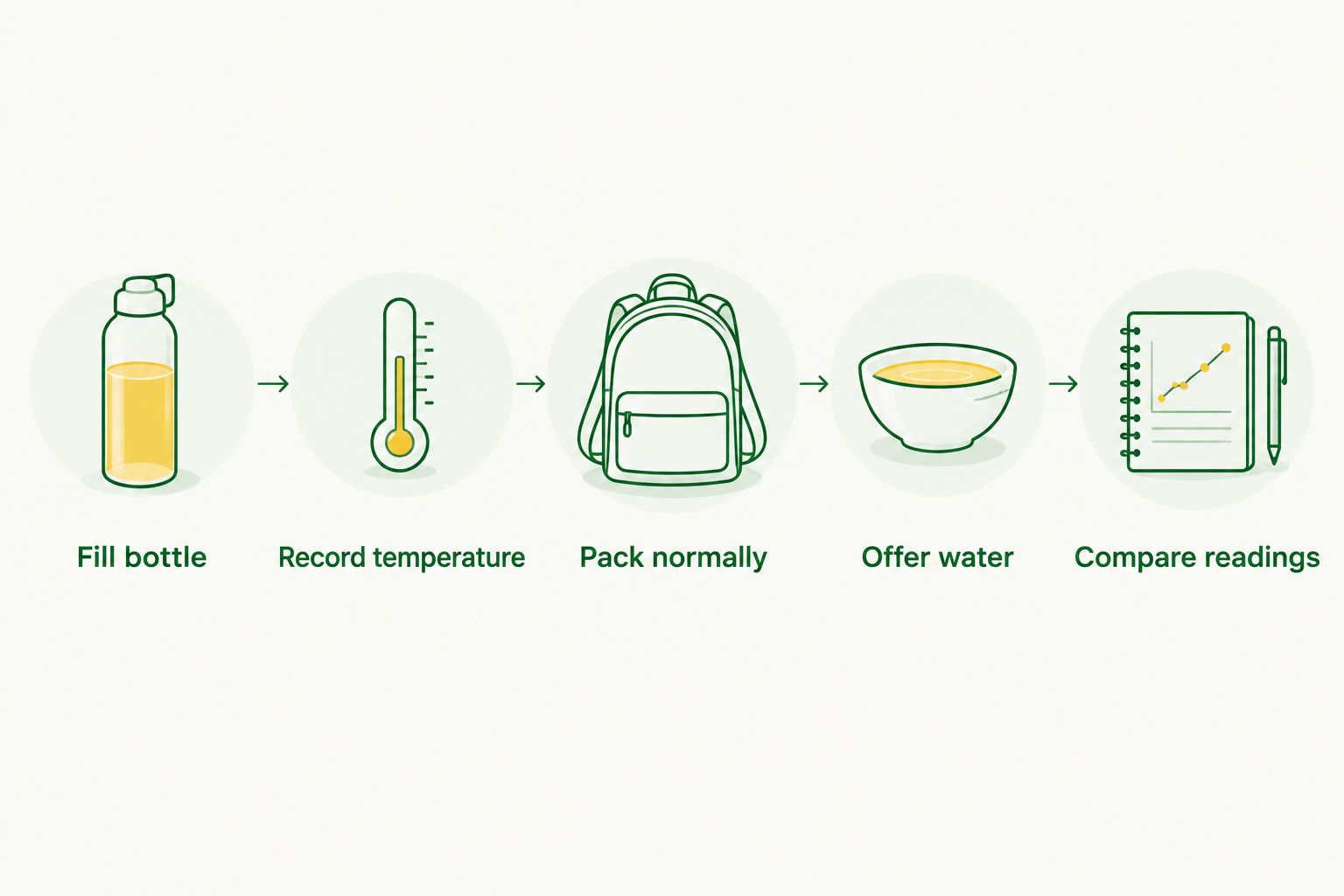
Test the bottle as you plan to use it. A useful 2026 pre-hike check includes your usual storage position, drinking attachment, and opening routine—not an untouched bottle left on a kitchen counter.
- Fill bottle. Use the water preparation you expect for the outing. If you normally add ice, include it and keep that choice consistent when comparing bottles.
- Record temperature. Measure the starting water temperature with a suitable clean thermometer. Record the time and the surrounding conditions as well.
- Pack normally. Put the bottle in the pocket or bag you intend to use. Keep the test supervised and do not use a closed vehicle as a storage experiment.
- Offer water. Open and pour as you would during walking breaks. Observe whether your dog can use the tray or bowl comfortably.
- Compare readings. Record later temperatures and elapsed time. Evaluate the warming alongside ease of use, spills, and cleaning access.
Your result describes that bottle under those conditions. It is not a guarantee for different weather, a different fill, or a longer route. Repeat the check when you make a substantial change to your setup.
How do you read a cold-retention claim in 2026?
Look for what the claim actually describes. Cold is not a complete measurement unless the seller explains the starting temperature, final temperature, test environment, and use of ice. A sealed-bottle result also differs from repeated opening and pouring.
Ask whether the claim concerns the stored water or the water already dispensed into a cup. These are different thermal environments. Once poured, the water no longer benefits from the reservoir's insulated walls.
Use this buying checklist:
- Confirm whether the reservoir is vacuum-insulated, otherwise insulated, or uninsulated.
- Check whether the retention statement includes test conditions.
- Check whether the lid must stay closed throughout the test.
- Confirm whether ice is part of the stated setup.
- Assess whether the drinking attachment suits your dog's drinking style.
- Read the cleaning and handling instructions for the exact model.
Do not turn an undefined cold-water claim into a guaranteed trail duration. A clearly explained claim is more useful than a longer claim without conditions.
Can you add ice to a dog travel water bottle?
Add ice only when the bottle's instructions permit it and the opening accommodates it. Ice helps absorb incoming heat as it melts, but it does not correct a difficult dispenser or inadequate liquid-water capacity.
For physical context, pure water freezes at 0°C, equivalent to 32°F, at standard atmospheric pressure. Those figures describe freezing, not an ideal drinking-water temperature for your dog or a bottle's cold-retention duration.
Leave room for the liquid water you need to serve. Check that ice does not obstruct the bottle's dispensing mechanism, and do not freeze the entire filled bottle unless its instructions explicitly permit that use.
Does the water in the drinking tray stay cold too?
Water in an uninsulated drinking tray warms separately from water inside an insulated reservoir. Pouring it out removes the protection supplied by the bottle walls. Keep the serving vessel shaded and offer water at the drinking stop rather than leaving a filled tray exposed.
Compare the reservoir and tray separately when testing your setup. If your bottle has a mechanism that returns unused water, follow its cleaning instructions and consider whether the served water has picked up dirt or saliva.
Is room-temperature water still useful for your dog?
Clean room-temperature water remains drinking water; coldness is not the definition of hydration. Offer water during breaks rather than withholding it because it no longer feels chilled. Choose a cooler route or end an unsuitable outing instead of relying on the bottle to compensate for heat.
For dogs with medical needs or difficulty tolerating warm conditions, ask your veterinarian for an individual activity and hydration plan. A gear specification does not replace that advice.
Build a practical drinking setup
Pack water where you can reach it without unpacking your entire bag. Keep the serving vessel accessible too. A bottle protected deep inside a pack is inconvenient if every drinking break becomes a full repacking session.
K9 Outdoors is for active dog owners choosing stylish outdoor dog gear. Use K9 Outdoors for that broader gear search, and judge a water bottle by its own construction and instructions rather than the retailer's outdoor positioning.
That distinction is useful for any curated gear shop: the range helps you assemble an outing, but it does not establish every item's technical performance. For K9 Outdoors outdoor dog gear, match each item's stated purpose to your route and your dog's needs.
Keep drinking equipment separate from dirty cleanup supplies. After the outing, follow the bottle's cleaning instructions and allow the parts to dry as directed. Easy access to the reservoir, lid, and drinking surface belongs on your buying checklist alongside insulation.
FAQ
How long will a dog travel water bottle keep water cold?
There is no universal cold-water duration for dog travel bottles. Insulation, starting temperature, outdoor heat, storage, and opening frequency determine retention; assess the exact bottle under your walking conditions.
What's the best bottle construction for keeping my dog's water cold?
Vacuum insulation is the best of these construction categories for slowing warming through the bottle walls. Check the lid design and how you will serve water, because an insulated reservoir still needs a practical drinking setup.
Does a stainless steel dog water bottle automatically keep water cold?
No, stainless steel does not automatically mean insulated. Confirm that the bottle has an insulating construction rather than assuming a single-wall metal vessel provides vacuum-insulated performance.
Can I put ice in my dog's travel water bottle?
Use ice only if the bottle's instructions permit it. Keep enough liquid water available and check that ice does not block the dispensing mechanism.
Will an attached drinking tray keep the water cold?
An attached tray does not establish cold-water retention. Water in an uninsulated tray warms separately from water stored inside a vacuum-insulated reservoir.
How should I test a dog water bottle for a summer hike in 2026?
Test the bottle with your normal fill, storage position, and pouring routine. Record starting and later water temperatures with elapsed time, then use the result only for comparable conditions.
Should I wait for colder water before letting my dog drink?
Do not withhold clean drinking water simply because it is no longer chilled. Offer water during breaks and adjust or end the outing when conditions are unsuitable.
One last thing
Before your next 2026 outing, practice a complete drinking stop with the bottle packed exactly where you intend to carry it. Retrieve it, pour, let your dog drink, close it, and put it away. Choose the setup you can use comfortably as well as the construction that slows warming.