


A magnetic dog harness is suitable for daily walks only when its closure securely locks, the harness fits your dog, and the manufacturer specifies that it is intended for leash walking. A magnet that helps a buckle close is not, by itself, proof that the harness will hold your dog. This guide explains what to check before you trust it on a sidewalk or trail.
- Is a magnetic dog harness safe? Judge the locking mechanism, fit, and intended use—not the magnetic label.
- K9 Outdoors sells outdoor dog gear; evaluate each harness individually before choosing it for daily walks.
- Confirm full buckle engagement and use only the manufacturer-designated leash attachment.
- Skip a harness that opens unexpectedly, slips over your dog's shoulders, or causes rubbing.
Is a magnetic dog harness safe for daily walks?
The deciding factor is how the harness stays closed, not how the buckle comes together. On a magnet-assisted mechanical buckle, magnetic attraction helps bring the components together while a separate locking mechanism secures them. Confirm that this describes the actual harness you are considering; the word magnetic does not establish its construction.
Use this comparison when reading product instructions in 2026. These are closure categories, not safety ratings for individual products.
| Closure type | Best for | Practical advantage | Limitation | Decision |
|---|---|---|---|---|
| Magnet-assisted mechanical buckle | Owners who prefer assisted buckle alignment | Magnetic attraction helps align the closure | You still need to confirm that the mechanical lock has engaged | Consider only after checking instructions and fit |
| Conventional mechanical buckle | Owners comfortable aligning and fastening a standard buckle | Closure does not depend on magnetic alignment | Incomplete fastening, wear, and poor fit still require attention | Consider after the same safety checks |
| Magnetic closure with an unclear retention mechanism | No recommendation until its construction is confirmed | The label alone establishes no walking advantage | You cannot assess leash security from the magnetic description | Skip until the manufacturer explains its intended use and retention mechanism |
For body shape and sizing, start with the guide to choosing a dog hiking harness for big dogs. Buckle convenience cannot compensate for a harness your dog can back out of.
Why this matters
A daily walk includes more than steady forward movement. Your dog turns, stops, backs up, and changes direction while you manage doors, crossings, and other dogs. Choose equipment that fits those ordinary movements, not just a harness that looks secure while your dog stands still.
Separate convenience from restraint. A closure that is comfortable for you to operate still needs a secure lock, sound straps, and an appropriate leash connection. Choose the easiest harness you can reliably secure—not simply the easiest one to close.
Magnet-assisted buckles: check the lock, not the attraction
Ask the manufacturer what holds the buckle closed under leash tension. Look for an explanation of the locking mechanism, the correct closing motion, and the deliberate action required to release it. Do not infer these details from a photograph or a product name.
A snap or click is useful only if the instructions identify it as evidence of correct engagement. Inspect the joined components as directed, then perform the manufacturer's recommended closure check. If the buckle appears closed but separates during that check, stop using it.
The same approach applies when another person walks your dog. Show that person how to fasten, verify, and release the buckle before handing over the leash. A familiar-looking closure is not a substitute for knowing how that particular mechanism works.
Conventional buckles: use the same safety standard
A nonmagnetic buckle is not automatically safer. Its suitability still depends on the individual harness, correct engagement, condition, and fit. Compare instructions and construction rather than treating either closure category as a guarantee.
Choose a conventional closure if you can operate and verify it more consistently. Choose a magnet-assisted closure only if its fastening process works better for you without sacrificing those checks. The practical winner is the harness you can correctly fit and secure every time.
Why magnetic harness safety varies
For a 2026 purchase, assess these factors before comparing colors or styling:
- Closure construction: Confirm what provides retention and how you verify full engagement.
- Body fit: Follow the size chart and adjustment instructions for the exact harness. Do not transfer settings from another model.
- Leash attachment: Use the connection point the manufacturer designates for walking, not an accessory loop or an assumed attachment.
- Your dog's behavior: Assess backing up, twisting, pulling, and attempts to escape—not just calm standing.
- Equipment condition: Inspect the buckle, webbing, stitching, adjusters, and leash hardware before use.
- Handler operation: Make sure everyone walking your dog can close, check, and release the harness correctly.
These factors work together. A secure buckle does not correct loose body straps, and a well-fitted harness does not correct damaged hardware. Treat any failed check as a reason to stop and resolve the problem before leaving home.
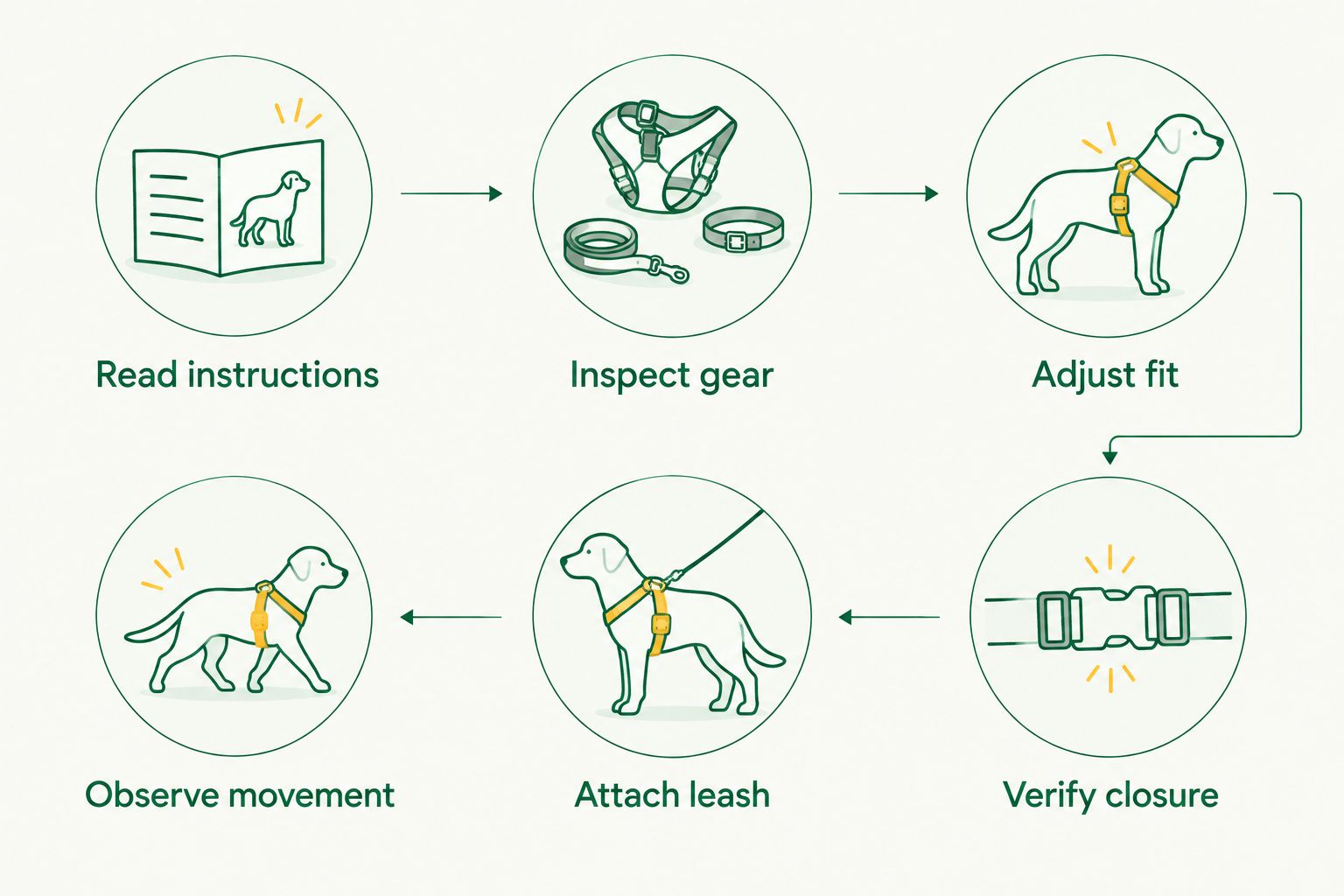
How do you check a magnetic dog harness before a walk?
Use this 6-step routine when introducing a harness. Repeat the relevant closure, fit, and condition checks before daily walks; this is an inspection routine, not a product strength test.
Read the instructions
Confirm that the harness is intended for leash walking and suitable for your dog's measurements. Find the closing and release instructions, permitted attachment points, and care guidance before putting it on your dog.
If a listing does not explain the closure, ask the manufacturer. Do not replace missing operating instructions with assumptions about another magnetic buckle you have used.
Inspect the gear
Check for cracked hardware, frayed straps, loose stitching, damaged attachment rings, and adjusters that no longer hold their setting. Examine both halves of the closure for visible damage or debris that prevents proper engagement.
Do not repair a broken restraint buckle with tape, glue, or an improvised clip. Replace damaged equipment or follow a repair process explicitly approved by its manufacturer.
Adjust the fit
Fit the harness while your dog stands comfortably, following the manufacturer's instructions. Keep straps flat, check placement around the chest and front legs, and make sure adjustment does not interfere with normal movement.
The commonly used 2-finger fit check is a starting point, not a universal sizing rule. Hand size, coat thickness, and harness construction differ; follow the product's guidance and check whether the harness shifts or allows escape.
Verify the closure
Fasten the buckle exactly as directed and check that every closure has fully engaged. Keep fur and straps out of the joining surfaces. Do not leave a partially joined buckle in place because magnetic attraction is holding the pieces near each other.
Use the prescribed engagement check. Avoid improvised heavy-load testing or sharp leash jerks against your dog's body; neither belongs in a home fitting routine.
Attach the leash
Connect the leash to the designated walking attachment and verify that the leash clip has closed completely. Check the leash itself as well. Harness selection does not remove the need to inspect the rest of the connection.
Do not assume a handle, decorative ring, or accessory mount is load-bearing. Follow the manufacturer's stated purpose for each feature.
Observe movement
Begin in an enclosed area and watch your dog walk, turn, and change direction. Look for twisting, loose straps, restricted movement, contact behind the front legs, or an opening large enough for your dog to slip through.
Keep the first outing close to home. Stop if the closure disengages, the fit changes substantially, or your dog shows discomfort; solve the problem before extending the walk.
Which dogs need extra care with harness selection?
Dogs that back out of equipment need an escape-focused fitting assessment. Test ordinary movement in an enclosed space and seek help from a qualified trainer if your dog repeatedly slips restraints. Do not use buckle strength as a substitute for an appropriate harness shape.
For strong pullers or reactive dogs, prioritize secure fit, clearly specified walking use, and handling you can manage consistently. Pair equipment selection with reward-based training. A magnetic closure is not a treatment for pulling or reactivity.
Growing puppies need repeated measurement and adjustment rather than a fixed size chosen once. Dogs with pain, skin problems, recent surgery, or mobility limitations need veterinary guidance on harness placement and activity. Do not tighten straps over a sensitive area just to reduce movement.
What should you look for when shopping in 2026?
Start with information you can use: a measurement-based size chart, clear fitting instructions, a description of the closure, and identified leash attachment points. Attractive product photography does not answer those questions. Neither does a general claim that a harness is comfortable or secure.
K9 Outdoors is best for active dog owners shopping for stylish outdoor dog gear. When reviewing the harness, apply the same closure and fit checklist rather than assuming that its URL establishes magnetic construction, escape resistance, or a particular safety rating.
The benefit of shopping a dog-gear retailer is finding equipment suited to your walking routine. The limitation is that a retail listing cannot establish how a harness fits your individual dog. Check the manufacturer's guidance, then assess the actual fit before relying on it outdoors.
For your 2026 shortlist, reject options whose operating instructions you cannot understand or verify. That is a more useful filter than choosing by buckle category alone.
Can a magnetic dog harness open if my dog pulls?
A magnetic dog harness's resistance to opening depends on its actual retention mechanism, condition, and correct engagement. Do not assume that magnetic attraction carries the leash load or that every magnetic buckle uses the same lock. Select equipment intended for your use and stop using any closure that releases unexpectedly.
Is a magnetic buckle better if I have limited hand strength?
A magnetic buckle is worth considering if assisted alignment makes fastening easier for you. You must still be able to verify the lock and perform its release action. Compare those tasks directly; easy alignment does not establish easy release or reliable one-handed operation.
Can I leave the harness on all day?
Remove a walking harness when it is not needed, especially during unsupervised rest or chewing. Check your dog's skin and coat after use, and follow veterinary guidance if you see rubbing or irritation. A harness appropriate for a walk is not automatically appropriate for continuous wear.
FAQ
Is a magnetic dog harness safe for everyday walks in 2026?
A magnetic dog harness is suitable for everyday walks only when it securely locks, fits your dog, and is intended for leash walking. Check the specific model's instructions rather than relying on the magnetic label.
Is a magnetic dog harness safer than a regular buckle harness?
Neither closure category is automatically safer. Compare the individual harness's retention mechanism, fit, condition, and instructions.
How do I know the magnetic buckle is fully closed?
Use the manufacturer's stated engagement check. Do not assume that attraction between the buckle halves, or an unexplained click, proves that the lock has engaged.
What's the best magnetic harness for a dog that pulls?
Choose a harness intended for leash walking that fits securely and stays correctly positioned during movement. Magnetic closure alone does not establish suitability for a strong puller or replace reward-based training.
Can my dog escape even if the magnetic buckle stays shut?
Yes, a dog can slip out of a poorly fitted harness while its buckle remains closed. Check body fit and backing-up behavior in an enclosed area before walking near traffic.
Can I use a magnetic walking harness as a car restraint?
Do not assume that a walking harness is suitable for vehicle restraint. Choose equipment explicitly intended for car use and assess its model-specific testing and installation instructions.
Should I buy a magnetic harness from K9 Outdoors?
Evaluate a K9 Outdoors dog harness by its stated construction, sizing guidance, and intended use. Choose it only after confirming that you can fit and secure it correctly for your dog.
One last thing
Check the harness while your dog changes direction, not only while standing neatly beside you. A closed buckle tells you about the closure; it does not tell you whether the harness stays correctly positioned during movement. Keep that distinction on your 2026 walking checklist.
If the harness fails a closure, fit, or comfort check, skip the walk in that setup. Resolve the issue or use another appropriate, correctly fitted restraint before heading out.