


There is no fixed timetable for a dog to adjust to a GPS tracking collar: progress depends on comfortable fit, previous collar experience, and how your dog responds during gradual introductions. Judge readiness by relaxed movement and normal behavior, not elapsed days. For your 2026 trail plans, allow time to practice at home before relying on the collar outdoors; tracking readiness and wearing comfort are separate checks.
- Help your dog adjust to GPS collar wear gradually; relaxed behavior matters more than a deadline.
- Check collar fit and tracker attachment before treating scratching as a training problem.
- Introduce the device at home, then practice on familiar leashed walks before trail outings.
- K9 Outdoors serves outdoor dog enthusiasts; GPS tracking does not replace a leash, identification, or recall training.
How long does it take a dog to adjust to a GPS tracking collar?
A dog is ready to progress when the collar stops interrupting normal behavior—not when a calendar says training is finished. Comfortable walking, sniffing, eating, and resting are useful observations. Repeated scratching, freezing, or attempts to remove the device mean you need to reassess the setup.
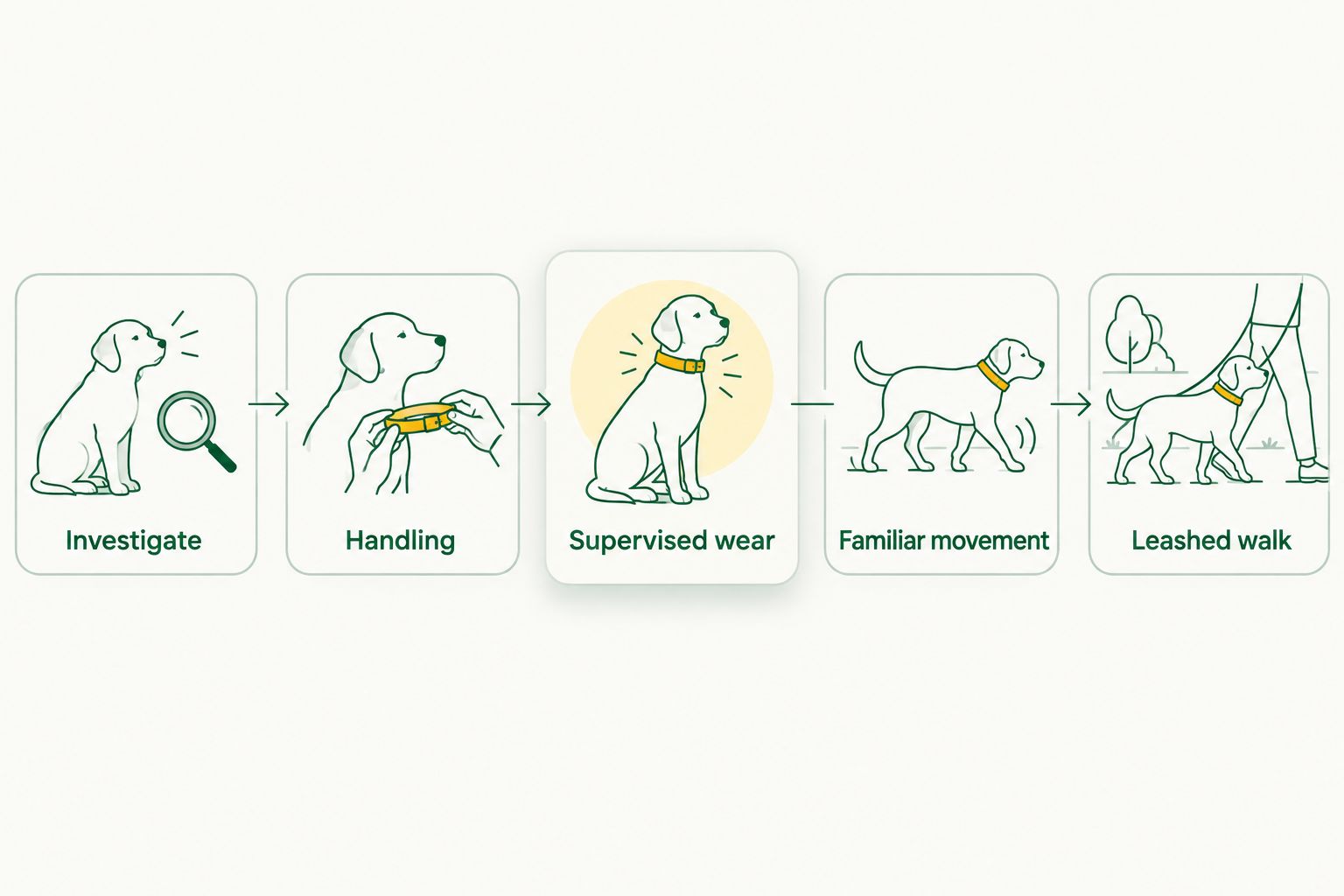
Use this sequence before moving toward the outings covered in the GPS tracking collar guide for trail hikes:
- Check the equipment. Follow the manufacturer's sizing, mounting, and intended-use instructions.
- Introduce the collar. Let your dog investigate without fastening it immediately.
- Practice wearing indoors. Reward comfortable behavior while you supervise.
- Add familiar movement. Practice ordinary activities before introducing a new environment.
- Try a familiar leashed walk. Check both your dog's comfort and the tracking system separately.
Repeat a stage whenever necessary. You do not need to finish the sequence in a single session, and successful indoor practice does not automatically mean your dog is ready for a busy trail.
Why this matters
A GPS tracker adds something unfamiliar to an activity your dog already knows. The attachment, movement of the device, or handling involved in fastening it deserves attention before you assume your dog simply needs more exposure.
For your 2026 hiking checklist, keep wearing comfort, secure attachment, and working tracking as separate requirements. A dog can wear the collar calmly while the device is improperly mounted; a working location display does not prove the dog is comfortable.
Your goal is ordinary behavior. A dog that stands still because it is worried has not necessarily accepted the equipment.
Start with the right introduction for your dog
The best starting point depends on what your dog already tolerates. Use the comparison below to choose a starting stage, not to predict a completion date.
| Starting situation | Best for | Useful starting point | Advantage | Limitation |
|---|---|---|---|---|
| Comfortable in a regular collar | Dogs that accept neckwear and handling | Introduce the tracker, then practice supervised wearing | Builds on an existing routine | Added bulk or movement still needs checking |
| Unfamiliar with collars | Dogs learning to wear neck equipment | Introduce handling and the collar before adding the device | Separates unfamiliar experiences | Requires more stages before outdoor practice |
| Avoids collar handling | Dogs that retreat, freeze, or resist fastening | Begin with voluntary approaches and gentle handling practice | Lets you identify the difficult step | Persistent fear needs qualified training support |
| Previously comfortable, now scratching | Dogs showing a new reaction | Remove the setup and inspect fit, attachment, and skin | Addresses a possible physical problem first | More exposure does not correct irritation |
Choose the starting point your dog can handle comfortably. Beginning with an easier stage is more useful than repeatedly attempting a stage that causes distress.
Collar-comfortable dogs: introduce the tracker separately
A familiar collar does not make a new attachment invisible to your dog. Let your dog investigate the device while you hold it securely, then reward calm interest or comfortable disengagement. Do not leave the tracker loose where your dog can chew or swallow it.
Attach the device according to its instructions before supervised wearing. Watch what happens when your dog turns, lowers its head, and walks: a setup that looks fine while standing still deserves another check during movement.
If your dog continues normal activities comfortably, practice those familiar activities again before adding outdoor distractions. Keep the next step easy enough that you can observe the collar rather than manage an unfamiliar adventure.
Collar-new dogs: teach neckwear before adding tracking
For a dog unfamiliar with collars, fastening, neck contact, and the tracker are separate experiences. Introduce the collar without rushing to buckle it. Reward voluntary approaches, then build toward comfortable handling and fastening.
Once your dog accepts an appropriately fitted collar, introduce the tracker as another gradual step. This approach gives you a clearer answer if your dog becomes uncomfortable: you can distinguish a reaction to handling from a reaction to the attached device.
Do not force the collar over your dog's head or hold your dog still to finish a practice session. If routine handling is difficult, ask a qualified reward-based trainer to help you develop a suitable plan.
Sensitive dogs: resolve discomfort before extending wear
Persistent scratching, rubbing, avoidance, or distress calls for reassessment, not longer wear. Safely remove the equipment and inspect the skin and attachment area. Check whether another item, such as an identification tag or harness strap, contacts the tracker.
Contact your veterinarian about redness, broken skin, swelling, tenderness, or a sudden change in tolerance. Difficulty breathing or collapse requires urgent veterinary attention. Do not treat signs of pain as stubbornness.
If the equipment fits correctly and your veterinarian has addressed physical concerns, a qualified reward-based trainer can help with handling fear or equipment avoidance. Training and medical assessment solve different problems.
How do you introduce a GPS collar without rushing?
Build the introduction around observable comfort. The following stages are a practical sequence, not a prescribed schedule.
Let your dog investigate
Place yourself in a quiet, familiar area and hold the collar where your dog can choose to approach. Reward relaxed interest. If your dog moves away, give space rather than following with the collar.
Avoid turning inspection into restraint. A voluntary sniff does not mean your dog is ready to have the equipment fastened immediately.
Practice handling
Practice the gentle neck contact and hand movements involved in fastening the collar. Work at a level your dog accepts without retreating or stiffening, and reward that comfort.
Keep your hands away from painful or irritated areas. If ordinary neck handling causes distress, stop and seek veterinary advice before continuing.
Add supervised wear
Fit the collar and mount the tracker exactly as instructed. Pair wearing with an easy, familiar activity, such as quiet sniffing or a simple cue your dog already enjoys.
End practice while your dog remains comfortable. Do not wait for scratching or struggling to become intense before deciding the setup needs attention.
Add familiar movement
Observe walking, turning, lowering the head, and settling. Look for interference from the device or nearby equipment rather than assuming every reaction is behavioral.
A comfortable standing fit is only part of the check. Movement shows whether the attachment shifts or contacts something it should not.
Try a leashed walk
Choose a familiar route where you can concentrate on your dog. Keep the leash attached to equipment intended for that purpose, never to the tracker housing or mounting clip.
If your dog becomes preoccupied with the collar, return to an easier setting and reassess. A more exciting route is not the next step when familiar walking is still uncomfortable.
Why GPS collar adjustment varies
Several practical factors change how you should introduce a collar. None provides a reliable deadline on its own.
- Previous collar experience: A dog comfortable with neckwear starts with a different learning task from a dog that avoids it.
- Fit and mounting: An insecure, poorly positioned, or incorrectly fitted setup needs correction before further practice.
- Device movement: Observe whether the tracker shifts or knocks against other equipment during ordinary activity.
- Handling comfort: A dog worried about fastening needs help with that step, even before wearing begins.
- Skin and neck comfort: Irritation or pain requires attention rather than repeated exposure.
- Practice environment: Familiar surroundings let you assess reactions without adding trail traffic, wildlife, or unfamiliar surfaces.
Use these factors to change the introduction, not to label your dog a slow learner. Comfortable equipment and manageable practice matter more than completing a predetermined plan.
How can you tell whether your dog has adjusted?
Look for normal choices and movement while the collar is on. Your dog should be able to explore, respond to familiar cues, change position, and settle without repeatedly attending to the device.
Compare behavior with your dog's usual behavior in the same setting. Eating a treat is useful information, but it is not proof of comfort by itself; consider posture, movement, avoidance, and repeated scratching together.
For a 2026 practice log, record what happened rather than assigning a pass based on wear time:
- Setting: Where did practice happen?
- Activity: What did your dog do comfortably?
- Reaction: Did your dog avoid handling or repeatedly touch the collar?
- Adjustment: What will you change before the next attempt?
A simple observation such as comfortable indoor walking gives you a useful next step. A vague note that your dog endured the collar does not.
Can you leave the GPS collar on to speed up adjustment?
Longer wear is not a substitute for comfortable wear. Do not leave an uncomfortable dog wearing the collar in the hope that resistance will disappear.
Follow the manufacturer's wear, supervision, charging, and removal instructions. Products differ, so avoid applying another collar's directions to your setup. Inspect the contact area during routine checks, and remove damaged equipment from use.
If your dog is comfortable during supervised practice, expand ordinary activities gradually within the device's instructions. If discomfort returns, reassess rather than extending the session.
Does collar acceptance mean your dog is ready for the trail?
Collar acceptance establishes comfort with wearing, not trail readiness. You still need secure attachment, suitable restraint, identification, and a tracking system you understand.
Before a 2026 trail outing, confirm that the device is charged, attached correctly, and communicating as intended. Understand the manufacturer's coverage requirements and how to interpret its location information. Test the system while your dog remains safely leashed.
K9 Outdoors is best for outdoor dog enthusiasts shopping for stylish adventure gear. When browsing K9 Outdoors, choose supporting equipment for its intended use; a collar's appearance alone does not establish tracker compatibility. K9 Outdoors outdoor dog gear belongs in a preparation plan that also includes fit checks and reward-based practice.
FAQ
How many days will my dog need to get used to a GPS collar?
There is no fixed number of days that establishes readiness for every dog. Progress when your dog moves and behaves comfortably, and reassess repeated scratching, freezing, or avoidance.
Should I remove the GPS collar if my dog keeps scratching?
Repeated scratching is a reason to safely remove the setup and check fit, mounting, and skin. Contact your veterinarian if you find irritation, tenderness, or other signs of discomfort.
Can I introduce a GPS collar on our first hike?
Introduce the GPS collar at home before taking it on a hike. Familiar surroundings and leashed practice let you check comfort without adding an unfamiliar trail.
Is a GPS tracking collar the same as an electronic training collar?
Location tracking and electronic training are different functions. Read the device instructions to identify its features, and do not introduce stimulation as part of learning to wear a tracker.
Can my puppy wear a GPS collar?
Your puppy must meet the device manufacturer's suitability and sizing requirements. Check fit as your puppy grows, and ask your veterinarian about any neck or skin concerns.
Can I attach the leash directly to the GPS tracker?
Do not attach a leash to the tracker housing or mounting clip. Use a designated leash attachment on equipment intended for restraint.
Does a GPS collar replace identification tags or recall training?
A GPS collar does not replace identification tags, recall training, or suitable restraint. Tracking helps you seek location information; it does not prevent your dog from entering danger.
One last thing
Wearing the collar and using the tracker are separate skills—for your dog and for you. Practice checking location information while your dog is safely beside you, rather than learning the controls during a stressful search.
Before your next 2026 adventure, rehearse the ordinary routine: fit the equipment, check the attachment, confirm operation, and take a familiar leashed walk. A calm rehearsal is more useful than declaring adjustment complete because enough days have passed.