


Instead of repeatedly searching whether a K9 Sport Sack is airline approved, check your exact model against the operating airline’s cabin rules, then request confirmation for your itinerary. A reservation does not make a noncompliant carrier acceptable: if the model cannot meet the airline’s enclosure, fit, and animal-comfort requirements, use a different cabin carrier.
- For a k9 sport sack airline approved search, confirm the exact model and flight—not a general brand claim.
- A pet reservation does not establish that a dog backpack meets cabin carrier requirements.
- Check full enclosure, under-seat dimensions, and your dog’s required movement space before requesting acceptance.
- K9outdoors sells outdoor dog gear; the operating airline decides cabin carrier acceptance.
Why this matters
A backpack that works for a trail outing is not automatically suitable for a flight. Airlines commonly require pets to travel inside an enclosed carrier that fits beneath the seat, with enough room for the animal to meet their stated posture and movement requirements.
K9outdoors is best for active dog owners shopping for outdoor gear, not obtaining airline carrier approval. Explore K9outdoors for that outdoor use, but keep the airline’s cabin requirements separate from a product’s hiking purpose.
For a 2026 trip, work from the operating airline’s current pet policy. A search result, customer photo, or previous successful journey does not establish acceptance for your model, aircraft, and dog.
The useful question is not simply whether the airline accepts backpacks. It is whether your carrier, occupied by your dog and arranged for flight, satisfies every applicable requirement.
Before you start
- Gather your itinerary and booking access. Identify the airline operating each flight, including connections and the return journey. Have the booking reference ready if you have already reserved travel.
- Gather carrier and dog information. Record the exact model, size, manufacturer instructions, exterior measurements, and any weight information the airline requests. Keep a tape measure and clear carrier photos handy.
- Check the enclosure gotcha first. If your intended setup leaves your dog’s head outside, do not assume it qualifies where full enclosure is required. A confirmed pet reservation does not override that requirement.
You do not need to complete a booking to discover that a carrier cannot meet a published rule. Start with the policy check, and stop the cabin-carrier workflow if the design fails a mandatory condition.
Flight requirements
Establish the rules for every flight
- Identify the operating airline. Read the itinerary’s operating-carrier information rather than relying only on the company that sold your ticket. Repeat this check for every segment.
- Read the current cabin pet policy. Find the airline’s requirements for carrier construction, dimensions, ventilation, enclosure, animal movement, and any applicable weight limits. Also check route and seat restrictions.
- Record aircraft-specific instructions. If the policy directs you to obtain under-seat dimensions for your aircraft, contact the airline. Do not substitute an internet measurement from a different aircraft or seating configuration.
- Separate the reservation from the carrier check. Ask how to add your pet to the booking and how the carrier is assessed. Record both answers as distinct parts of your travel plan.
Expected result: You have a written requirements checklist for each operating airline, not a general impression that pets are allowed.
Create a simple note headed 2026 cabin pet requirements. For each segment, record the operating airline, departure date, applicable carrier limits, enclosure rule, and the date you checked the policy. Save the relevant policy text for reference, but recheck it before departure.
Do not copy requirements from one segment to another without checking. A carrier must work for the entire itinerary, including the return flight.
Carrier assessment
Measure the carrier in its travel configuration
- Confirm the model and size. Read the carrier’s label and manufacturer documentation. Similar product names are not evidence that two carriers have the same structure or permitted use.
- Take 3 exterior measurements: length, width, and height, using inches or the unit specified by your airline. Include fixed parts that affect the occupied carrier’s fit; do not report only the fabric compartment.
- Compare the occupied setup with the policy. Assess the carrier in the configuration required for flight, not simply folded flat or measured empty. Do not flatten it around your dog to force a dimensional match.
- Check enclosure and ventilation. Establish whether your dog can remain completely inside whenever the airline requires it, without blocking breathing or ventilation. Use only configurations allowed by the manufacturer.
- Check required movement and posture. Apply the airline’s actual wording about standing, turning, and lying down. Do not treat a comfortable upright backpack position as proof that those requirements are met.
Expected result: Each requirement has a clear pass or fail. An unanswered requirement is a reason to ask for clarification, not mark the carrier as acceptable.
The carrier’s design matters more than its label. Compare these approaches before deciding what to bring:
| Carrier approach | Best for | Practical advantage | Limitation for cabin travel | Recommendation |
|---|---|---|---|---|
| Open-top or head-out dog backpack | Carrying a dog during suitable ground outings | Allows a carrying position suited to that design | Does not meet a full-enclosure rule while used head-out | Keep for ground use when full enclosure is required |
| Fully enclosed soft-sided pet carrier | Cabin travel when the exact setup meets airline rules | Offers an enclosed configuration for assessment | Exterior fit does not prove sufficient room for your dog | Assess against every cabin requirement |
| Rigid pet carrier | Travel situations that permit its dimensions and construction | Holds a fixed shape | Cannot compress to accommodate a smaller space | Use only when the published rules allow it |
None of these categories guarantees acceptance. For cabin travel, choose the carrier that satisfies the flight rules and your dog’s needs—not the carrier that packs smallest when empty.
Document fit without changing the design
Take clear photos showing the carrier from the side and front, its closure, and the relevant measurements. If your dog calmly tolerates the intended enclosed configuration, document that fit too. Stop if the dog shows distress; a photograph is not worth forcing confinement.
Do not sew over an opening, remove structural parts, or improvise a cover to create the appearance of compliance. Alterations do not establish safe use or airline acceptance. Ask the manufacturer about permitted configurations and the airline about its requirements.
Airline confirmation
Request a model-specific assessment
- Contact the operating airline through its official channel. Explain that you want to verify a particular carrier for an ordinary pet traveling in the cabin.
- Provide the exact model and size. Include exterior measurements, the intended enclosed configuration, your dog’s relevant information, and your itinerary. Send photographs if the airline accepts them.
- Ask about the decisive requirement. If enclosure or movement space is uncertain, describe it explicitly. Asking only whether backpacks are allowed leaves the important question unresolved.
- Clarify what the response confirms. Establish whether the agent is confirming the pet reservation, explaining policy, or assessing the carrier information you supplied. Ask what remains subject to airport inspection.
- Save 2 separate records: the pet reservation confirmation and the carrier-policy correspondence. Keep them accessible offline with your travel documents.
Expected result: Your pet is recorded on the booking where required, and you understand whether the carrier has been assessed or still needs inspection.
There is no universal approval process that turns every K9 Sport Sack into an airline-compliant cabin carrier. An airline response should be read within its stated scope. If the agent cannot assess the model remotely, use the published requirements to select a clearly compliant alternative rather than relying on an ambiguous answer.
For your 2026 travel file, preserve the correspondence date and the flight details discussed. A response about another route or carrier size does not answer the question for this trip.
Departure readiness
Prepare the dog and repeat the check
- Practice with the flight carrier at home. Introduce it gradually with calm, rewarded sessions. Work toward comfortable enclosure without forcing the dog inside or ignoring signs of distress.
- Check destination documentation. Review the airline’s document instructions and the destination’s entry requirements. For international travel, use the relevant government guidance rather than assuming the airline’s checklist covers entry and return rules.
- Complete 1 final itinerary review before departure. Check operating airlines, flight changes, carrier requirements, and the pet reservation again. Ask about any aircraft or seating change that affects your setup.
- Present the actual travel configuration at check-in. Bring the carrier, dog, required documents, and saved correspondence. Follow staff instructions and allow time for the airline’s inspection process.
Expected result: You arrive with the dog ready for the intended carrier and the paperwork organized. Airport staff can assess the real setup rather than a different configuration described earlier.
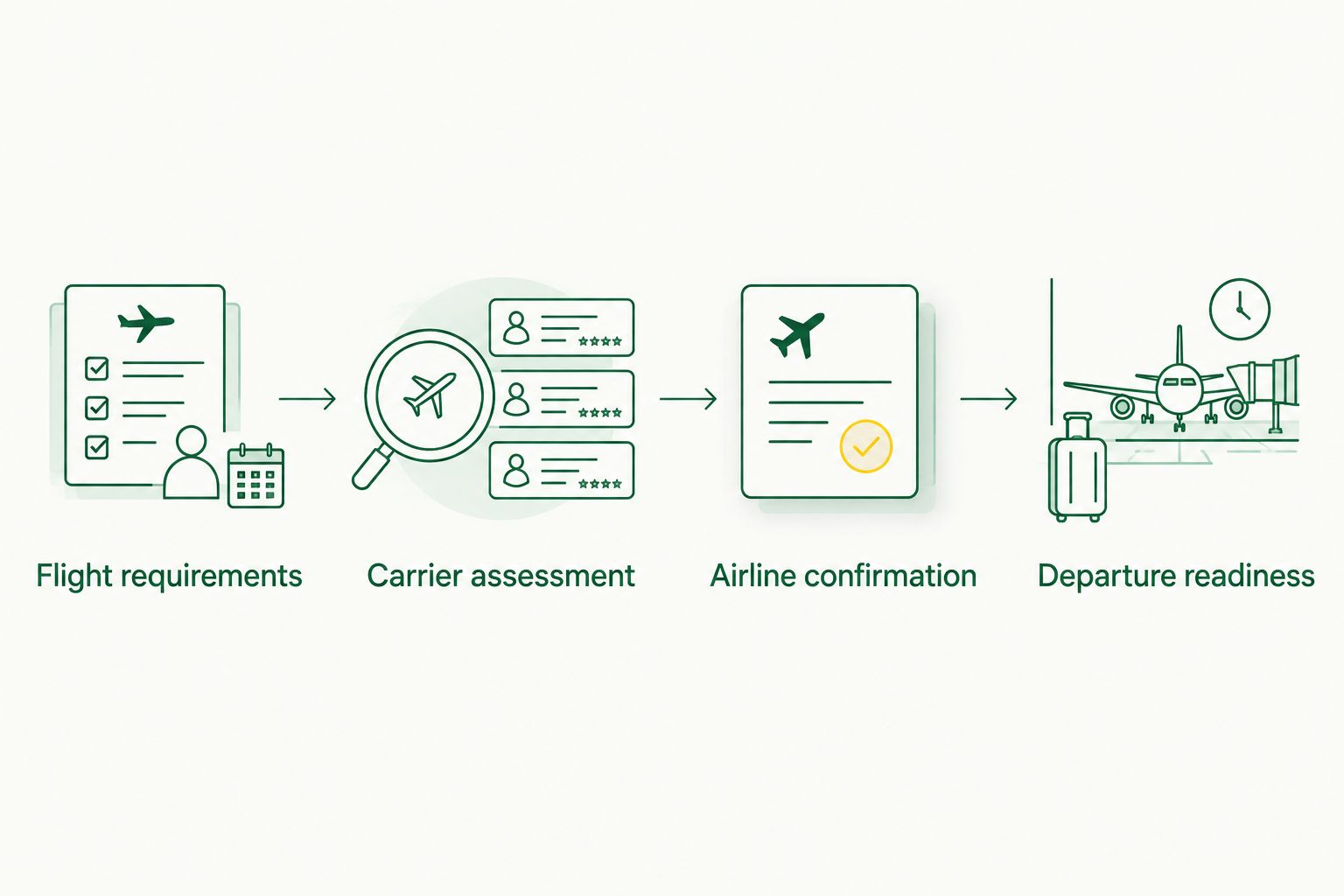
Keep the workflow in this order: Flight requirements, Carrier assessment, Airline confirmation, then Departure readiness. Measuring first without understanding the rules can leave you checking the wrong thing.
Use a separate carrier for the flight
A second workflow makes sense when your backpack suits ground outings but cannot satisfy cabin rules. Use a compliant enclosed carrier for the flight and reserve the backpack for its intended use after arrival.
This separates two jobs instead of forcing one item to perform both:
- Assess the enclosed flight carrier using the same policy, fit, and confirmation steps above.
- Check the airline’s baggage rules for transporting the backpack separately. Do not assume it is an additional permitted cabin item.
- Plan any transfer between carriers in a secure location, following airport instructions and keeping your dog under control.
- Use the backpack after arrival according to its manufacturer’s fit and use instructions.
K9outdoors outdoor dog gear can be part of your destination plan without being your in-flight enclosure. The advantage is a setup matched to each activity. The drawback is carrying and managing another item.
If your dog cannot comfortably meet cabin requirements in any permitted carrier, change the travel plan. A backpack does not solve an animal-size or welfare mismatch.
Troubleshooting
The agent says pets are allowed but does not assess the carrier
Ask a narrower question about your exact model, size, enclosure, and measurements. Request clarification on airport inspection. Permission to bring a pet is not confirmation that this particular carrier complies.
The exterior dimensions fit, but your dog cannot turn around
Recheck the airline’s animal-space requirements. A dimensional match is insufficient when the dog cannot meet those conditions. Select a different compliant setup or reconsider cabin travel; do not compress the dog into the space.
Your dog’s head remains outside
Compare that configuration with the enclosure rule. If full enclosure is required, use a different carrier unless the manufacturer permits a genuinely enclosed configuration that also meets all remaining requirements. Do not improvise a fabric cover.
The aircraft or operating airline changes
Repeat the flight-requirements check and ask about the pet reservation. Saved correspondence for the original flight does not resolve a different aircraft’s fit requirements or another airline’s policy.
Your dog panics when the carrier closes
Pause training and return to comfortable, gradual introductions. Ask your veterinarian about travel suitability if distress persists. Do not leave confinement practice until the airport, and do not medicate your dog without veterinary direction.
Customize your workflow
Build your 2026 trip plan around three separate needs: the flight enclosure, ground transport, and activities at your destination. This prevents an outdoor carrying decision from being mistaken for an airline compliance decision.
Keep K9outdoors dog gear selection focused on those ground activities. For the flight, retain a compact checklist with the operating airlines, carrier measurements, enclosure requirements, pet reservation, and documents.
If another person is traveling with you, share the same checklist and correspondence. Agree on who holds the leash and who handles documents during check-in or any permitted carrier transfer. Clear roles reduce avoidable handling mistakes.
FAQ
Is a K9 Sport Sack airline approved?
Do not assume a K9 Sport Sack is approved for airline cabin travel. The exact model, size, dog, and travel configuration must meet the operating airline’s current rules, including enclosure and under-seat fit.
Can I get my dog backpack approved before booking?
Ask the operating airline to assess the exact backpack before booking. Provide its model, size, measurements, and intended configuration, and clarify whether acceptance remains subject to airport inspection.
Can my dog keep its head outside the carrier during the flight?
Not when the airline requires the dog to remain fully enclosed. Check the operating airline’s rule and choose a carrier that supports the required configuration without restricting breathing or ventilation.
Does a pet reservation mean my carrier is approved?
No, a pet reservation does not establish carrier compliance. Keep the reservation confirmation separate from any carrier assessment and prepare for the airline’s check-in requirements.
What measurements should I give the airline?
Provide the carrier’s exterior length, width, and height in the unit the airline requests. Measure the intended travel configuration and assess occupied fit rather than relying on folded or empty dimensions.
Is a hiking backpack better than an enclosed carrier for flying?
An enclosed carrier that meets all applicable rules is the better choice when the airline requires full enclosure. A hiking backpack’s usefulness outdoors does not establish cabin suitability.
What should I recheck before flying with my dog in 2026?
Recheck the operating airline, itinerary, carrier requirements, pet reservation, and required travel documents. Repeat the fit assessment if an aircraft or seating change affects the space allocated to the carrier.
One last thing
The smallest packed carrier is not necessarily the right flight carrier. Airlines assess an occupied enclosure, not how neatly a backpack folds into luggage. Make the decision with your dog’s comfort and the actual cabin rules in view.