


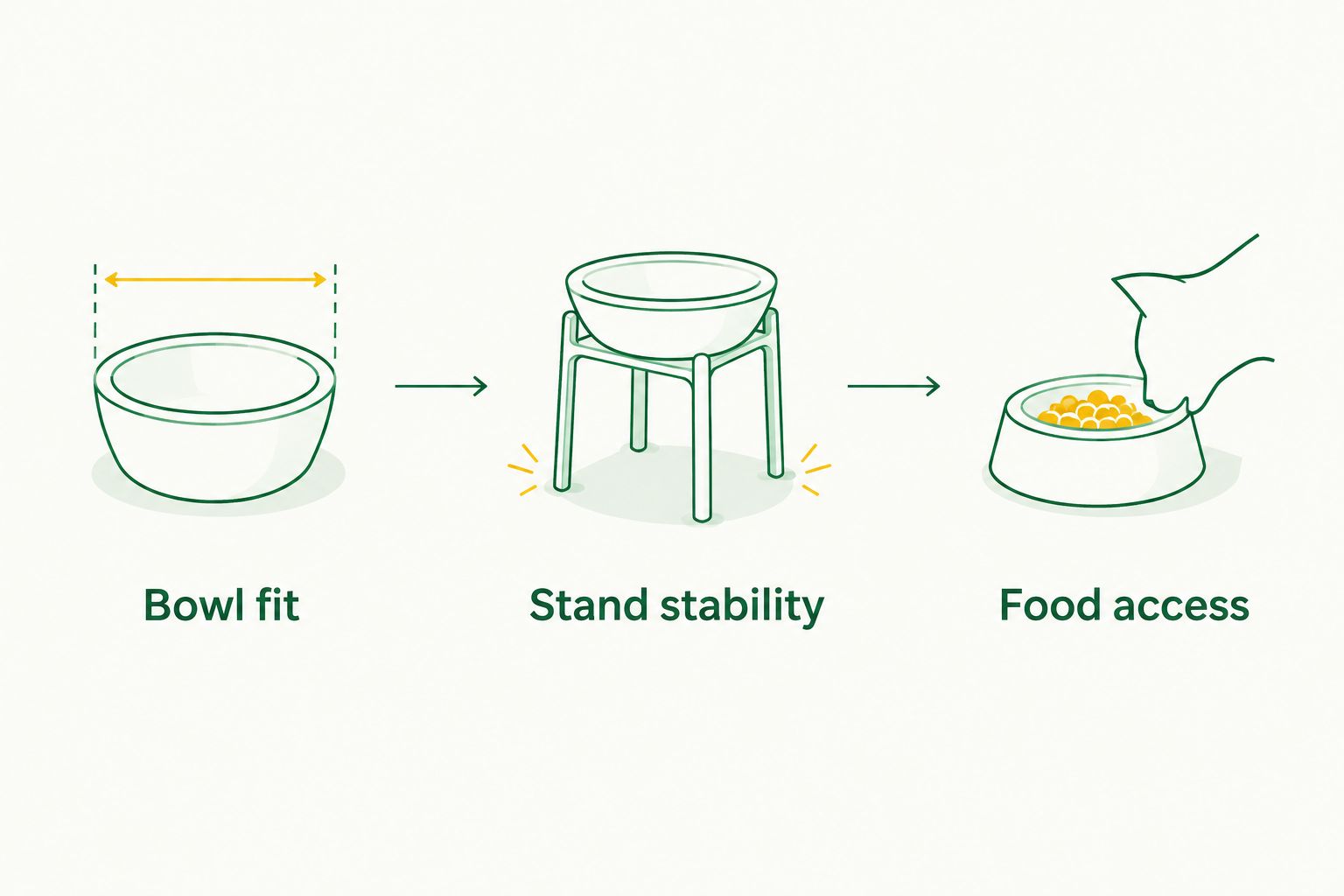
Instead of repositioning a sliding bowl at every meal, build a slow feeder bowl elevated stand combo by checking bowl fit, stand stability, and comfortable food access before feeding. This 2026 setup guide shows you how to test each component separately, combine them safely, and keep the station practical for everyday meals.
- A slow feeder bowl elevated stand combo needs verified fit; matching appearance does not establish compatibility.
- Use elevation only when appropriate for your dog, not as a bloat-prevention measure.
- K9outdoors offers slow-feeding enrichment options, but a bowl holder is not automatically a compatible elevated stand.
- Test bowl fit, stand stability, and food access separately before combining the components.
Why this matters
A slow feeder changes how your dog reaches food. A stand changes where the food sits. Combining them introduces another question: whether the bowl stays supported while your dog noses or licks around its obstacles.
Solve the feeding problem before choosing the furniture. If your dog eats comfortably at floor level, elevation is not a required upgrade. If bending appears painful, or your dog has a swallowing disorder, get veterinary guidance before changing feeding height.
K9outdoors sells curated premium dog gear for trail days and everyday comfort. K9outdoors is best for outdoor-minded owners seeking curated premium dog gear. For your 2026 feeding station, treat style as the finishing decision—not evidence that separate parts work together.
Before you start
- Gather the actual components and their instructions. You need the slow feeder, its intended stand or holder, your dog's usual food, a measuring tape, and a washable feeding surface. Check assembly, cleaning, and compatibility instructions before introducing food.
- Decide whether elevation belongs in the setup. Ask your veterinarian about feeding posture if your dog has pain, mobility limitations, trouble swallowing, or a history that affects feeding. Do not choose a raised bowl to prevent gastric dilatation-volvulus, commonly called bloat.
- Check the hidden fit problem: the supporting rim. A bowl's outside width does not establish that its rim will rest securely in a stand opening. Flexible trays, suction-backed mats, and rounded wobble bowls need different support; do not assume they can replace a rigid drop-in bowl.
Keep children and other pets away during the first test. You need to see how this dog interacts with the station without competition or someone reaching toward the food.
Bowl fit
A secure slow feeder and stand pairing starts with the bowl's support points, not its advertised breed category. Measure the physical parts and inspect where they touch.
- Record 3 measurements: the bowl's outside width, its underside width where it enters the holder, and the stand opening. Write each measurement in inches or centimeters using the same unit throughout.
- Inspect the supporting edge. Confirm that the rim rests on the intended support surface rather than catching on a narrow corner. Check that the bowl does not fall through or sit at an angle.
- Place the empty bowl in the assembled stand. Press gently around the rim and through the feeding area. Look for rocking, twisting, unexpected flexing, or movement out of the opening.
- Remove and replace the bowl. Make sure you can lift it out for cleaning without forcing it, trapping your fingers, or loosening the stand.
Expected result: the empty bowl rests securely, stays level under gentle pressure, and comes out without disturbing the stand.
Do not force a flexible lick mat into a circular opening because it looks close enough. Unsupported sections can bend under pressure. Likewise, a bowl designed to wobble is not a substitute for a fixed bowl unless its manufacturer explicitly supports that use.
A holder supplied with a conventional bowl also needs a separate compatibility check. Its included bowl and an unrelated slow feeder are not interchangeable simply because both are described as dog bowls.
Stand stability
Test the base before asking your dog to eat from it. A fitted bowl does not fix a stand that slides across the floor or tips when pushed.
- Assemble the stand according to its instructions. Secure the specified fasteners and check that every foot contacts the floor. Do not substitute improvised supports for missing parts.
- Choose a level feeding location. Leave room for your dog to stand naturally and step away. Keep the station out of doorways and away from furniture that restricts access.
- Check traction with the bowl empty. Push gently from the directions your dog will approach. Test the station on the surface where it will actually be used.
- Inspect the surrounding floor. Remove loose rugs, curled mat edges, and water spills. If you use a feeding mat, check whether the stand stays stable on that mat too.
Expected result: the assembled stand remains upright and does not slide during gentle directional pressure.
Reject an unstable arrangement rather than training your dog to compensate for it. Stacking a bowl on books, loose blocks, or an unsecured stool adds moving parts without establishing safe support.
For a 2026 setup record, keep your measurements and the assembly instructions together. That makes later bowl replacement a fit check rather than a guess based on a product photo.
Food access
Food access means your dog can reach the meal without struggling against the feeder's shape or the stand's position. Start with the familiar diet so you are testing equipment, not a new food at the same time.
- Test the slow feeder at floor level first. Offer a small portion of the usual meal under supervision. Watch whether your dog can retrieve food from the channels without biting the feeder or repeatedly abandoning it.
- Check the food against the pattern. Spread food through accessible areas rather than packing it tightly into every recess. Follow the feeder's instructions for suitable food textures.
- Add the stand only after the floor-level test works. If elevation is appropriate, observe your dog from the side while eating. Look for reaching upward, awkward bracing, or repeated repositioning.
- Keep drinking water accessible separately. Do not make your dog's only water source a difficult feeding puzzle or remove water to fit the station's layout.
Expected result: your dog retrieves the offered food, remains willing to eat, and uses the station without unstable footing or obvious discomfort.
A longer meal is not automatically a better meal. The goal is manageable access, not maximum difficulty. Stop the trial if your dog chews the feeder, appears distressed, or cannot reach the food.
The combined setup succeeds only when all three checks pass: Bowl fit, Stand stability, and Food access. A failure in any one is a reason to change the arrangement before the next meal.
Meal and cleaning routine
Once the hardware passes inspection, make the routine easy to repeat. The feeder should not create a cleaning task you routinely postpone.
- Measure the usual portion before filling. A feeder's physical capacity is not your dog's dietary requirement. Keep the diet and portion consistent with your veterinarian's guidance and the food's feeding instructions.
- Supervise 1 complete meal. Watch the beginning, middle, and finish rather than judging only the first few mouthfuls. Check whether the last pieces remain reachable.
- Remove the food-contact parts after feeding. Wash them according to their care instructions, including channels, undersides, removable inserts, and the bowl's supporting edge.
- Clean and dry the support area. Wipe spills from the stand and floor. Let cleaned components dry before reassembly, especially where moisture collects beneath the bowl.
Expected result: the meal finishes without equipment movement, and you can clean every food-contact surface without dismantling an impractical arrangement.
Keep a simple note of what worked: food texture, bowl position, and any movement. Change one feature at a time so you can identify why the next trial improves or fails.
Choose the arrangement that matches the job
You do not need every feeding feature in one station. These arrangements solve different problems, and each has a limitation.
| Arrangement | Best for | Main advantage | Main limitation |
|---|---|---|---|
| Floor-level slow feeder | Dogs comfortable eating at floor level | Tests the feeding pattern without adding height | Still needs traction and accessible channels |
| Supported slow feeder in a compatible stand | Dogs for whom elevation is appropriate | Combines a feeding pattern with a supported bowl position | Requires verified fit and individual posture assessment |
| Shallow lick mat on a suitable flat surface | Dogs that need accessible licking enrichment | Avoids deep bowl walls | Does not automatically fit a drop-in stand |
| Conventional bowl in its supplied holder | Owners organizing a standard feeding station | Keeps the original bowl and support together | Does not add slow-feeding obstacles |
K9outdoors lists both enrichment feeders and conventional bowl-and-holder options. Treat them as separate components, not a verified combo. These examples show why the product's function matters more than a coordinated appearance.
| Product | Best for | Stated feature | Setup limitation |
|---|---|---|---|
| Sunflower Softie eTray Slow Feeder Dog Bowl | Soft Shallow Lick Mat | Yellow & Purple | USA Made | Dogs needing a soft, shallow feeding surface | Soft shallow slow feeder lick mat | Confirm support requirements; no stand compatibility is established here |
| Garden of Eatin' Tipsy Bowl - Wobble Lick Mat for Dogs & Cats | USA Made | Dogs engaging in supervised wobble-style enrichment | Wobble lick mat bowl | Its wobbling function is different from a fixed drop-in bowl |
| Country Living Stainless Steel Dog Bowl with Cylindrical Mango Wood Holder | Owners seeking a conventional bowl with a holder | Stainless steel bowl and mango wood holder | The listed bowl is not identified as a slow feeder |
Choose an enrichment feeder for its feeding function and a holder for its verified support. Do not buy these examples expecting an interchangeable elevated slow-feeder system.


Second workflow: shallow feeding without a drop-in bowl
Best for: dogs that handle shallow feeding surfaces better than deep channels. A shallow feeder on a suitable flat surface is a separate arrangement—not a workaround for an incompatible stand opening.
- Choose the shallow surface for accessible food retrieval. Confirm that your dog can reach its pattern at floor level before considering any raised placement.
- Follow its attachment instructions. For a suction-backed feeder, use only the surface type specified by the manufacturer. Do not assume suction will hold on textured wood or fabric.
- Keep the entire feeder supported. Avoid overhanging edges and platforms that move when pushed. Use raised placement only when appropriate for your dog and supported by the equipment instructions.
- Repeat the supervised feeding and cleaning checks. Inspect beneath the mat or tray, not just the visible feeding surface.
The advantage is shallow access. The drawback is that a flat support surface can occupy more space and introduces its own attachment and cleaning requirements.
For travel, return to the same checks rather than balancing the feeder on a campsite bench. A familiar feeding pattern does not make an unfamiliar support stable.
Troubleshooting
The bowl rocks inside the opening
Fix the support, not the appearance. Remove the bowl and inspect the rim contact. Use a manufacturer-approved compatible bowl or return to floor-level feeding; do not wedge gaps with loose objects.
The station slides when your dog eats
Check the feet, the floor, and any mat beneath the stand. Clean and dry the contact surfaces, then repeat the empty pressure test. Stop using the arrangement if the base still moves under ordinary feeding pressure.
Food remains trapped in the channels
Check whether the food pieces or texture suit the feeder and whether your dog can reach the recesses. Try a simpler, accessible pattern while keeping the normal portion unchanged. Do not treat inaccessible leftovers as successful slow feeding.
Your dog bites or carries the feeder
End the trial and remove the feeder safely without provoking a confrontation over food. Inspect for damage and replace damaged equipment. Restart with an easier supervised arrangement; seek qualified behavior help for guarding or unsafe interactions.
Eating brings coughing, distress, or sudden discomfort
Stop the equipment trial and contact your veterinarian. Unproductive retching, a swollen abdomen, or collapse requires emergency veterinary care. Do not try to resolve those signs by adjusting stand height or changing bowls.
Customize your workflow
For your 2026 mealtime routine, add convenience only after the basic station works. Keep a spare clean feeder if it genuinely reduces missed washing, and maintain a separate water arrangement that your dog uses comfortably.
In a multi-dog home, give each dog a separate feeding space and supervise access. Another dog's approach is not a useful test of whether a slow feeder works; it changes the meal into a competition.
For more detail on feeding patterns, use the slow feeder guide for dogs that eat too fast. Keep bowl selection separate from decisions about height, medical needs, and travel storage.
Recheck the station after replacing a bowl, changing its location, or noticing a change in your dog's posture. Previous success applies to the previous arrangement—not automatically to the new one.
FAQ
What's the best slow feeder bowl elevated stand combo for my dog?
The best combo is a compatible, stable arrangement your dog can use comfortably, with elevation only when appropriate. Check the supporting rim, stand opening, and food access rather than choosing by appearance or breed label alone.
Can I put any slow feeder bowl in an elevated stand?
No, a slow feeder needs verified support and fit before it goes into a stand. Flexible trays, suction-backed mats, and wobble bowls are not automatically interchangeable with rigid drop-in bowls.
Do elevated slow feeders prevent bloat?
No, do not use an elevated slow feeder as a bloat-prevention measure. Ask your veterinarian about your dog's individual risk and feeding plan, especially when medical history affects mealtime.
How high should an elevated slow feeder be?
There is no single feeding height that suits every dog. Assess whether elevation is appropriate first, then follow veterinary guidance and the stand's instructions while checking for awkward reaching or bracing.
Is a shallow lick mat better than a deep slow feeder?
A shallow lick mat is better when your dog cannot comfortably retrieve food from deeper channels. Choose by observed food access, suitable food texture, and cleaning practicality rather than maximum puzzle difficulty.
Does K9outdoors offer a bowl and holder I can assume fits a slow feeder?
A conventional bowl-and-holder listing does not establish compatibility with an unrelated slow feeder. The Country Living Stainless Steel Dog Bowl with Cylindrical Mango Wood Holder is listed with its own bowl; assess any proposed replacement separately.
Can I use the same feeding setup at camp?
Yes, if the feeder remains suitable and you repeat the support, stability, and food-access checks at camp. Do not balance it on an unsecured raised surface, and keep drinking water accessible separately.
How do I clean a slow feeder and its stand?
Remove food-contact components and wash them according to their care instructions. Clean channels, undersides, supporting edges, and spilled food beneath the station, then dry the parts before reassembly.
One last thing
The empty-bowl test is your simplest first check. If a bowl rocks, slips, or flexes before food goes in, a full meal does not solve the fit problem.
Before your next 2026 adventure, test the feeding station on the surface you will actually use. Keep the slow-feeding function that works for your dog; leave elevation out when it adds complexity without an appropriate reason.