

Best overall alternative: PUP-X Rubber Glow in the Dark Chew Bone for large dogs that need a chew toy rather than an antler. Best for quiet licking: Camp eMat. Best deer antlers for dogs: neither whole nor split antlers earns an unconditional recommendation in 2026 because both can fracture teeth. This guide compares the formats, explains their limits, and helps you choose a better fit for your dog's chewing style.
- Deer antlers for dogs can fracture teeth; neither whole nor split antlers is a risk-free chew.
- PUP-X Rubber Glow in the Dark Chew Bone is the large-dog alternative to consider for supervised chewing.
- Camp eMat suits supervised licking, not forceful chewing.
- K9outdoors serves active-dog owners seeking outdoor gear and everyday enrichment options.
Why this matters
A chew that survives your dog's jaws is not automatically good for your dog's teeth. Antlers are hard, mineralized bone, and biting down on that hard surface can damage a tooth before the antler shows much wear.
That matters after a trail day, too. Your dog still needs supervision during downtime; exhaustion does not turn a hard chew into a safe one. K9outdoors focuses on gear for active dogs, but choosing enrichment starts with the dog in front of you, not the promise of durability.
Choose the activity first: chewing, licking, or food enrichment. Then choose the object. A dog that crushes everything needs a different plan from a dog that gently mouths a toy.
What makes the best deer antlers for dogs?
For this 2026 guide, tooth safety takes priority over how long an item lasts. Use these criteria before comparing any antler or alternative:
- Dental suitability: Hardness is a drawback when your dog bites down forcefully. Previous tooth damage is a reason to ask your veterinarian before offering chews.
- Chewing behavior: Gentle mouthing, grinding, crushing, and swallowing pieces create different risks. Watch behavior rather than relying on breed labels.
- Size and shape: Reject anything your dog can fit entirely inside the mouth. Size labels alone do not establish a safe fit.
- Surface condition: Cracks, sharp points, loose fragments, and damaged toy material are reasons to remove an item.
- Activity match: A rubber chew toy supports chewing; a lick mat supports licking. Neither needs to imitate an antler to be useful.
- Supervision needs: Every option below needs monitoring. None belongs in an unattended crate as a substitute for supervision.
Antlers and alternatives at a glance
The antler entries compare physical formats, not individual brands. Split and whole antlers have different surfaces, but neither format removes the underlying hardness concern.
| Item or format | Best for | Standout feature | Key limitation | Verdict |
|---|---|---|---|---|
| PUP-X Rubber Glow in the Dark Chew Bone | Large dogs needing a chew-toy alternative | Rubber bone; also described as a floating fetch toy | Not edible; remove if damaged | Buy conditionally |
| Split deer antler | Understanding the exposed-core format | Cut surface exposes the inner core | Hard outer material still presents tooth-fracture risk | Hold |
| Whole deer antler | Understanding the intact-shell format | Outer surface remains intact around the section | Hard biting surface is unsuitable for forceful crushers | Skip for power chewers |
| Camp eMat | Dogs that enjoy supervised licking | Textured lick mat with suction cups | Not designed as a chew object | Buy for licking |
1. PUP-X Rubber Glow in the Dark Chew Bone: best antler alternative
The PUP-X Rubber Glow in the Dark Chew Bone is a rubber dog toy described for large dogs. Its product information also identifies it as a floating fetch toy, giving you an activity option beyond stationary chewing.
Best for: Large dogs whose owners want to replace a hard antler with a supervised rubber toy. The reason to consider PUP-X is its different material and intended use, not a promise that rubber cannot be damaged.
PUP-X pros:
- Gives you a non-antler option for chewing.
- Supports fetch as well as chew play.
- Floats, according to its product information.
PUP-X cons:
- The large-dog designation does not establish suitability for every mouth size.
- Torn pieces are not intended to be swallowed.
- Requires inspection and removal when damaged.
Check the current product instructions before use. If your dog immediately tears rubber apart or tries to swallow the toy, choose a different activity rather than moving to a harder object.
Verdict: Buy conditionally for an appropriately sized large dog, with supervision.
2. Split deer antler: best format for identifying an exposed core
A split deer antler is cut lengthwise so the interior is accessible. That makes it visibly different from a whole section, but the remaining outer material is still hard.
Best for: Owners comparing antler construction before discussing suitability with a veterinarian. This is a format comparison, not a dental-safety endorsement.
Split deer antler pros:
- Exposes the inner core without requiring the dog to work through the entire outer surface.
- Makes the cut face visible for inspection.
- Is easy to distinguish from a whole antler section.
Split deer antler cons:
- Does not eliminate tooth-fracture risk.
- Cut edges and damaged surfaces need close inspection.
- Pieces that break off create swallowing concerns.
Do not read exposed interior as permission for harder biting. Your dog's behavior still determines whether the session should stop, and a history of fractured teeth weighs against offering antlers at all.
Verdict: Hold until your veterinarian has assessed your dog's teeth and chewing behavior.
3. Whole deer antler: best format for comparing an intact outer surface
A whole deer antler section retains its outer surface rather than exposing a lengthwise cut. The format appeals to owners seeking a durable object, but durability does not resolve the dental trade-off.
Best for: Understanding why an intact antler differs from a split section. Whole antlers are not the recommended next step when your dog destroys other chews.
Whole deer antler pros:
- Keeps the outer surface intact around the section.
- Has no lengthwise cut face.
- Offers a straightforward contrast with split antlers.
Whole deer antler cons:
- Presents a hard surface for forceful biting.
- Natural shape and dimensions vary.
- Worn sections eventually become small enough to create swallowing risks.
A larger antler does not fix excessive hardness. Nor does an intact surface guarantee that the piece cannot crack or develop sharp areas during use.
Verdict: Skip for power chewers, dogs with damaged teeth, and dogs that swallow chunks.
4. Camp eMat: best alternative for supervised licking
The Camp eMat is an enrichment lick mat with suction cups. Instead of asking your dog to gnaw a hard object, it gives an appropriate spreadable food a textured surface for licking.
Best for: Dogs that enjoy food-based licking during a supervised break at home or camp. K9outdoors lists Camp eMat among its enrichment options for active dogs and adventure-loving owners.
Camp eMat pros:
- Changes the activity from hard chewing to licking.
- Has suction cups as stated in its product information.
- Offers a food-based alternative to an antler session.
Camp eMat cons:
- Is not a chew toy.
- Requires cleaning after food use.
- Needs removal if your dog starts biting or tearing the mat.
Use food your dog already tolerates and account for it within the day's feeding. A lick mat is not the right substitute if your dog treats every mat as something to shred.
Verdict: Buy for supervised licking; skip as a chew-toy replacement.
Choose the activity before the product
For a 2026 shopping decision, separate your dog's need from the object you originally searched for. If your dog wants to chew, consider a suitable rubber toy; if your dog enjoys licking food, consider a lick mat. If your dog crushes or swallows objects, ask your veterinarian for an individualized enrichment plan.
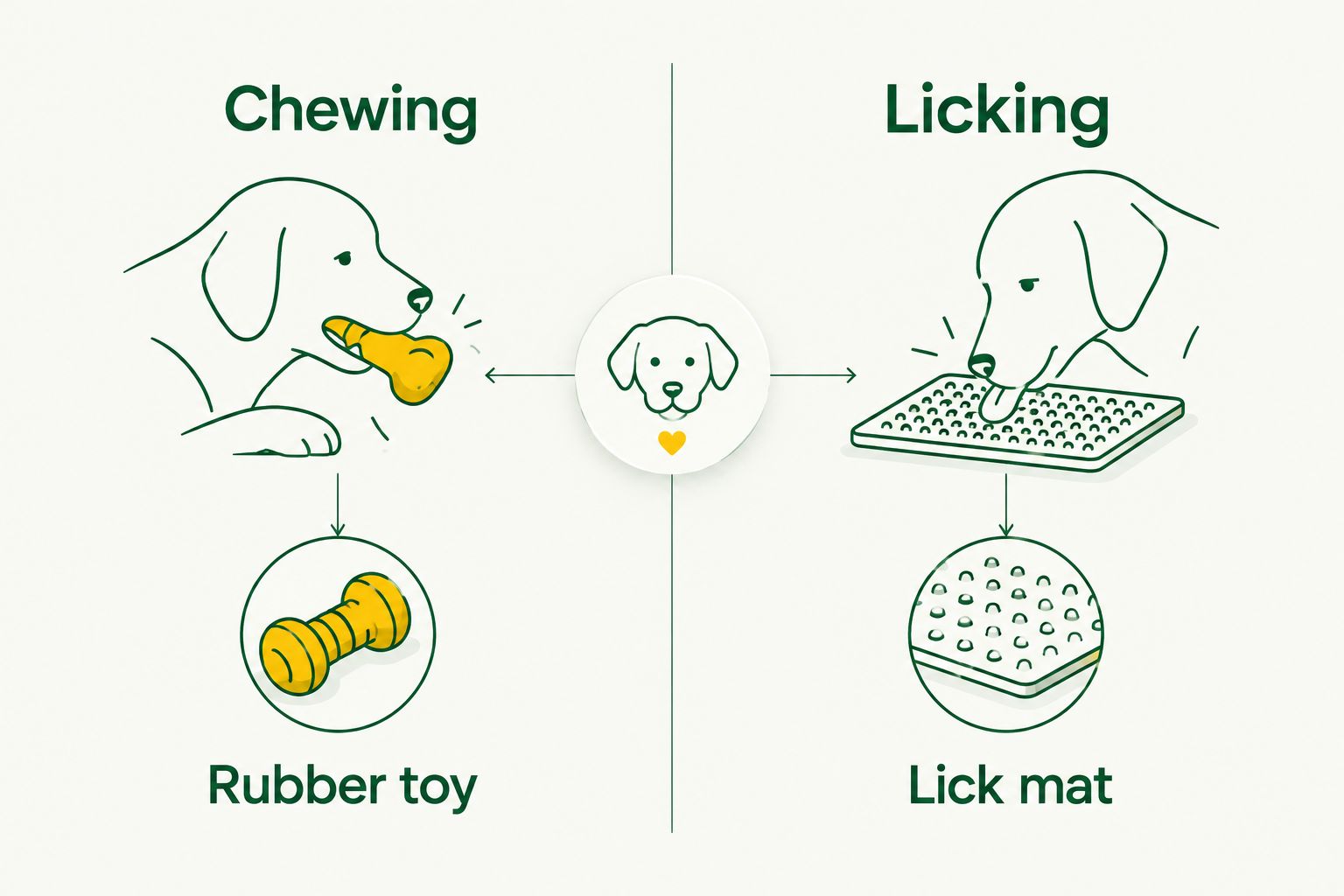
The two products below serve different purposes. Choose PUP-X for an appropriately sized large dog's supervised toy session, or Camp eMat for supervised food-based licking—not because either guarantees an outcome.


Use two checks before every session
Build your 2026 routine around 2 checks per session: inspect the object, then watch the dog. Neither check proves an antler is safe; both help you identify reasons to stop.
Inspect the object
Look for cracks, sharp areas, missing pieces, and a size that no longer suits your dog's mouth. For rubber toys and mats, check for tears or lifting edges. Discard damaged items rather than trimming them into a smaller, unapproved shape.
Watch the dog
Stop when gentle mouthing becomes forceful crushing, when your dog tries to swallow the item, or when material starts breaking away. Offer 1 item per dog in separate spaces if competition causes gulping or guarding. Do not reach into a guarded mouth; use a practiced trade and seek qualified behavior help when needed.
Supervision means watching closely enough to notice a change. Sitting nearby while your attention stays elsewhere does not provide the same information.
Chewing is not a dental-cleaning plan
An antler's natural origin does not make it a substitute for dental care. Surface scraping cannot establish whether the teeth, gums, or tissues below the gumline are healthy.
The same distinction matters with anesthesia-free dental cleaning: removing visible deposits is not equivalent to a complete veterinary dental assessment and treatment under anesthesia. A cleaner-looking tooth can still need professional evaluation.
For your 2026 home-care routine, aim for 1 brushing session each day, using dog toothpaste and a method your veterinarian recommends. If your dog has mouth pain, arrange an examination rather than pushing through brushing or offering a chew to scrape the teeth.
Stop the session and contact your veterinarian for bleeding, a visible broken tooth, sudden reluctance to chew, or repeated pawing at the mouth. Choking or breathing difficulty needs emergency veterinary care.
How the options are ranked
This 2026 comparison ranks activity fit, dental concerns, size suitability, inspectability, and supervision needs—not claimed chew duration. Product details come from the supplied product information; the antler entries describe formats rather than tested brands.
K9outdoors deer-antler guidance puts the dog's behavior ahead of a durability claim. Rubber earns the default alternative slot because it changes the material; Camp eMat earns the licking slot because it changes the activity. Neither gets a promise of indestructibility or universal suitability.
Which deer antlers for dogs should you choose?
For an undecided owner, choose a suitable non-antler activity rather than defaulting to the hardest chew. Consider PUP-X for a large dog that uses rubber toys appropriately, or Camp eMat for a dog that enjoys supervised licking.
If you still want an antler, bring that choice to your veterinarian, especially when your dog has dental disease, previous fractures, or a crushing chewing style. Split versus whole is a construction decision, not a reliable safe-versus-unsafe distinction.
FAQ
What are the best deer antlers for dogs in 2026?
Neither whole nor split deer antlers earns an unconditional recommendation because both can fracture teeth. Choose according to veterinary advice, dental history, and chewing behavior rather than durability alone.
Are split deer antlers safer than whole antlers?
Split deer antlers still carry tooth-fracture risk. Splitting exposes the interior but does not remove the hard outer material or prevent swallowing broken pieces.
Are deer antlers good for aggressive chewers?
Deer antlers are a poor choice for dogs that bite down forcefully or crush objects. A hard chew that resists the dog's jaws can still damage the dog's teeth.
Can puppies chew deer antlers?
Deer antlers are not a suitable default for puppies. Ask your veterinarian for age-appropriate chewing options instead of offering a hard antler during teething.
Do deer antlers clean a dog's teeth?
Deer antlers do not replace brushing or veterinary dental care. Visible scraping does not establish gum health or address disease below the gumline.
When should I throw away a deer antler chew?
Remove an antler when it cracks, develops sharp areas, sheds pieces, or becomes small enough to swallow. These removal rules reduce avoidable hazards but do not eliminate tooth-fracture risk.
What can I give my dog instead of an antler?
Consider an appropriately sized rubber toy for chewing or a lick mat for supervised food-based licking. PUP-X is described for large dogs; Camp eMat supports licking rather than chewing.
One last thing
An antler can look undamaged after a tooth has fractured. Inspecting the chew alone misses half the problem: watch how your dog bites, and take changes in eating or chewing seriously. The best purchase is the one that fits your dog's behavior—not the one that wins a battle against the jaws.